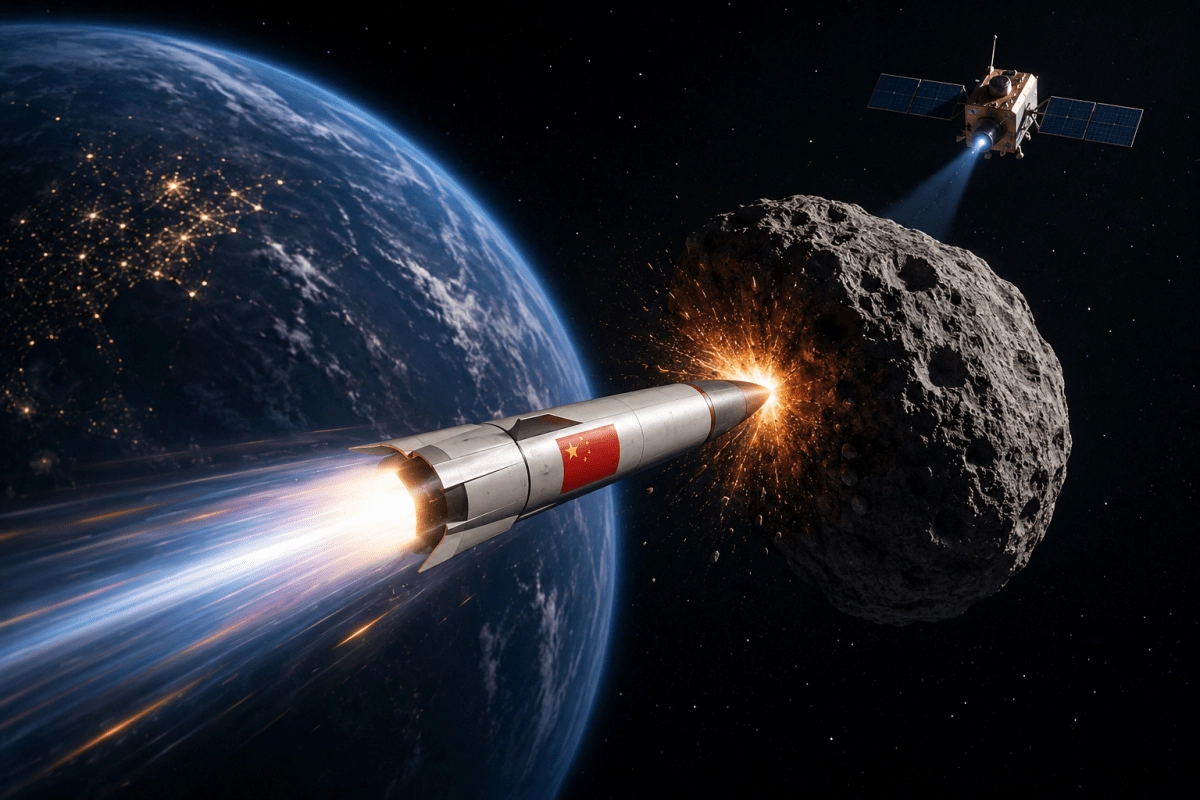

China is about to launch one of the most ambitious planetary defense tests ever proposed. The plan is to launch a projectile at a speed of about 20,000 miles per hour, equivalent to Mach 26, to hit asteroid 2015
This is the Chinese plan to hit an asteroid
The mission, developed by the China National Space Administration together with the Chinese Academy of Sciences, goes far beyond a simple impact test. The objective is to send two ships at the same time, one will function as a direct projectile and will be launched in a straight line towards the asteroid, while the other will use a gravitational assist from Venus to place itself in the perfect position and record the entire process.
When the impactor hits 2015 XF261, it will do so at more than 9 kilometers per second, a figure that sounds abstract until you compare it to something everyday. Chinese scientists have set four very clear goals to know if the mission was a success: hit the target precisely, make it change its orbit, accurately measure the effects of that collision and confirm that the asteroid's new trajectory does not represent any risk to our planet.
The interesting thing is that this test does not simply seek to push the rock, some researchers even propose that the blow could completely fragment the asteroid, something that NASA's DART mission never considered with such ambition. The team led by Li Mingtao, chief planetary defense scientist at the CNSA, wants to demonstrate that their technology can be even more aggressive than the American one.
How fast is Mach 26 in real life?
This is where things get really crazy. Traveling at 9 kilometers per second means that in just eight minutes you could cross the entire United States, from coast to coast, from New York to Los Angeles, a trip that takes almost six hours by plane.
And if that seemed fast to you, this is going to blow your mind. At that speed, reaching the Moon would take less than 12 hours, when the manned missions of the Apollo program needed between three and four days to complete the same journey. We are talking about a speed that multiplies by almost ten the speed with which we normally travel through space, and that converts any terrestrial distance into something almost instantaneous.
This comparison helps to understand why kinetic impact works as a defense method, it is not about destroying the asteroid with explosives like in the movies, but rather taking advantage of all that kinetic energy to push it enough to divert its course without needing to touch it with anything more than pure speed.
Why this technology could be key to the future of Earth
The real importance of this mission is not in 2015 XF261, which we already know does not represent any real danger to us. What China is seeking is to validate a technology that could one day be used against a truly dangerous asteroid, one that is heading directly toward our planet.
Therefore, in parallel to this impact mission, China is also building an early warning network with ground-based telescopes and a constellation of satellites designed to detect space rocks even when they are hidden by the direction of the Sun, a blind spot that until now has been difficult to monitor. This network will work by automatically calculating the probability of impact of each detected object, which would give humanity more reaction time in the face of any real threat.
The logic is quite simple to understand, if one day an asteroid is detected with a trajectory towards Earth, we would no longer have to start designing a solution from scratch. We would have a proven method, with real data of how far a space rock can be deflected and what impact velocity is needed to do so safely. It's the same philosophy behind NASA's DART mission, but China wants to take it a step further by testing even more aggressive speeds and impacts.
With this type of evidence, it is increasingly clear that planetary defense stopped being science fiction and became an active field of research, where several space powers work to have real tools ready the day we really need them.