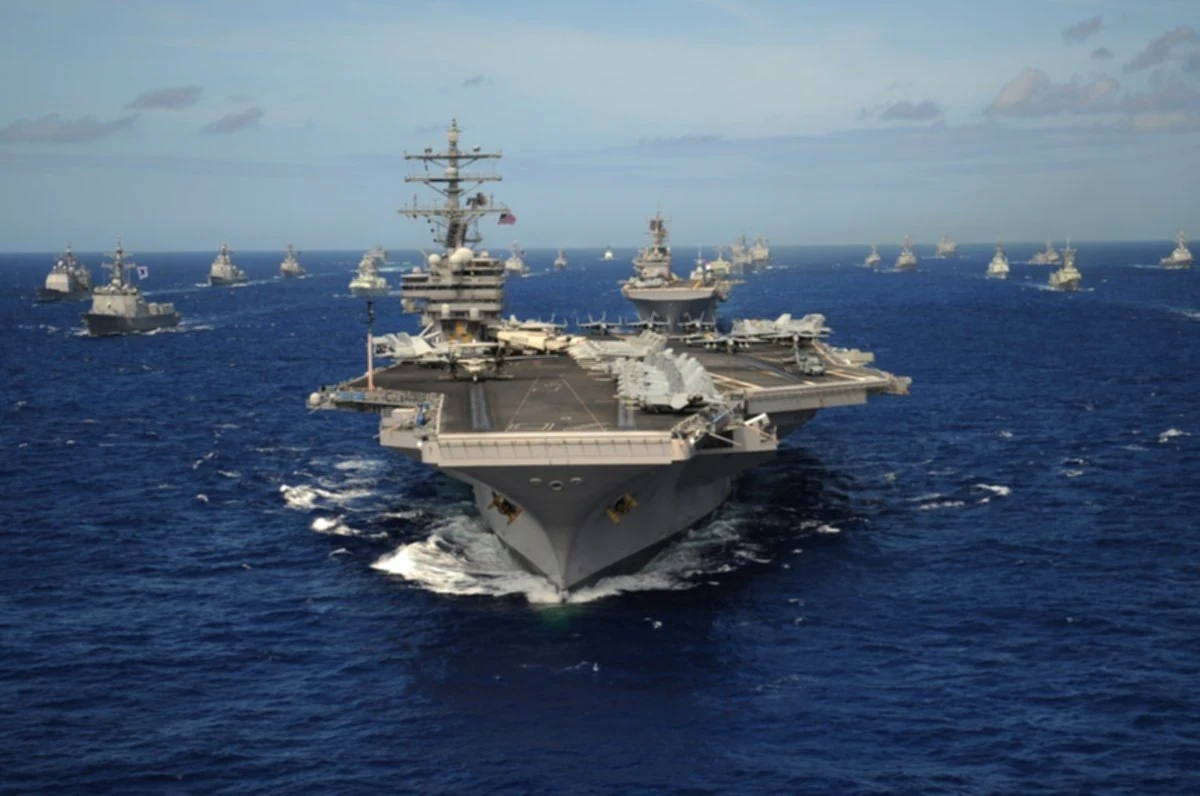

The catapults of an aircraft carrier are not a technical detail lost below deck. They are the mechanism that turns a runway of just a few hundred meters into an airport capable of sending heavy fighters, early warning planes and drones into the air. That is why Donald Trump's decision to promote the return of steam on future US aircraft carriers opens a huge discussion about cost, reliability, innovation and naval power.
The electrical impulse that launches planes
On the Gerald R. Ford-class aircraft carriers, the technology is called EMALS, which stands for Electromagnetic Aircraft Launch System. Instead of using pressurized steam to push the plane, it uses electricity stored and converted through solid-state systems. That energy powers a linear motor installed under the deck that pulls the launcher connected to the nose gear of the plane.
The easiest image to understand is that of a magnetic train reduced to scale and taken to the extreme. The engine doesn't need a huge burst of energy all at once. EMALS releases power in a controlled manner as the aircraft accelerates to the speed needed for takeoff. The result is a more progressive and precise launch, something especially useful when working with aircraft of very different weights.
That ability matters a lot. A fighter loaded with fuel and weapons needs a formidable push, while a light drone could suffer damage if it receives the same force intended for an F/A-18 Super Hornet. According to the US naval aviation itself, EMALS allows more precise adjustment of the final speed, reduces stress on the airframe and expands the range of aircraft that an aircraft carrier can launch, from light unmanned vehicles to heavy fighters.
The steam system, which for decades was a centerpiece of the Nimitz-class aircraft carriers, works differently. It uses steam generated by the ship's nuclear reactors to move pistons inside long cylinders. It is a powerful and well-known solution, although it requires pipes, valves, water and constant maintenance in an environment where salt corrosion is unforgiving.
The great virtue of EMALS is that it transforms launching into a much more programmable task. Operators can enter parameters based on the type of aircraft, its weight, the wind speed over the deck and the intended mission. Precision doesn't just mean a more elegant takeoff. It can translate into less accumulated wear on fuselages, landing gear and internal components that receive a brutal load on each departure.
Why Trump pushes for the return of steam
On August 13, 2026, Trump signed a national security memorandum directing the Pentagon to submit, within 60 days, a plan to replace EMALS and advanced weapons elevators with steam catapults and hydraulic elevators in the construction of the future USS Doris Miller, CVN-81. The first three Ford-class aircraft carriers would retain their electromagnetic systems.
Trump's motivation is not born out of nowhere nor is it recent. Already in 2017, he very clearly expressed his distrust of “digital” catapults, questioned their complexity and defended steam as a technology that the Navy knows by heart. His position connects with a fairly classic concern in defense. A less sophisticated system may be easier to repair, train and maintain when the vessel is away from home.
Here is the awkward point for EMALS advocates. The technology did not have a perfect debut. Ford program monitoring reports have noted that reliability did not improve appreciably despite hardware and software upgrades, while dependence on external technical support remained. For a platform that must generate air sorties on a sustained basis in a crisis, a breakdown is not a minor inconvenience. It can affect the rhythm of operations of the entire air wing.
Trump has also associated his criticism of catapults with electromagnetic weapons elevators. In his view, recovering steam and hydraulics reduces design complexity and returns to the ship systems whose problems are known to generations of sailors and engineers. Reliability is the word that summarizes this political and operational logic.
Even so, it is advisable to be exact. The memorandum calls for a replacement plan with resources, schedule and necessary measures. It does not mean that the technical change is already complete nor does it automatically resolve the cost of redesigning a ship that was conceived around an advanced electrical architecture. Specialized media and officials cited by the press have warned that turning back could increase costs and complicate construction.
Why EMALS continues to be the technological bet
Many analysts and naval officials consider that EMALS remains the most advanced option because it responds to how shipborne aviation will change over the coming decades. The aircraft carrier of the future will not only launch manned fighters. You will also need to operate refueling drones, surveillance aircraft and autonomous platforms that will likely have very different takeoff weights and profiles.
Steam can launch planes with enormous force, but it doesn't offer the same granularity to modulate that force. EMALS, on the other hand, can apply acceleration in a smoother and more calibrated manner. The Navy also maintains that the system takes up less space, requires less personnel and maintenance, can help increase the pace of launches and reduces costs over the life of the ship.
There is also a less striking advantage, although quite important for those who live and work below deck. By eliminating part of the steam infrastructure, the system reduces heat, noise and mechanical complexity in certain spaces of the ship. It is not an element that appears in a Hollywood trailer, but it does influence the crew's daily workload. Automation can save time on diagnostics and isolate faults more quickly if the software and logistics chain work as they should.
Strategic relevance goes beyond deciding which technology looks most modern. The United States bases a decisive part of its military projection on its aircraft carrier battle groups. Each catapult determines how many aircraft can take off, which aircraft can be integrated into the air wing, and how much wear and tear the fleet absorbs over years of deployments.
The return to steam does not erase the technological value of EMALS. Rather, it exposes a permanent strain on the military industry. The innovation promises performance, flexibility and readiness for drones. The maturity of a proven technology offers confidence when the margin of error is minimal. In the case of the USS Doris Miller, that tension will no longer be theoretical and will directly influence the design of the next American aircraft carrier.