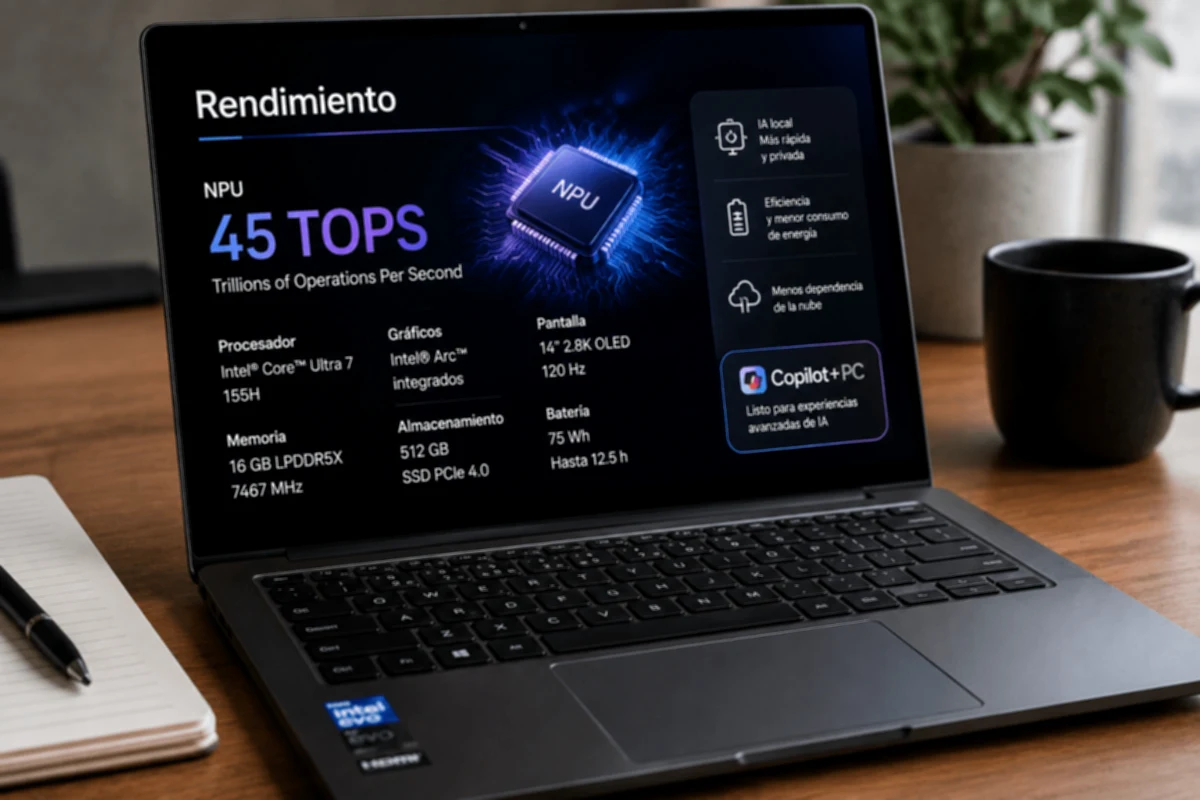

A word that had previously appeared reserved for technicians and device manufacturers has been added to the complex sheets for laptops. It is known as TOPS, and it already appears alongside much more well-known information, such as freedom, RAM, or computer. If you're looking at a fresh laptop, there's a good chance you'll see figures like 40 Top, 45 TOPS, or perhaps even higher.
It is not entirely clear. This number helps to foresee how well-equipped a laptop is to perform artificial intelligence tasks on its own, with more efficient responses, less energy consumption, and less reliance on cloud servers. Even so, it is wise to examine the amount with a nice head before assuming that that is the only reason to purchase.
Why does TOPS appear on a computer?
TPS stands for billions of businesses per minute, or billion of operations per second in Spanish. A chip you process how some mathematical operations per second when using loads from artificial intelligence, according to a measurement.
The creation of image, instant translation, bright camera blurs, and generation AI require a lot of calculations. Manufacturers have incorporated an NPU, which stands for Neurological Processing Unit, into their computers to handle these things. This part was created specifically to efficiently manage neural networks.
Most of these functions, up until recently, required the world to process the request. The job is processed in a distant data center as you type text, record music, or request that an object be removed from a photo. Some of that digesting does take place inside the laptop with a competent NPU. That might lead to lower overhead, more privacy, and better power management.
Top serve as a gauge for that NPU's ability. A higher score suggests that the team can complete more challenging AI tasks at once or at many times. Imagine a video phone with no background sounds, no correction of the camera's gaze, blurred surroundings, and real-time subtitle generation. Local AI motion allows for all of this without the primary processor turning into a toaster.
The 40 Heads that are altering Panels
40 dedicated Top on the NPU represent the number that matters most in the Windows world right now. Microsoft uses that bare minimum to classify Copilot PCs, which are computers designed to run several highly developed Windows AI applications directly. These include translated live captions, enhanced Windows Studio results, artistic tools, and other features that vary depending on the device, speech, and available improvements. know. google
That mark even calls for at least 16 GB of RAM and 256 GB of storage, which is crucial. Top do no operate on their own. A laptop with a very worthy NPU and limited memory may struggle when using complex applications, numerous browser tabs, local AI, or local AI running.
Here's a profitable advertising blunder. Some companies list the complete program TOPS and include CPU, GPU, and NPU functionality. Although the specific NPU has a much lower figure, the number may seem impressive. You must look for the exact NPU information above 40 TOPS, not the platform's complete, to determine whether the notebook meets the Copilot PC regular.
Teams with 10, 13, or 20 Top are not therefore worthless. They can make sure filters, video call results, voice recognition, and productivity tools faster. The only distinction is that they won't be able to use all the features that were created for the new Copilot Computer line. Microsoft claims that a number of its AI activities call for an Nvidia of 40 TOPS or higher.
If TOPS be required for your newest laptop?
Particularly if you intend to keep your computer for a while, it is worthwhile to pay attention to the TOPS. Microsoft already has artificial intelligence built into its office suites, photo processing, video calling, and development tools. As the technology matures, purchasing a computer with a contemporary NPU increases the chances of using it.
A computer with 40 TOPS or more is a real pleasure for a student, editor, professional who spends the day at meetings, or network worker. No longer do translations, subtitles, words confinement, and some local creative processes depend so much on the caliber of your link. It is also appealing to those who handle sensitive information and choose that specific problems become resolved on the device.
Now, TOPS are not a substitute for fundamentals. A laptop still needs a good screen, comfortable keyboard, solid autonomy, sufficient memory, fast storage and a balanced processor. Anyone who plays demanding titles or edits 4K video should look closely at the dedicated or integrated GPU, because many heavy graphical loads still go through there. A high TOPS number does not guarantee more frames per second or magically reduce traditional render times.
The most sensible recommendation for a new purchase points to an NPU of at least 40 TOPS, 16 GB of RAM as a base and a 512 GB SSD if the budget allows it. This combination enters the Copilot PC ecosystem and avoids buying a device that is already limited to the AI functions that are gaining space.
In the end, TOPS is a useful figure because it reveals a part of the immediate future of laptops. There is no need to obsess over chasing the highest number on the window. What's important is that your next machine has enough local AI power, good memory, and a balanced set of specifications. Artificial intelligence is no longer an open tab in the browser and is becoming a silent function that accompanies almost everything you do on the computer.