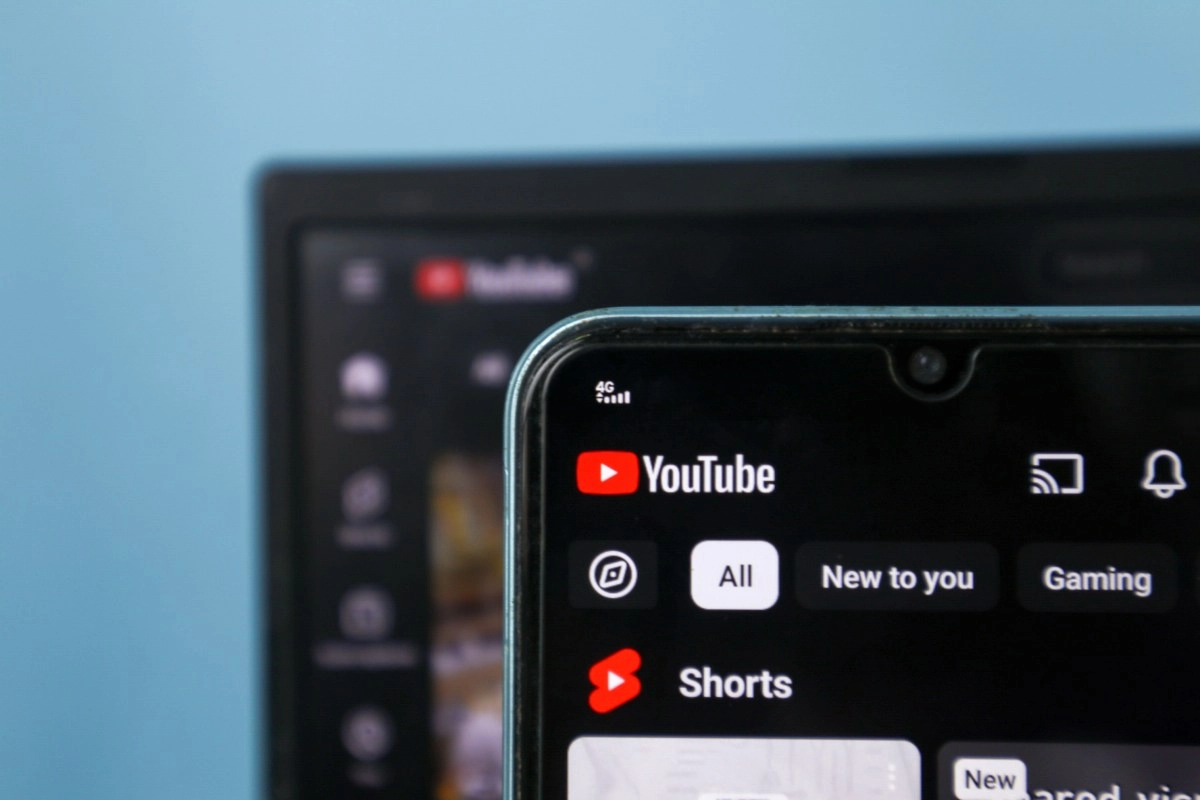

The world's largest picture program only took a step that many have been anticipating for a long time. YouTube made a major change to its naming system for long-form videos and shorts with a particular focus on hyper-realistic content, which may cause users to be a little perplexed.
YouTube has addressed this subject for the first time, but it is not the first time it has done so with such bluntness. Since 2024, the system had begun to ask makers if they had used artificial intelligence in their videos, but some people just ignored it because the procedure was so secretive. Points are now getting significant.
YouTube raises the quantity and makes keywords impossible to ignore
Where these names appear has a major impact on the most discernible shift. In the information and facts of the picture, recently, data could be lost. The tag presently appears directly below the person in long-form videos, before the description, and is placed exactly where the patient's eye naturally falls.
The Clothes have a unique solution. The tag is immediately overlaid on top of the video in that format, making it completely obvious. There is no way to miss it. And it makes sense because shorts are perhaps the file where information is consumed most quickly and where it is least difficult to refute it.
However, the announcement's most intriguing feature has to do with a significant contrast. This label will only appear in the middle for hyper-realistic information that could be mistaken for real persons, places, or situations. Without obstructing the viewing experience, the information is added to the prolonged description if the AI-generated content is evidently fantastical or stylized. It's a subtle approach that acknowledges that not all Artificial use is the same.
The advent of auto-discovery has a major impact on makers.
The biggest bend of this release is right here. YouTube introduced an AI auto-detection program in May 2026. This implies that the platform you use the label on its own if a creator doesn't attribute their movie as AI-generated but the algorithm determines that it was.
This is not slight. Prior to now, the program relied solely on the creator's integrity, which, in reality, left a lot of area for abuse. The software now has its eyes on material right away, without having to wait for anyone to raise their hand.
It is important to point out that some brands are permanent and cannot be removed. The labelling is fixed when content is created using YouTube's individual AI tools, such as Veo, or when metadata indicates that the content was created totally using conceptual AI.
Hyper-realistic information using AI has been a true issue for some time.
You have to look at the broader context to comprehend why YouTube is taking these measures. One of the biggest issues with social systems in recent years has been surreal content created by AI. AI's ability to create convincing realities has increased as systems have slowed to the same level as platforms '. From fake videos of famous people to clips of events that never occurred
Particularly, modern trust is directly threatened by deepfakes. It has become nearly impossible for the regular user to tell the difference between real and artificial with the naked eye because of the popularity of artificially cloning a person's voice, altering a person's face, or creating totally fake scenarios with a photorealistic appearance.
In this conflict, YouTube is not the only one. Regulation force in various regions of the world has been a determining factor as the engineering industry in general started to move in this direction. The distinction with this fresh news is that YouTube is actively influencing and identifying content rather than waiting for designers to act responsibly.
In the era of conceptual AI, transparency is no longer recommended, according to YouTube's actual message. Users deserve to have knowledge that the system is finally taking seriously, and that includes knowing whether what you're seeing was either captured by a lens or created by an algorithms. With more obvious keywords, automatic detection, and clearer rules, YouTube is redefining the relationship between authors, systems, and audiences at a time when that relationship has never been more complicated.