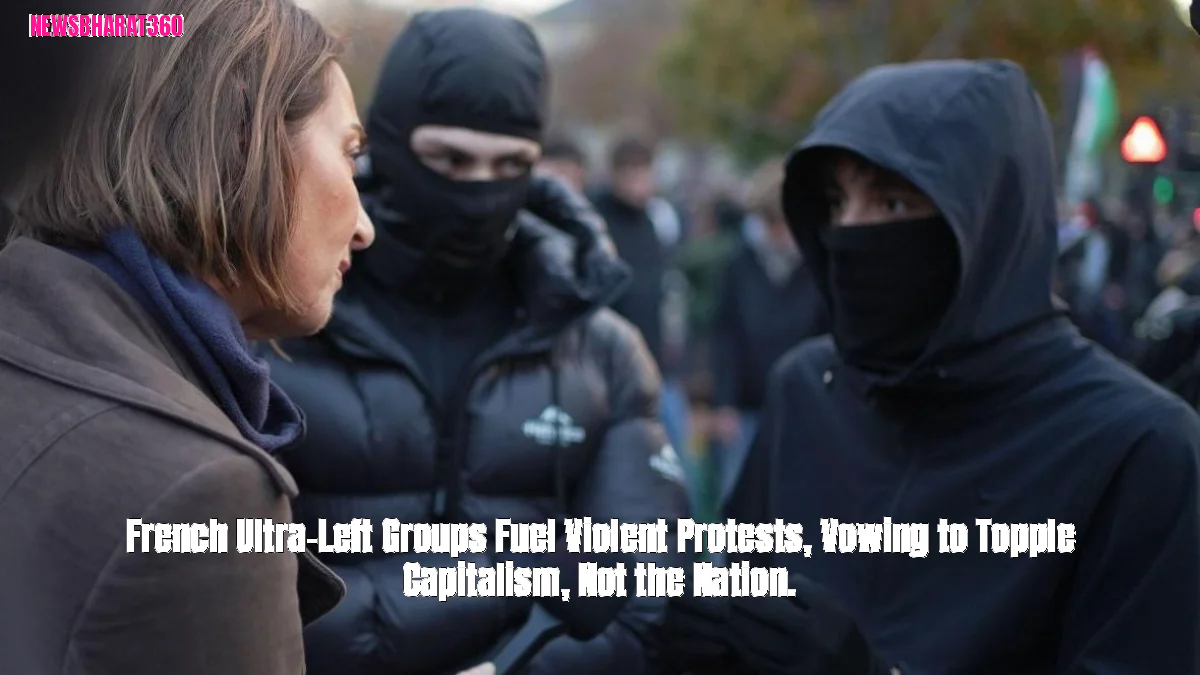

France is currently experiencing widespread turmoil. The country is grappling with significant public debt, an impending presidential transition with the incumbent's term nearing its end, and escalating social unrest. This unrest has been fueled by student-led protests, which have led to instances of looting and violence.
Consecutive weekend protests against rising costs and deteriorating public services continued for the sixth straight week, with allegations of police brutality also being raised. While protester violence has subsided somewhat from last month's levels, it remains a persistent issue.
French President Emmanuel Macron has publicly attributed the recent unrest to individuals he refers to as "delinquents" and "ultra-left groups," claiming their ultimate objective is to dismantle the French Republic.
The statement in question warrants a thorough examination due to its significant implications.
France's presidential and parliamentary elections scheduled for next year have taken a significant turn, with the ongoing riots becoming a pivotal concern in the country's political landscape.
France's left-wing faction has criticized the country's center and right-wing parties for exacerbating the current cost of living crisis, which has sparked widespread discontent among the French population. Conversely, the center and right-wing parties have accused the radical left of promoting violent behavior, a claim the radical left vehemently disputes.
French nationalist right-wing groups have pledged to prioritize restoring law and order, as well as ensuring public safety, if they were to assume power.
The "ultra-left" groups mentioned by Macron have raised questions about their composition and potential threat level.
Members of the radical left often have a strained relationship with mainstream media, viewing conventional outlets as part of a system they strongly criticize and reject.
The most effective approach was to join the protests and attempt to get near individuals wearing distinctive black clothing and sunglasses, which they claim helps conceal their identities from law enforcement. This attire is commonly associated with left-wing activists or agitators known as the Black Block.
Protesters have been a widespread concern across Europe, with notable instances in France. Demonstrations often take place in areas adjacent to major cities, transitioning from daytime protests to nighttime gatherings, during which anti-riot police are frequently deployed in large numbers.
Recent protests in France were accompanied by a surge of violence, with intelligence services initially underestimating the scale of the unrest. The resulting clashes between protesters and law enforcement resulted in over 1,000 police officers being injured, with some young protesters sustaining serious injuries, including fractures, and two losing a limb due to the use of explosive grenades by the police.
French newspaper Le Monde is publishing an ongoing article to track and investigate the increasing number of reports of injured protesters.
According to a recent assessment by the French Federation of Insurers, the total damage to private property on October 17, the peak day of the riots, was estimated to be approximately $240 million.
French authorities have implemented stringent measures to regulate demonstrations, with a significant police presence in place to maintain order.
During a recent protest, the situation escalated as individuals claiming to be whistleblowers found themselves outnumbered by law enforcement, with apparent projectiles such as glass bottles and homemade paint bombs at their disposal.
The protesters were overwhelmed by the law enforcement agents' arsenal, which included scratch-inducing projectiles, stun grenades, and tear gas.
During the confrontation, I attempted to engage in dialogue with the demonstrators.
A group of young individuals, including an 18-year-old identified as Nas, were hesitant to discuss their situation openly. However, they eventually agreed to share their concerns with the condition that their identities remain anonymous, citing fear of detection by law enforcement.
The scene appeared to conform to the typical image of a radical left-wing movement.
The question was posed to the individuals involved, inquiring about the justification for the violent actions taken.
A militant expressed the sentiment that non-violent methods are ineffective in conveying their message, stating that violent action is the only means by which their concerns can be heard and acknowledged.
The speaker hails from a region with a troubled history, where educational institutions are severely underperforming. High teacher turnover rates are a persistent issue, with many resigning from their positions. Additionally, the region's job market is highly competitive, requiring specialized qualifications to secure stable employment. Notably, the speaker emphasized that despite these challenges, the pursuit of equality remains a top priority, and the struggle will continue unabated.
Young individuals from the sprawling outskirts of French cities, commonly referred to as banlieues, have been identified as coming from areas often characterized by poverty, instability, and households with second or third-generation immigrant roots.
The group denied any affiliation with a political party or radical leftist organization, stating that their actions were driven by anger rather than ideological motivations.
Earlier, he witnessed two masked left-wing student activists standing atop a bus in front of a crowd of protesters, who were holding banners featuring the red anarchist symbol and the emblem of the Antifa movement.
France's long-standing tradition of respecting the right to protest is well-documented, yet the nation has been deeply disturbed by the escalating violence that has marred recent demonstrations.
Eyewitnesses who witnessed the riots expressed a desire to share their accounts, but only under the condition of anonymity.
The destructive nature of violence can tarnish the reputation of social movements, a sentiment widely shared. However, some argue that the severity of police actions, such as the use of electric guns against student protesters, outweighs the damage caused by broken glass windows.
French citizens are increasingly experiencing hardship, with many struggling to afford basic necessities and losing confidence in the social fabric of their country.
The notion that violence would result in a more equitable society was questioned by me.
Protesters in France assert that genuine brutality is perpetrated by the government, rather than by individuals.
French intelligence agencies have reportedly identified approximately 5,000 individuals associated with the country's ultra-left movement.
A 17-year-old individual, identified by the keyword name Starflix, is associated with anti-capitalist ideologies and is also a member of the Black Block movement, known for its violent tactics. The individual was observed in the vicinity of a protest, positioned near a narrow waterway.
A source has requested confidentiality due to concerns about potential law enforcement action.
A protester displayed a pair of homemade paint bombs, consisting of eggshells filled with paint and secured with medical tape, which can be used to throw at police. These projectiles were stored in his backpack, concealed within a sea blue t-shirt bearing the logo of an Italian football team.
Protesters have devised a tactic to counter the tear gas used by law enforcement, by throwing paint bombs onto police helmets, causing officers to lift their visors to see, thereby exposing themselves to the same irritant.
In addition to their other actions, protesters have been gathering and collecting various objects, including stones and rocks, that they encounter in Paris streets, with the intention of using them.
Concerns have been raised about the actions of Black Bloc members, who are allegedly causing significant disruptions on French streets, including property damage, physical altercations with law enforcement, and the undermining of peaceful protests.
According to Starflix, the individuals involved in the protest have expressed their political views, although not all participants, who were masked and dressed in black attire, necessarily concur with those sentiments.
The Black Bloc is a tactical approach rather than a unified entity, employed by individuals and groups to facilitate government reform through the use of direct action, including violent means. Its adherents aim to spark a revolutionary movement by challenging the existing social order.
Individuals who exploit anonymity for personal gain often engage in illicit activities, including theft. The widespread adoption of uniform attire can hinder law enforcement's ability to identify and apprehend suspects.
A protester expressed concern about the potential risks of injury or arrest, but stated that his primary fear is the prospect of societal inaction and a lack of meaningful change.
A Starflix source revealed that the individual and their companions rely on messaging apps Signal and Telegram to maintain communication during the ongoing protests.
Leftist organizations have established various online platforms, including websites and social media profiles on Instagram, to provide guidance and support to protesters and young individuals participating in demonstrations.
Protesters are employing various tactics to evade detection by law enforcement, including leaving their phones behind to prevent tracking, concealing their identities by covering their faces, and adopting a fluid, unpredictable movement style reminiscent of martial arts expert Bruce Lee's philosophy of being "like water," allowing them to blend seamlessly into the crowd.
In 2014, protesters in Hong Kong disseminated a message that has endured for nearly a decade.
The dissemination of sensitive information through online publications raises concerns about its potential impact on impressionable individuals. Although these groups do not directly orchestrate protests or violent actions, the availability of such information online may be seen as an attempt to exploit or manipulate young people's emotions and perceptions.
Several individuals involved in recent disturbances have maintained that their actions are spontaneous and not orchestrated, however, the possibility of a larger, underlying factor contributing to the events remains a subject of investigation.
Following an extensive search, our team secured an interview with a veteran Black Bloc activist, allowing us to delve deeper into the claims surrounding the French Republic's stability. We posed a question to the activist regarding President Macron's assertion that ultra-left groups are planning to overthrow the French government.
French authorities are accused of manipulating public opinion by portraying a false narrative of internal unrest, with activist claims that intelligence services are aware of the deception.
Widespread protests across Europe are characterized by a shared sentiment of intense anger, transcending national borders. Demonstrations in France, Italy, Germany, and Spain have been marked by a common thread of outrage, with participants often expressing their frustration through unconventional means. The protests have taken on a life of their own, fueled by a collective sense of discontent that is rapidly spreading across the continent.
Jean-Luc Mélenchon, the anti-capitalist presidential candidate representing La France Insubmise (LFI), has been observed at numerous protests, where his supporters often distribute campaign materials to attendees.
The activist disputes this characterization, asserting that Jean-Luc Mélenchon is a capitalist due to his involvement in the existing system. He claims that the La France Insoumise (LFI) and trade unions are attempting to mitigate the unrest, whereas he advocates for a more confrontational approach, suggesting that the level of resistance should be escalated.
You have chosen to engage in a conversation with us, and we are curious about your motivations. Are you seeking to destabilize the French government or do you have a different objective in mind?
The individual emphasized a desire to dismantle a capitalist system, rather than targeting France as a nation. Their goal is to reform society in a manner they believe will benefit the majority of people.
Fuel costs are becoming increasingly unaffordable for rural residents, with many struggling to meet the expenses of filling their vehicles' gas tanks.
In the rural French countryside during autumn, one can find some of the most well-organized and radical factions of the ultra-left movement.
A suspect remains in police custody in connection with a fire that broke out during environmental protests in Limoges last month.
A 19th-century structure, despite suffering significant damage, retains an air of elegance, serving as a poignant emblem of France's current state. Approximately one month after the incident, the lingering scent of smoke continues to pervade the surrounding area.
A 34-year-old individual from a village near Limoges, a region with a strong presence of anarchist and ecologist communities, has been identified as a suspect, despite maintaining his claim of innocence.
Efforts to secure comments from the suspect's father and lawyer were met with silence, as both declined to provide a statement. The suspect's father, an individual with ties to French intelligence due to his own activism, has thus far remained uncooperative.
A 39-year-old local resident, who is a father and a full-time activist for over two decades, shared his perspective with our investigation team. Due to concerns for his privacy, he requested to remain unidentified.
The official expressed his profound shock and distress at the unfolding fire, emphasizing the importance of taking swift action in response to the crisis.
The speaker expressed deep concern about the current state of the world, citing the need for significant change before passing it down to future generations. Specifically, they drew attention to the use of military vehicles and force by the state against young students, highlighting a pressing issue that requires immediate attention.
The public's frustration is palpable, with many questioning whether further action is necessary to prompt the government to take their concerns seriously.
A spokesperson for the organization was questioned about the recent controversy, prompting a request for clarification on their stance.
The individual, who was raised with the core values of French society, including liberty, equality, and brotherhood, has expressed deep concern over the current state of social injustice worldwide. As a devoted father, he feels compelled to take action and is willing to make the ultimate sacrifice to safeguard the future of the country's youth.
Preliminary assessments suggest that the radical left movement in France does not currently pose a substantial threat to the country, lacking sufficient size, military strength, and cohesion.
Repeated attempts have been made to solicit comments from French intelligence services, but they have declined to provide a statement. This reluctance underscores the sensitivity of the current situation, particularly given the heightened tensions surrounding France's upcoming presidential elections.
Michel Klein, a former police commissioner, expressed his skepticism regarding the perceived threat posed by the radical left to the French state.
The individual expressed concern that radical left-wing groups and anarchists possess the intent to dismantle the Republic, but lack the capability to achieve this goal.
French authorities have expressed concern over potential violence between extremist groups, specifically those on the far-left and far-right, in the lead-up to the presidential election, but do not foresee a nationwide civil war.
Current election polls indicate that a runoff vote is likely between Marine Le Pen, a nationalist candidate, and Jean-Luc Mélenchon, a candidate opposed to capitalism.
Far-right paramilitary groups have started to emerge at protests in multiple cities across France, claiming to safeguard the nation's streets.
Jean-Luc Mélenchon, a prominent extreme-left presidential candidate, frequently participates in demonstrations where his supporters distribute political literature to the gathering. However, Mélenchon has consistently denied any involvement or association with violent activities.
France's political landscape is highly fragmented, suggesting that the upcoming presidential elections may not bring a resolution to the country's current state of turmoil. A complex interplay of left and right ideologies, combined with widespread social and political discontent, is creating a volatile atmosphere that shows no signs of abating.
The original article was written in English and underwent translation using an artificial intelligence tool. Prior to publication, a BBC reporter reviewed the translated text to ensure its accuracy.