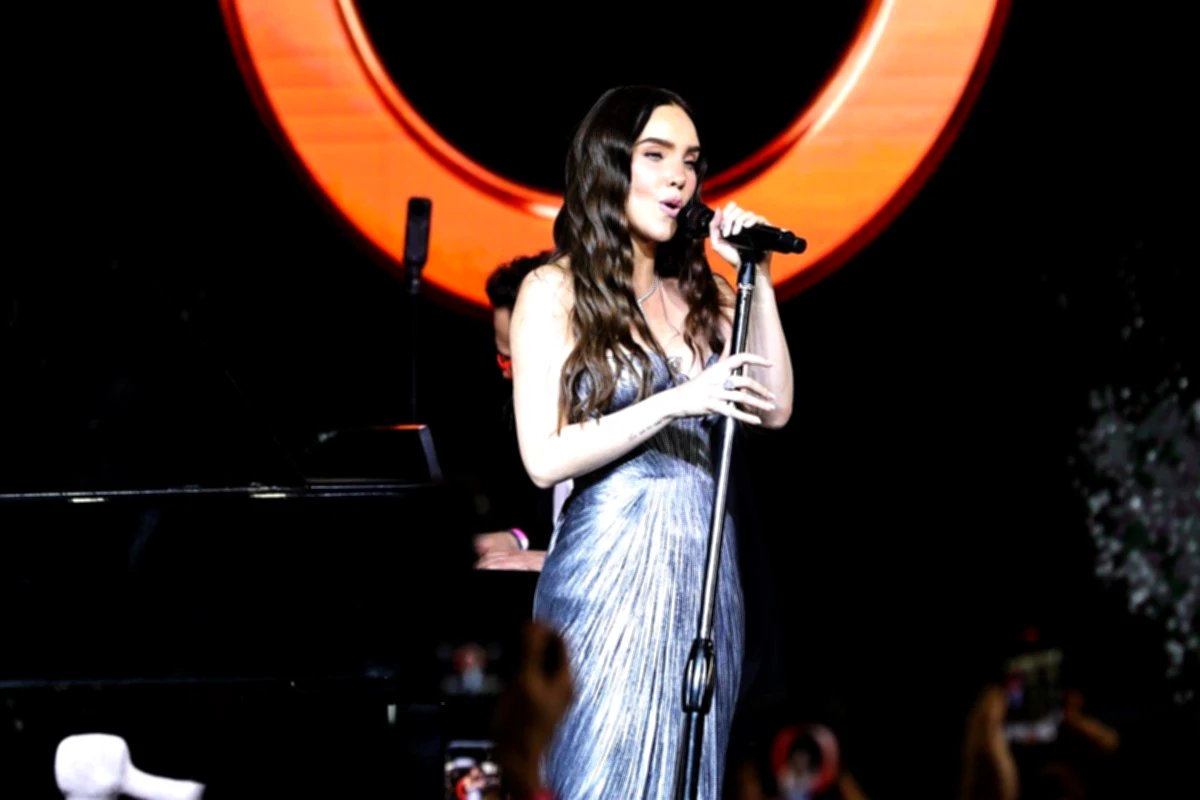

Iranian authorities allegedly assaulted a prominent singer and four members of her entourage, including her band and production team, for failing to wear the mandatory hijab.
A member of Parastoo Ahmadi's defense team informed the BBC that four individuals, including a musician and a producer, were each sentenced to 74 lashes in Qom.
Iranian authorities have reportedly taken action against a 29-year-old female performer, Ahmadi, who appeared in a public live performance in December 2024, violating the country's strict laws that prohibit women from performing in public and mandate the wearing of a veil and modest attire.
A Qom criminal court handed down a guilty verdict in June to Ahmadi and eight co-defendants, who were found to have engaged in behavior deemed an attempt to undermine public morality through the dissemination of allegedly obscene and indecent content, a charge they have consistently denied.
A court has imposed a 74-beat sentence on the individuals, in conjunction with a two-year ban on engaging in audiovisual performances and international travel.
A court of appeals in Qom upheld the verdict at the end of September, according to the accused's lawyers, who stated that their appeal had been rejected.
Iranian artists and human rights advocates have expressed strong disapproval of the handed-down sentences, characterizing the punishment as a form of cruel, inhuman, and degrading treatment that contravenes international prohibitions on torture.
A lawyer for one of the defendants disclosed to the BBC on Monday that Ahmadi and four of his male co-defendants were allegedly subjected to physical abuse within the third section of the Criminal Sentencing Office in Qom.
The individual expressed disappointment that efforts to overturn or mitigate the verdict were unsuccessful.
Efforts to delay the enforcement of the judgment were made by the other lawyers involved, however, the relevant authorities remained resolute in their insistence that the execution proceed without delay.
A lawyer, Mostafa Nili, has reportedly identified four men who were allegedly beaten alongside Ahmad Abadi, as Soheil Faghih-Nasiri, Amin Taheri, Amirali Pirnia, and Mohsen Lashkari.
The Iranian government's actions against Parastoo Ahmadi, who was punished for her personal choices in dress and song, represent a blatant disregard for her basic human rights and a stark example of the authorities' intent to restrict women's liberties and severely penalize those who resist their discriminatory policies.
In Iran, women and girls are required to adhere to specific dress codes as mandated by the country's interpretation of Sharia law. This includes covering their hair with a hijab and wearing long, loose-fitting clothing that conceals their body shape.
Protests erupted across the Islamic Republic in 2022 following the death of Mahsa Amini, a 22-year-old Kurdish woman, while in custody. She had been arrested by the morality police in Tehran in September of that year for allegedly violating the country's dress code by wearing a hiyab in a manner deemed unacceptable.
During a series of national anti-clergy protests, hundreds of people lost their lives as a result of brutal suppression by security forces. In a poignant display of defiance, female protesters used their clothing as a symbol of resistance, either setting their pants ablaze and placing them on their heads or waving them in the air as a bold statement against the oppressive regime.
Women and girls have increasingly defied a dress code by going unveiled in public, prompting authorities to implement intermittent crackdowns, including arrests, warnings, and the closure of establishments.
Thousands of individuals lost their lives and tens of thousands were detained in January of this year as security forces suppressed a large-scale wave of protests against the government, which had been sparked by the nation's economic downturn.
Iran has significantly increased the application of the death penalty against demonstrators since the escalation of tensions with the United States and Israel in late February.
Iran Human Rights, a Norwegian-based organization, has reported that at least 39 men convicted in connection with the January protests and two individuals convicted in relation to the 2022 riots have been executed. Additionally, 16 people allegedly linked to banned opposition groups and 17 others convicted of espionage or collaborating with foreign states have also been executed.
A recent report indicates that 121 individuals, including six women and five minors, who were arrested in January, have been sentenced to death and are currently at risk of execution.
The original text was composed in English and translated using an artificial intelligence tool. Prior to publication, a BBC journalist reviewed the content for accuracy.