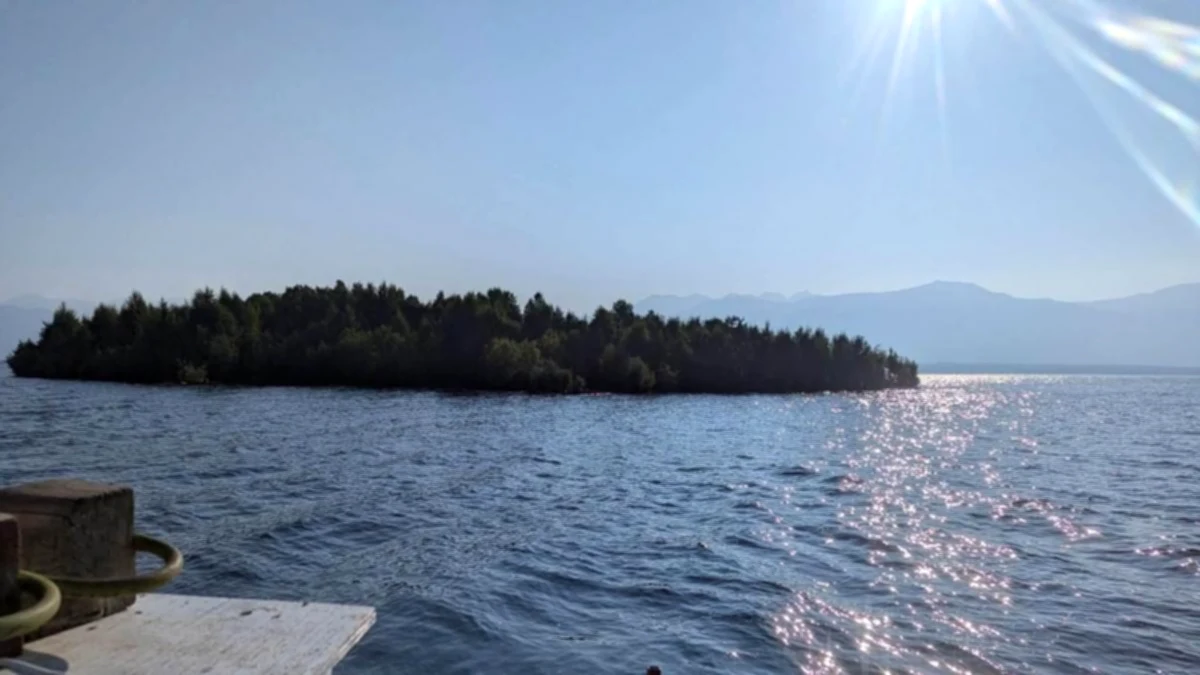

A small floating island in a lake in Canada was found again, after authorities lost their trace in satellite images after its initial discovery.
The forested island was first seen in early August in the middle of Lake Williston — the largest freshwater lake in the Canadian province of British Columbia — by sailors who recorded the scene in a video that later became viral.
A satellite image from late July confirmed the existence of the island, whose size is approximately the size of a football field and a half.
However, a few weeks later, the island had disappeared from that place.
British Columbia officials said they had managed to locate her again, although it is unclear what happened.
Bob Gammer, a spokesman for BC Hydro — the public company that manages the lake and a nearby dam — learned of the island’s existence after seeing a video circulating on Canadian social networks.
The video, recorded by some sailors, showed a portion of forested land that seemed to float and balance over the water.
Gammer said at first he thought it was a video generated by artificial intelligence.
“I thought, ‘Well, this could be anywhere,’” he told the BBC.
However, a July 21 satellite image, retrieved by his team, confirmed it was real and that it actually floated in the middle of the lake, in a remote area north of the province.
However, the island seemed to have disappeared in another satellite image taken just a few weeks later, on August 5.
His disappearance was in several international media and aroused curiosity around the world.
“We just don’t know where he went,” Gammer said, “has he sunk? has he moved to another corner of the dam?”
Gammer said he can now clear those doubts.
According to him, the island appears to have drifted to the shore and encalled about 30 km from the place where it was first seen.
This, he added, was confirmed by a new satellite image and by the testimony of two pilots who flew over the area.
BC Hydro estimates that the island has an area of 9,800 square meters — one hectare —, approximately the size of 1.5 football fields.
As for its origin, Gammer noted that BC Hydro is not yet fully certain, but there is a solid theory: it is likely that the island has been formed over many years through the accumulation of floating wood, which served as the basis for plants and trees to take root.
He believes the island slipped off the banks of the basin this summer, when the water level reached an unseen height since 2012.
Floating islands have also been spotted elsewhere.
One of them, located on Lake Chippewa, in Wisconsin, is known as Forty Acre Bog.
It is believed to have arisen when turf masses broke off from the bottom of the lake and floated to the surface.
Some years, local sailors push this floating mass of turf to prevent it from drifting to a nearby bridge.
According to the Lake Chippewa Flowage Tourist Complex Association, the island hosts a diverse fauna — such as frogs and salamanders — and, like the rest of the lake and its shores, has state legal protection.
Cheryl Treland, a local resident, told Wisconsin Public Radio in 2024 that this floating meltdown is “like an iceberg.”
“It’s not like a leaf floating on the surface of water,” he said.
Gammer warned that the British Columbia island is not a stable structure and recommended not trying to tramp it.
“It’s in a remote area and most people will never get close to it,” he said.
For those who have the means and interest in seeking her, Gammer releases a serious warning: “Don’t climb the island.