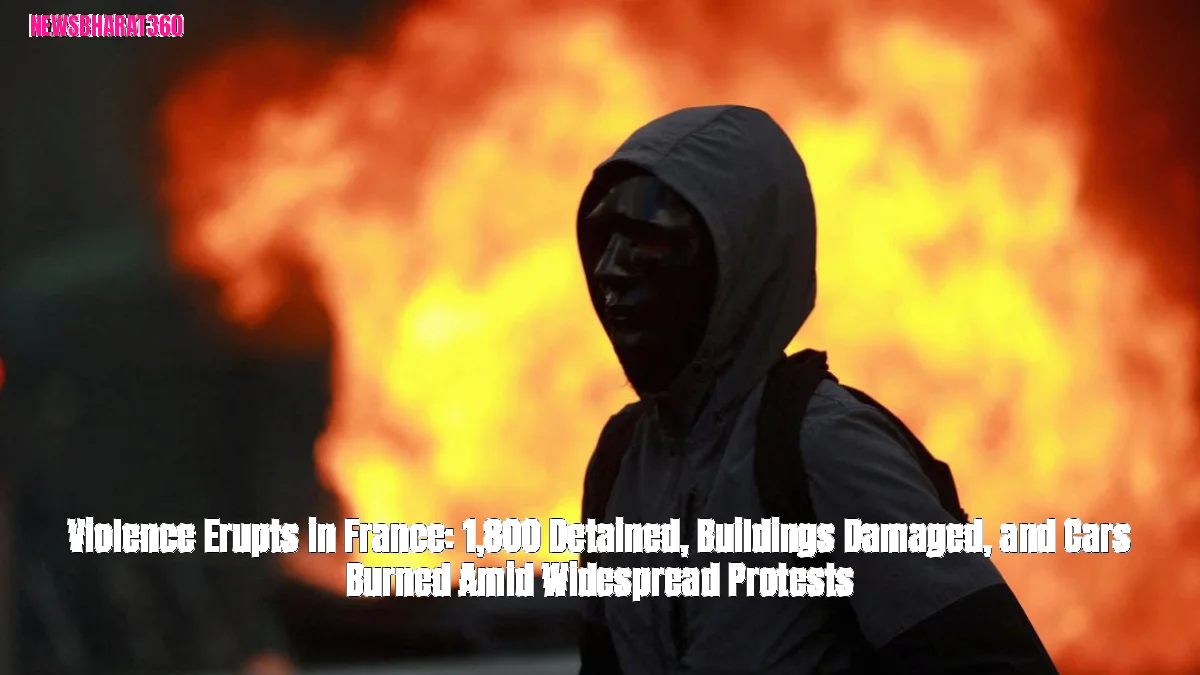

Widespread destruction was evident in France as the country grappled with the aftermath of a tumultuous day marked by intense clashes between law enforcement and protesters. The demonstrations, which were sparked by concerns over the decline of the education system, rising costs, and the state of the welfare system, resulted in scenes of significant devastation.
Scenes of devastation unfolded in Paris, where damaged vehicles, incinerated bicycles, and substantial piles of debris and glass littered the streets.
Saturday saw a significant law enforcement response, with approximately 1,800 individuals detained. Concurrently, a massive crowd of more than 550,000 protesters participated in largely peaceful street demonstrations.
French President Emmanuel Macron emphasized that his nation does not tolerate violent behavior.
The government has attributed the recent protests to the influence of extreme left-wing elements, which it claims were instrumental in organizing the demonstrations prior to the April presidential election. Conversely, the leader of the country's primary leftist party has criticized the government for recklessly escalating tensions by provoking chaos in the streets.
French Prime Minister Sébastien Lecornu reported that a total of 150 police officers were among those injured during the recent unrest.
Interior Minister Laurent Nuñez reported instances of looting or attempted looting in multiple cities across France, specifically in Paris, Rouen, Nantes, Toulouse, and Marseille.
A large-scale protest unfolded in the heart of Paris, the capital city of France.
In the city of Limoges, located approximately 400 kilometers south, firefighters were dispatched to combat a blaze engulfing the town hall, a historic 19th-century structure.
A significant portion of the building's exterior has been severely damaged, with approximately two-thirds of its facade now missing, resulting in substantial loss of the structure.
An incident involving an unauthorized entry and a fire broke out within the building, according to the Interior Minister.
A devastating incident occurred in Saint-Étienne, with a young man reportedly suffering a severe injury, including the loss of a hand, due to a small explosive device. Régis Juanico, the mayor of the city, expressed his shock and concern, stating that such a tragedy should never have occurred.
Following several weeks of student-led protests, a diverse array of groups nationwide began to mobilize in support.
Protests erupted in schools last month in impoverished outer districts of northern Paris, initially sparked by teachers' frequent absences and subpar school infrastructure. The grievances soon escalated into a broader national movement, focusing on disparities in public investment and the decline of educational standards.
Protesters from various groups, including the "yellow wheels," a faction known for opposing fuel price hikes, and labor unions, as well as young people, were present.
Violence erupted in Marseille, resulting in damage to a local police station and scenes of chaos, with images capturing flames and individuals roaming the streets.
The prefect of the Bocas del Ródano region, where Marseille is situated, reported that 107 police officers were injured, with three sustaining severe injuries, as a result of violent clashes and disturbances in the city.
Protesters in Lyon, a city in eastern France, targeted several key locations, including the local tourism office and the offices of the Agence France-Presse (AFP) news agency, setting them ablaze.
Protesters were seen gathered in front of the building, with the structure engulfed in flames that were spreading both within the building and in the surrounding area.
Law enforcement officials reported that hostile individuals were obstructing firefighters' efforts to safely extinguish the blaze, while police were actively working to disperse violent crowds.
A BBC reporter based in Paris described the scene on Saturday, noting that numerous buildings in the area have been severely damaged and that some protesters have engaged in destructive behavior, including vandalism and the use of glass bottles, which has exacerbated the overall chaos.
French President Emmanuel Macron has stated on social media that individuals responsible for vandalizing and attacking prefectures, shops, and municipalities will face consequences and be held accountable for their actions.
The leader emphasized the need for collective unity in the face of those who seek to disrupt social order by undermining institutions and hindering peaceful protests.
The interior minister stated in a televised address that law enforcement played a crucial role in maintaining order during the peaceful protests by effectively managing and containing violent elements among the demonstrators.
French politician Nuñez has condemned the radical left-wing groups that openly advocated for civil unrest, stating they will be held accountable for the chaos that unfolded in French streets on Saturday.
French Prime Minister Asserts National Resilience, Vowing Not to Be Deterred.
The official emphasized that any attempt to utilize violence as a precursor to the upcoming presidential elections will be met with firm resistance.
French politician Lecornu criticized the left for providing justification for violent protests, commended law enforcement officers for their bravery in the face of extreme violence, and emphasized that they deserve the public's support.
French leftist party leader Jean-Luc Mélenchon, head of La France Insoumise (LFI), has criticized the French prime minister for escalating the conflict.
French politician Jean-Luc Mélenchon has expressed concerns that the government's approach to addressing protests has had the unintended consequence of uniting young people and labor unions. Mélenchon further stated that the government's orders for repression have led to a massive and unprecedented mobilization across the country.
A high-ranking official's involvement in a contentious political issue undermines their credibility as a representative of the state, suggesting instead that they are acting in a manner more befitting a subordinate. The official's actions are causing significant harm and it is unclear what motivations drive their decision to engage in this dispute, particularly given the current circumstances.
The individual expressed concern that the government's recent decisions have led to chaotic circumstances, citing a lack of competence in their implementation.
The General Confederation of Labour in France characterised the recent wave of protests as a significant escalation in the ongoing mobilization effort, emphasizing that the government must promptly address the population's demands.
The French government, led by President Macron, is advocating for several key concessions, including higher wages and pensions, as well as the reinstatement of a wealth tax.
The CGT is urging continued peaceful demonstrations in conjunction with young people over the coming days, with the movement culminating in a large-scale intersyndical strike on November 5.
A stark contrast emerged between the officially sanctioned demonstration, which proceeded from the Place de la République to the Place de Clichy, and the events unfolding in various other locations throughout the city.
The primary demonstration seemed to proceed without incident, although scattered groups of protesters were observed roaming the capital, with some individuals appearing intent on instigating unrest.
The initial reports from the early morning hours were later complicated and escalated into more intense and violent circumstances as the day progressed.
Schofield noted that the current situation bears resemblance to the early stages of the 2010 "yellow vest" movement, in which the violent behavior of unmanaged groups overwhelmed law enforcement.
Local authorities in Tolon, southern France, reported incidents of violence on Saturday, occurring in the vicinity of a procession.
During the incident, two police officers were injured by projectiles, and authorities reported that the perpetrators also utilized the dismantled shelves of a Christmas market as makeshift weapons against law enforcement.
A demonstration in Caen, Normandy, was marred by violent incidents, with local authorities reporting that certain groups engaged in destructive behavior, including looting and acts of vandalism.
Protesters engaged in acts of vandalism, hurling stones and spray-painting graffiti on multiple public structures within the city. Additionally, they employed a makeshift barricade to breach a police blockade, resulting in damage to two law enforcement vehicles, according to official statements.
French presidential candidate Marine Le Pen, representing the far-right National Rally (RN), has alleged that counter-protesters, often referred to as "stunners," attempted to disrupt nationwide demonstrations on Saturday by spreading unrest.
The politician has accused the protesters' demands of being hijacked by radical left-wing elements, claiming that groups that condone violence are attempting to plunge the country into chaos.
A BBC correspondent based in Paris, Hugh Schofield, has been reporting on current events.
The French protests have sparked a question about their nature: are they a continuation of the country's long-standing tradition of public demonstrations, or do they signify a more profound and meaningful shift in the nation's dynamics.
The current protests exhibit a familiar pattern, mirroring past demonstrations that have been marked by a common sequence of events, including the underlying cause, mass gatherings, property damage, the use of tear gas by law enforcement, arrests, and allegations of excessive police force.
In France, a recurring phenomenon unfolds annually, typically in the autumn season, where a collective sense of fatigue culminates in a final, decisive moment. This event is characterized by a predetermined sequence of events and a clear conclusion, evoking the structure of a theatrical performance.
The question remains whether the current period will be remembered as a pivotal moment in history, comparable to significant events such as the May 1968 protests in Paris, the Paris Commune of 1870, or the European social revolutions of 1848.
Supporters of this perspective have valid points to consider.
The French centrist government has faced criticism for its inability to take decisive action. A decade-long experiment in radical policies under President Macron has yielded disappointing results, leading to widespread disillusionment with the current state of politics.
France is facing a significant debt crisis, with some experts warning that it poses a substantial risk of defaulting on its financial obligations.
Tensions in Europe have escalated into a state of conflict, while the global landscape is also being shaped by the presence of former US President Donald Trump. Meanwhile, France is preparing for its presidential elections, scheduled to take place in April and May.
Global instability is currently on the rise, with a rapidly shifting landscape.