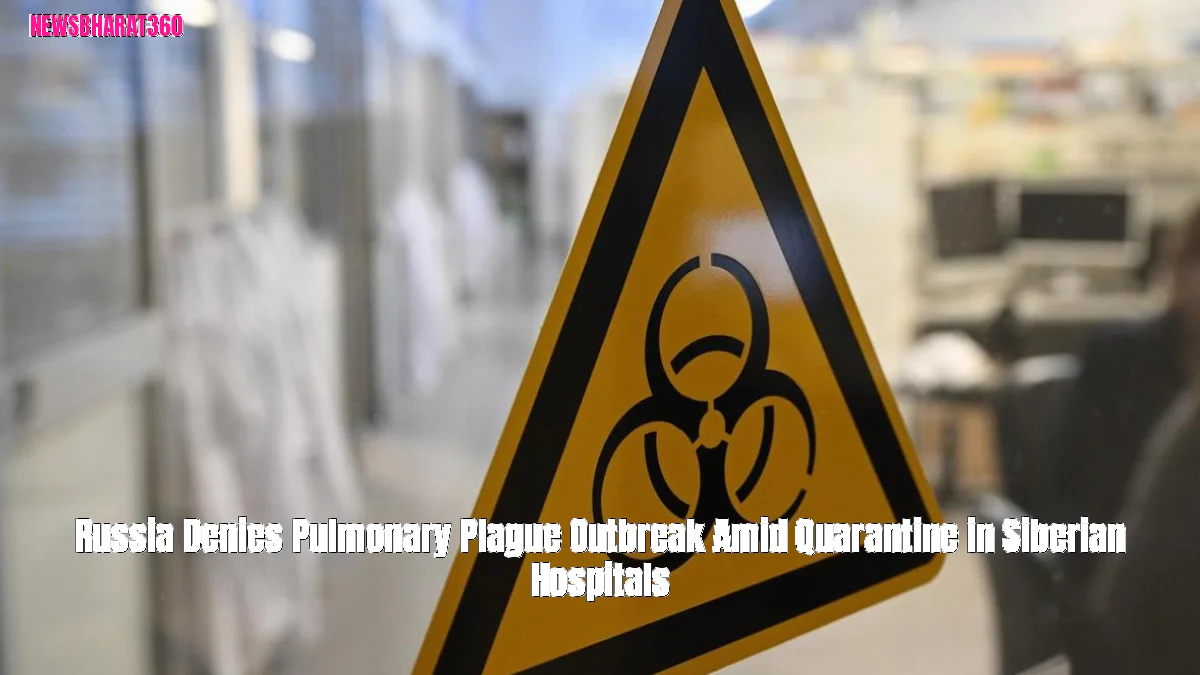

US authorities are closely monitoring the investigation into the death of a Russian laboratory technician at a plague research facility in Siberia.
Russian media reports have been cited by several newspapers, including The Guardian and The Times, which have identified a 28-year-old woman, Darya Shipilova, as the individual who passed away in Shelekhov, Russia, on the previous night.
A global health warning has been issued in response to a developing situation in the Irkutsk region, prompting the implementation of strict isolation protocols.
US Secretary of State Marco Rubio voiced concern that the incident may have contributed to the potential spread of pneumonic plague, while emphasizing that there is no cause for widespread alarm.
President Donald Trump stated on Tuesday that the case is being closely monitored by the White House.
The official expressed regret over the difficult situation the individuals are facing, while also assuring that assistance will be provided to support them.
Local authorities have yet to confirm whether the young woman's death is linked to a potential plague infection.
The governor of Irkutsk revealed that the cause of the woman's death was a pneumonia of unknown origin, with no microorganisms linked to her occupation detected in her biological samples.
Unverified accounts indicate that Shipilova may have contracted an illness following an incident in which she broke a test tube containing the pathogen or after visiting an area where the plague is endemic among wild rodents.
Irkutsk Governor Igor Kobzev stated that, according to Rospotrebnadzor, the Russian agency responsible for health supervision and consumer protection, no other staff members of the institute have required medical care following the woman's death.
A biosecurity inspection conducted by a team at the Siberian and Far Eastern Plague Institute in Irkutsk revealed no indication of an emergency situation.
Workers at the center were placed under a strict quarantine on site.
Russian government officials are advising citizens to rely on credible information from authorized sources, specifically Rospotrebnadzor, and to disregard unsubstantiated rumors.
The death of Shipolova prompted a response from senior federal health officials, who intervened in the situation.
Russia's top public health official, Anna Popova, traveled to Irkutsk on Friday to participate in an urgent meeting of the regional health and epidemic council, convened to discuss a reported case of a highly hazardous infection.
The governor of the Irkutsk region urged residents to remain calm, citing that all individuals identified as contacts of the incident have been placed under medical observation. To date, none of these individuals have exhibited symptoms and laboratory test results have been negative.
Approximately 200 individuals who had been in contact with the deceased person were placed under medical observation as a precautionary measure by Russian health authorities.
Following the incident, health screenings have been strengthened in four countries of Central Asia.
Kazakhstan has strengthened health protocols at its border crossings, joining neighboring countries Tajikistan and Kyrgyzstan in implementing enhanced health checks.
US Senator Marco Rubio was asked about the suspected case of plague in Russia, to which he responded that a laboratory worker had been infected, raising concerns about potential internal transmission of the disease. He noted that similar quarantines have already been implemented in response to such outbreaks.
The situation is being closely monitored and watched for any signs of further spread, particularly outside of controlled environments. While it is not deemed alarming at this time, it warrants attention and ongoing follow-up to ensure the situation does not escalate.
The deceased woman had traveled to the Buriatia region, located near the border with Mongolia, in the recent past.
Yersinia pestis, the bacterium responsible for the devastating Black Plague that claimed up to half of Europe's population in the 14th century, has been detected in the region, primarily among rodents such as marmots.
The Pest Institute of Siberia and the Far East was established in the early 20th century, following a significant outbreak in the 1920s.
A University of Reading associate professor of cell microbiology, Simon Clarke, has stated to the BBC that the lung variant of Yersinia pestis is typically fatal if left untreated, however, it can be effectively treated with antibiotics.
The transmission of pneumonic plague from person to person has raised significant concern due to its potential for human-to-human spread.
The expert emphasized that the situation at hand does not involve confinement measures or COVID-19, which are typically associated with outbreaks of infectious diseases.
Historians often assume that the plague is a relic of the past, having disappeared centuries ago, but according to Clarke, this is not the case.
The disease remains present in various regions globally and continues to pose a risk to human well-being, necessitating ongoing research and investigation.
A scientist acknowledged that the pathogen in question could have been researched for its potential as a biological agent, leaving open the possibility of its use in such a context.
Clarke suggested that the prevailing assumption about Russia may not be the most accurate, and instead believes his initial explanation is more plausible.
The BBC's Russian service conducted an interview with biologist Irina Yakutenko to gain insight into the purported risks and extent of the Shipilova case.
A scientist participating in the podcast What Was It? noted that the scarcity of data significantly complicates the process of predicting potential scenarios.
The available information confirms that an incident occurred, but beyond that, the accuracy of the details is uncertain.
The agency relies solely on official reports from local authorities, as information from unverified sources is considered unreliable.
An expert notes that, even if the woman's death is attributed to pulmonary plague, the likelihood of a widespread epidemic outbreak in Russia and beyond is extremely low.
The pneumonic plague exhibits a limited chain of transmission due to the high mortality rate, preventing a large number of individuals from becoming infected. In contrast, the bubonic plague, historically responsible for millions of deaths, relies on a specific combination of factors: the presence of rats, fleas, and densely populated living conditions.
Plague outbreaks have occurred naturally on Earth for thousands of years. Fortunately, the risk of human-to-human transmission of the disease is mitigated when conditions conducive to its spread are not present in human populations.
Experts have concluded that the risk of a plague epidemic in developed countries, including Russia, the United States, and Europe, is nonexistent due to the absence of conditions that could facilitate such an outbreak.
Professor Ian Jones, a virology expert at the University of Reading in the UK, conveyed a similar sentiment.
A laboratory accident appears to be the likely cause of this incident, with minimal risk of significant consequences. While pulmonary plague is a highly transmissible disease, the individuals who had direct contact with the primary case have been identified and can receive prompt treatment if they exhibit any symptoms of infection.
Pest, a disease with a long history, still affects various regions globally, including Russia. However, the living conditions that facilitated its spread in the past are now relatively rare, and the availability of antibiotics significantly limits its potential impact.
The World Health Organization reports that pulmonary plague has a brief incubation period, typically ranging from 24 hours, and can be life-threatening if left undiagnosed and untreated.
A recent study published in the journal Nature Medicine has revealed a significant breakthrough in the treatment of a rare genetic disorder. Researchers at the University of California, San Francisco, led by Dr. Eric Olson, have successfully developed a gene therapy that has shown promising results in treating the disorder, known as Barth syndrome. The study, which was conducted over a period of five years, involved a total of 15 patients with the condition. The gene therapy, which was administered through a single injection, has been found to be effective in improving the patients' symptoms and quality of life. The study's findings have been hailed as a major advancement in the field of genetic medicine, and researchers are optimistic about the potential for this therapy to be used to treat other genetic disorders in the future.