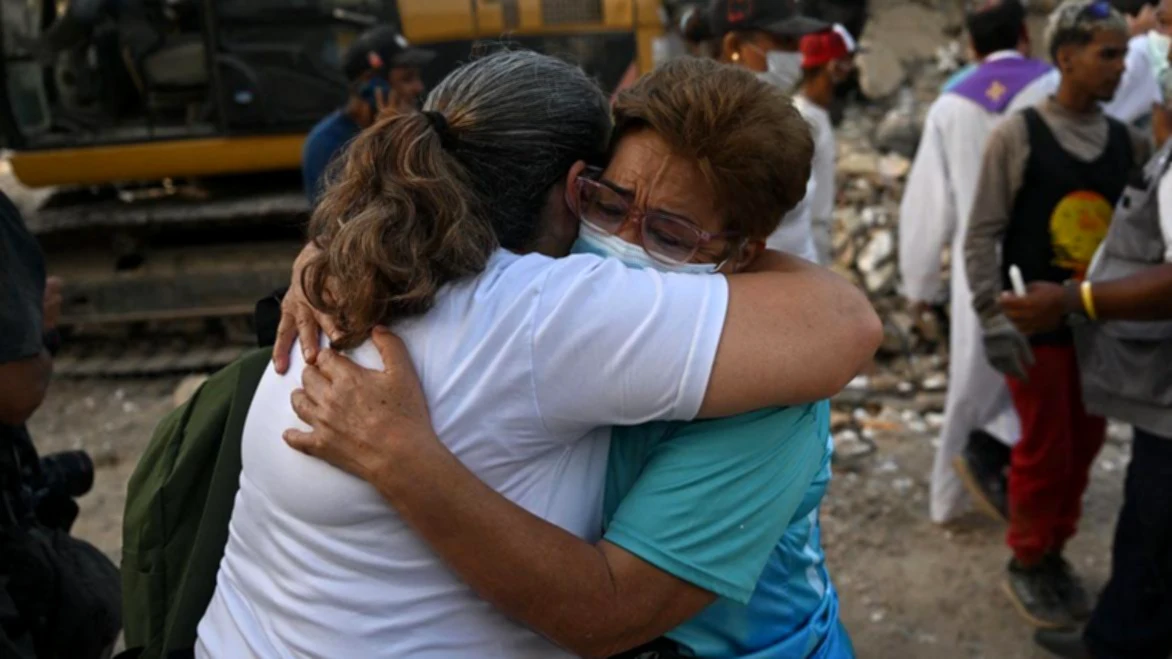

Mrs. Mara was residing in the earth floor of the building.
His girlfriend was residing in the room upstairs.
At that moment, at 6:04 in the afternoon, two earthquakes shook northern Venezuela with a difference of 39 seconds.
Maria was saved, but her sister died.
“She feels guilty because she went out and because when she was on the ground floor she didn't hurry her sister enough to come down,” Dr. Francis Bell, a psychologist specializing in neurodevelopment, tells me.
Bell tells me about “survivor's guilt” and how common it can be in catastrophes like the one Venezuela experienced on June 24, when two earthquakes of magnitude 7.2 and 7.5 devastated areas of the country.
It is a reaction that psychologist Hamilton Lizcano has also observed after the 7.4 magnitude earthquake that shook western Colombia on August 10.
“I could have rescued you, daughter, many hours passed, I could have rescued you,” she heard a father say who was hugging the lifeless body of his little girl in Cali.
“That dad feels guilty for not having taken her out of the rubble,” the specialist tells BBC Mundo.
Bell, with his experience in Venezuela, points out that there are people who, for example, feel guilty for having stayed at home while their relative, who had left, died.
“He is guilty for what he did or did not do.”
“These are thought patterns that are common, seeing the illusion that you could have controlled the situation or that you had responsibility for something that happened.”
“Feeling guilt for being left alive and guilt for what happened to your loved one.”
Helping those victims who have these thoughts to stop experiencing them is one of the many challenges of mental health specialists in Colombia and Venezuela.
A mechanism in chaos
In Colombia, the earthquake left more than 280 dead and 140 missing, according to official reports.
In Venezuela, more than 6,000 people died in the double seismic event, according to government information. And, although there is no certainty, other sources estimate tens of thousands of missing people.
Bell is head of the neurodevelopment unit at the Ciudad Caribia Hospital, located very close to the area devastated by the earthquakes, in the state of La Guaira, in Venezuela.
There, he has treated victims of the earthquakes.
Over the phone, she tells me the case of the woman who had no children and who lost her sister, but she did not give me her name and I did not ask her either. To protect her privacy I call her Maria.
“She no longer has a home, she feels the total abandonment of her existence because she lost what for her was her essence: the other person.”
“Now, he normalizes a state of depression, hopelessness, as if it were part of his life because his soul mate, who was his sister, is no longer there.”
Bell explains that, from a clinical and neuropsychological perspective, survivor guilt arises as a defense mechanism to counteract chaos.
“Whether due to bonds of empathy, the survivor feels that moving forward or being well is equivalent to betraying the pain and memory of those who died.”
There are people who minimize themselves, who feel that they do not deserve to have survived the tragedy that left them without their loved one.
And this phenomenon does not only occur between family members.
"It happens frequently to rescuers and health personnel, people who did everything they could to save someone and couldn't. They think: 'I'm here, alive, and I couldn't save that person.'"
“That doesn't make you unfair.”
According to the expert, survivor's guilt can manifest itself with symptoms that include insomnia, recurring nightmares, muscle tension, and panic attacks.
And also with self-punishment, with depriving yourself of moments of rest, of joy, of positive thoughts.
“It's like experiencing mourning in itself, not that of dressing in black, but that of not enjoying absolutely anything because they believe it is disrespectful to someone who did not survive.”
Some people may tend to isolate themselves and not reconnect with other family members for fear of being judged.
“The person died, but you stayed alive,” Bell points out. “And that doesn't make you unfair, the issue is how you approach that situation.”
And in that sense, it is essential to have specialized professional help.
María Teresa Cuervo, director of the Psychology program at the Pontificia Universidad Javeriana Cali, in Colombia, tells BBC Mundo that in those moments it is not useful to simply tell the person “it is not your fault.”
“You have to progressively help her review what was really under her control and what was not.”
The right accompaniment, he points out, can turn that guilt into other ways of connecting with your loss, such as gratitude, solidarity, and purpose.
“The goal is not to forget who died, but to be able to continue living without feeling that doing so constitutes a betrayal.”
Clara Astorga, president of the Federation of Psychologists of Venezuela (FPV), tells BBC Mundo that survivor's guilt, although it is a natural response, is a cognitive distortion that does not adhere to reality.
“The reality is that human beings face the adversity of life and have little control over many things that happen.”
The questions
Lizcano is one of the psychologists from the National Learning Service (SENA) who participated in the humanitarian aid deployed in Cali, one of the areas most affected by the earthquake in Colombia.
There, the building where the father who lost his daughter lived collapsed.
"The man did not move from the place, neither at night nor during the day. He helped the rescuers remove rocks and rocks and rocks."
As the hours passed and the girl was not found in the places where some survivors had left, the specialists, guided by crisis intervention protocols, took a very difficult step.
"At one point we began to tell him that it was possible that, if we found her, she would no longer be alive. Saying that to a father who fights and fights is very hard, but it had to be done, we had to talk to him about the possibilities, about the sense of reality."
The father continued helping to dig and Lizcano and the other members of the group supported him.
In the early hours of Friday they found the girl.
"That cry, that collapse of that father moved us. Tears came to my eyes, we all wanted to find her alive."
However, the expert states that the fact that he was able to do some of his mourning at the scene of the tragedy "is a significant advance for his health."
"Questions arose: 'Why couldn't I get there sooner? Why did we have to wait hours?' And that's when the rescue doctor approaches, sits him in a chair and tells him: "No, dad, she died because a wall fell on her, not because hours passed and we couldn't rescue her."
“That dad needs a support network,” says the psychologist. Her relatives have already been located in towns near Cali and the girl's mother, who lives abroad, had already returned to Colombia. For them, specialized emotional care is essential.
Lizcano is now in Neiva, in southwestern Colombia.
“Remembering that image is very, very painful,” he tells me about the father and his daughter.
“The fire corner”
Bell remembers those first days after the double earthquake and the survivors of different ages who arrived at the hospital where he works in Venezuela.
“My biggest challenge was the emotional chaos, it was silent, heartbreaking, I had no words to describe the feeling of each of the people who work and support these types of people.”
“I stayed in the hospital, day and night, for a few weeks.”
"The night and the morning were the same, the only difference was the change in color of the sky. When you are in a hospital facing a crisis, the day becomes night and the night becomes afternoon, without a zone of psychic safety for those of us who work in that space."
Many of her colleagues began to look for her and she supported them with different techniques.
“It was a double job: accompanying these vulnerable people due to the earthquake and also accompanying my colleagues, nurses, rescuers, who came with panic attacks, who had never faced a situation of this type and who needed attention.”
And, thus, an idea arose inspired by what in some schools is known as “the calm corner.”
Bell installed “the fire corner” in his office for his colleagues.
"That's where you have to throw out the fire, where you have to throw out everything you feel, you can give yourself permission, you are alone, you can scream, cry, talk to yourself. In some way, drain what you feel."
“And, after they felt ready, they would come and talk to me.”
That retreat, those staggered breaks, he says, somehow allowed them to continue “because we had no chance of faltering.”
"It was a space to self-regulate for 10, 15 minutes. On duty, it was the opportunity to try to disconnect for a moment from the critical and emergency situation. That was very important."
“We lost coworkers, we lost family members of coworkers, we lost patients that we had seen for a long time.”
“Tears of love”
Bell explains that, in the emergency, psychological first aid was implemented to stabilize the levels of anxiety and hopelessness of the survivors arriving at the hospital.
But in addition to emotional containment techniques, for her it was key to provide them with “fundamental tools to continue.”
“You have to have a methodology to be able to make the person identify their own worth and know how to move forward.”
On her tours through the rooms and wards of the hospital, the psychologist not only listened to the heartbreaking stories of the patients, but also invited them to see “the possibility of a future.”
And she also lived experiences that made her smile and shed “tears of love,” like the boy who asked his aunt to take him to see her. “He hugged me and gave me a kiss.” That child was trapped with his family for five days and was the only one who survived.
Remember a girl who, after losing her mother and brother, was left alone.
"I talked to her, I visited her in the morning, in the afternoon, I came back another day at noon, and then at night. I exchanged."
“But she hardly spoke, she hardly said anything to me, she just looked at me.”
The 21-year-old had had problems with her mother. “His fear or guilt was that he had not resolved things with his mother.”
One day she told Bell: “I would have liked you to have been my mother, but, through you, I see that my mother is talking to me because she is telling me that she forgave me.”
With an emotional voice, the doctor tells me the impact those words had on her, the feeling that, in some way, she was helping that young woman to free herself from guilt and realize that she could have support to face her pain.
He also tells me the story of a man who had lost his wife, his two daughters and his house in the landslide, also in La Guaira, in 1999.
“He remarries, has two small children, and loses his family and home again in the earthquakes.”
“I talk to him and he tells me that he no longer has hope, that he has no strength or courage to have a partner or children, because he realized that that is not for him.”
"And it turns out that in the same hospital he met his first girlfriend, his first love. The lady told him: 'Come with me, we're going to Barinas, my dad is there.' That case brought tears to my eyes."
Astorga, like many psychologists, has gone to La Guaira to provide support.
"It's like any apocalypse movie you've seen for miles and miles and miles. It's an image that no brain, no human being, is prepared for."
He says that three days after the earthquakes, the FPV opened specialized training because “being a psychologist is not enough to deal with something like this.”
The course focuses on areas such as psychological first aid, trauma psychology and emergency psychology.
“700 psychologists signed up,” he says. "We have an army of psychologists prepared to continuously accompany the population, but we know that the challenge is very great."
Duel among the rubble
Many people, both in Colombia and Venezuela, do not lose hope that their loved ones can be found in the rubble.
“Grieving the death of a loved one will always be hard,” says Astorga. “But when you have to mourn a body that you didn't see, that you have no way to say goodbye to, it becomes very complicated,” he says, referring to the situation in Venezuela.
And there are people who are experiencing this grief in multiple ways because they were the only survivors in their families.
“It is a priority for a person who needs to make closure, say goodbye, recover their loved one to bury them, but it is also important that they eat, drink water, try to sleep, and take care of themselves.”
With psychological tools, he points out, it is essential to accompany and understand that survivor in this emotional process, but “it is the person who sets the tone, not the specialist.”
“I came to tell you”
Anicarmen Chirinos is a psychologist from the United Nations Population Fund (UNPF) who, after the earthquakes, was assigned to a transitional camp that the same community set up in a baseball stadium in La Guaira.
Together with three psychologists from other United Nations agencies and a Dominican hospital, she offered support to victims in the camp and surrounding areas.
The role of community leaders was key to reaching them. “Despite suffering their own tragedies and grief, they continued to assume leadership.”
Chirinos treated several adolescents and women in individual emergency sessions for emotional containment.
In the fourth session of one of them, something marked her.
“I came to tell you that I just took a shower and that it took me 40 minutes,” he told her with a smile. "I hadn't washed my hair since the earthquake. I also put a gel on it. It felt so good."
That thirty-something woman and many others had expressed their fear that another earthquake would occur and they would have to run naked.
But, the sessions with Chirinos helped her “feel calmer” and remember the importance of self-care.
He survived with his mother, but they lost loved ones and their home.
That detail of telling him that he had bathed at a neighbor's house is something that Chirinos greatly appreciates.
“It allows me to find the beauty within this whole catastrophe.”
He also tells me how much the desire to live of a 19-year-old girl who was the only survivor of her family and who lost her home impacted her.
In addition to individual psychological work, the specialist addressed with her the risks of being alone and mechanisms to protect herself “because gender-based violence was something real.”
For Chirinos, it was essential that survivors understand that psychosocial support is like a cane that helps you gain momentum.
When UNPF set up the team that would stay in the camp for the next six months, Chirinos said goodbye. He returned to Maracaibo, from where he spoke to me via video call.
here and now
For Astorga, at this time the most important thing for psychology and psychiatry professionals in Venezuela is that many people are coming out of the initial shock to begin processing their grief and seeing how they will continue with their lives.
"We cannot trivialize or only distract. The message is that you have the right to cry, this is the moment, and we accompany you."
What is sought is to prevent post-traumatic disorder from developing.
“It is important to remind him that he is a survivor, that he is here and now and that there are other social networks that grew in his life, other things that are still in his life, a talent, some studies, some interests.”
When pain is recognized, he indicates, people can develop the ability to continue and lead a meaningful life, without forgetting what happened.
“We also have a long job to accompany front-line professionals who have been almost direct victims, they are personnel who have been subjected to extreme situations,” says Astorga.
In six weeks, he says, the various FPV programs have carried out more than 2,160 consultations, of them more than 1,400 in the field.
Hundreds of services have been provided through its Lapsi emergency telephone line and digital platforms.
About 200 volunteer psychologists rotate at different times to assist survivors in the field.
The government, academic institutions, such as the Andrés Bello Catholic University, and non-governmental organizations have also opened lines of psychological support.
In Colombia, the Ministry of Health has an emotional support line that operates 24 hours a day.
After the earthquake, the Konrad Lorenz University Foundation activated a psychological care service.
“A light at the end of the tunnel”
Cuervo poses several challenges of providing psychological help to the victims of the earthquake in Colombia, among them is that the support does not end when media attention decreases.
“Some psychological consequences may appear weeks or months later, when the person begins to process what happened.”
Another challenge is that it is not just about serving individuals and their specific needs.
“Psychological recovery also involves rebuilding trust, cooperation and a sense of belonging.”
In the case of Venezuela, Bell suggests, it is essential to devise mental health care programs, through public policies, that provide tools to move forward in case of trauma, crisis, unexpected situations, and that cover all levels, starting from school.
“Go beyond the discourse of aid, which is necessary, and implement the pedagogy of emergency: that you have hope, options, that you step on the ground and see reality, that you do not see the darkest world, but that you see a light at the end of the tunnel.”
Stripping psychological help of any stigma is key for Chirinos, as well as understanding that each survivor has their priorities and reality.
“They also have their times.”
Hence the importance of the support networks that have been woven to reach the victims.
“We only save ourselves together, there is no other way,” reflects Astorga.