
Hundreds of thousands of people in Puerto Rico have been without drinking water for two days in a row, while the authorities of this US territory adopt drastic measures to combat a serious drought.
Many homes on the Caribbean island have been distributed into two groups; Each one's water supply is cut off on a rotating basis for 48 hours.
Residents of San Juan — where supplies were interrupted on Friday — have criticized rationing.
For their part, the authorities have not reported when they will end this measure.
Most of Puerto Rico faces drought conditions ranging from moderate to severe, according to the US Drought Monitor.
However, many argue that the problem is not only due to the lack of rain, but also because the infrastructure and water management system is fragile and has lacked proper maintenance for years.
In June, for example, a water main burst, affecting service to tens of thousands of customers in the San Juan area. It was later repaired, but the outages persisted.
The combination of the lack of rain and poor maintenance, experts say, is what has led Puerto Rico to the current crisis.
With infrastructure in good condition, the impact of the drought would have been manageable, they add. But with infrastructure already damaged, the impact is even greater.
On the other hand, water production in key purification plants has been decreasing for years, due to a reduction in investments as a result of an economic crisis.
180,000 properties affected
The Puerto Rico water authority indicates that about 65% of this liquid is lost or not billed, largely due to leaks and deteriorated pipes, according to CBS, the BBC's news partner in the United States.
The island's governor, Jenniffer González, has acknowledged these problems, but affirms that rationing was applied due to weather conditions, which have left the strategic Carraízo reservoir practically empty.
Puerto Rico recorded the driest July in its history and currently 68% of the island is experiencing drought conditions.
The rationing affects seven regions normally supplied by the reservoir and 180,000 properties, which would mean hundreds of thousands of people, according to the government.
González stated that the decision was made “after carefully evaluating the current conditions of the Carraízo reservoir along with meteorological forecasts.”
“This situation is beyond our control,” he said in a statement.
And he added that “it is the result of the meteorological conditions that we have been facing, which experts had already warned about weeks ago.”
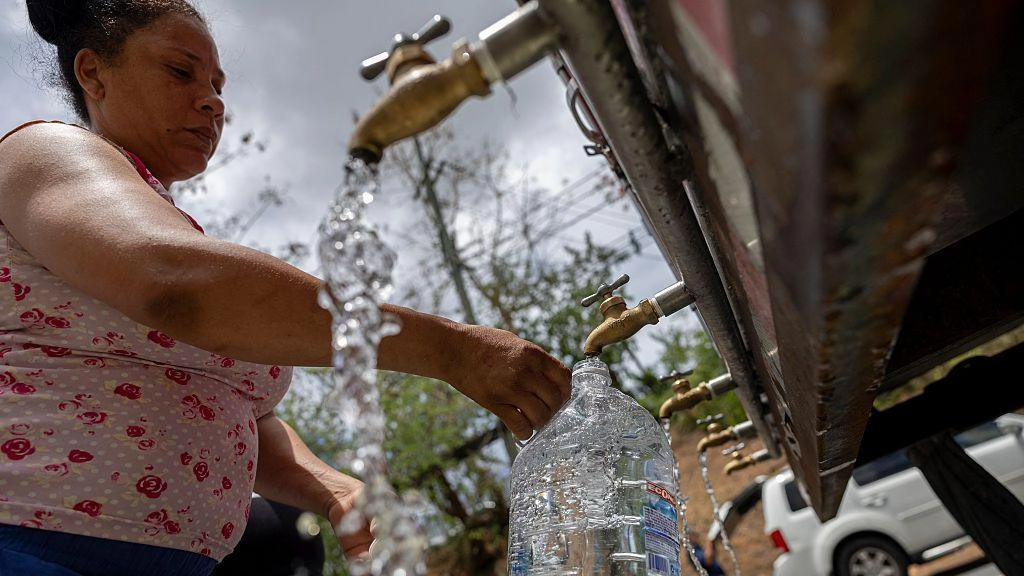
As cuts to the distribution network are implemented, people line up in front of tankers sent to affected areas to fill large containers.
“It's incredible to have to experience this today,” San Juan resident Gloriany Baba told CBS, calling the situation “brutal.”
However, there is some confusion in the territory about which homes and businesses will be affected and when.
In the Morcelo area, south of San Juan, it had been promised to restore water on Friday and cut off the supply again on Sunday, once the first 48-hour period had ended. However, residents told local media that they were still without running water.
“People are restless because they know that we are within the 48-hour period during which we are supposed to have drinking water,” community leader Rubén Torres told El Nuevo Día newspaper on Saturday.
"What is happening? The first 24 hours have already passed and the water has not arrived."
Deteriorated infrastructure
In addition to the deterioration of infrastructure and lack of rain, experts have also pointed to excess sediment in reservoirs as a contributing factor to the water crisis.
Water rationing had already been implemented in 2020 and 2015, when some 400,000 homes received running water only every three days.
Puerto Rico has previously been affected by extreme weather events that scientists say are more likely due to climate change caused by human activity.
The island's electrical grid was devastated in 2017 by Hurricane Maria, which caused thousands of deaths.
Scientists say that climate change has increased the likelihood of the extreme rainfall associated with this phenomenon.
González also told CNN that there are currently active fires in Puerto Rico and that rains could return once the Saharan dust cloud moves away from the Caribbean.
“It's a difficult situation,” he said, adding that the U.S. federal government “is helping us,” though he offered no further details.