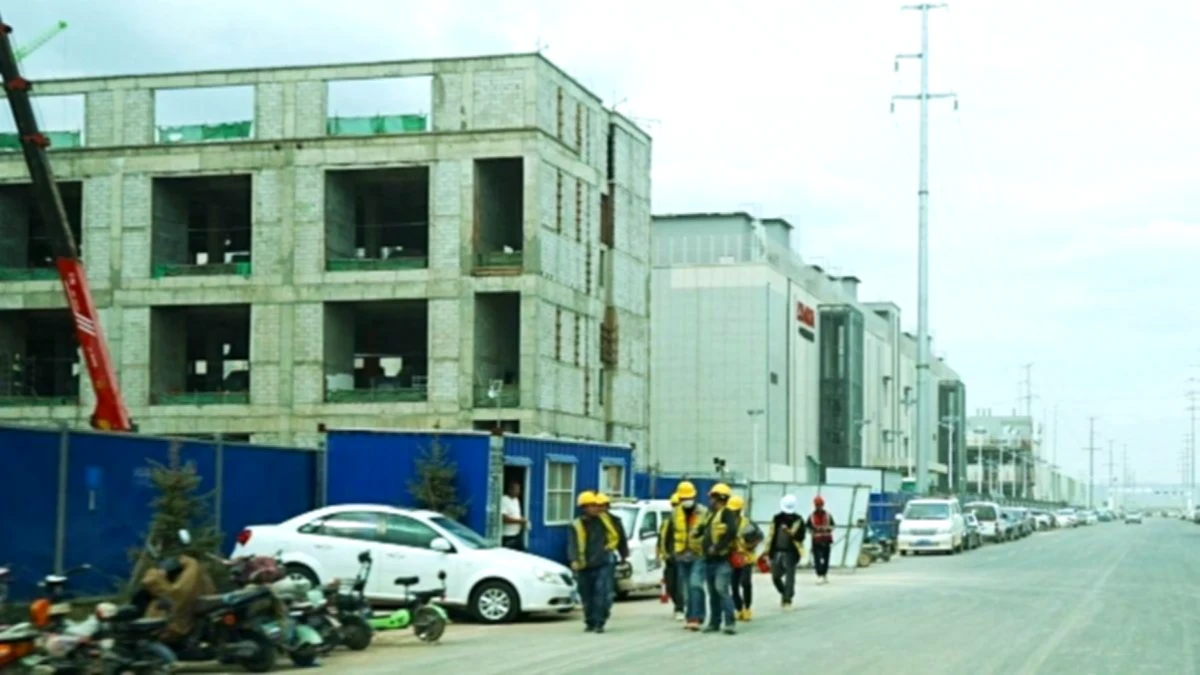

Farmers grow dark potatoes alongside new neighbors in the vast prairies of Inner Mongolia, large rectangle blocks that will supply China's artificial intelligence platforms.
With its plains and volcanoes, Ulaqab has an unexpected electric border. It has been the Pope's standard home for many years in China. However, as a result of Donald Trump and his Taiwanese counterpart, Xi Jinping, meeting only a few days ago, they have also started to build up their fields, which includes the safety of artificial intelligence.
Heavy equipment is being transported through the works by hundreds of golden device workers, and metal stairs emit sparkle welding sparks. Large cranes exactly move to create roofs above them, while other employees are kept in balance on stairs to lower the tomb.
A worker quips," This is the rate of China. "
He describes his nation as" an equipment maniac," and laughs as he leaves.
There is one step every year. The second is this. There will be many more aspects in the future, an electrical expert says.
The key to the conflict between China and the United States lies in the power of the region's data processing centers, where AI is at the center.
These properties are essential to the country's economic and safety, according to the Communist Party of China. When finished, they will contribute to their goal of integrating AI into 90 % of all business and society by 2030.
China is developing both infrastructure and a talent pool, with some of its citizens today seeing their nation as a place of possibility because of conflicts with the US. And Trump's immigration regulations have stifled his American vision.
According to Jack Zhang of the Chinese University of Science and Technology, "fewer and fewer students and researchers travel to the United States, and more and gain from the United States to China. "
After attending Yale, USA, and Cambridge, UK, he was himself recruited for a high-level system.
I wanted to apply to the lab job I was doing on artificial intelligence to include animal health and medicine. That requires more resources, more staff, and, occasionally, more political support, which is something that can be challenging to access abroad, he said.
One of the reasons why the United States has been is that China's growing ability to develop synthetic intelligence, in spite of the industry's own clear warnings that the technology is developing very quickly, is that he says he doesn't want to slow his progress.
President Trump said last month," Whoever wins in the field of Artificial win. "
Dario Amodei, the CEO of AI company Anthropic, praised slowing down and ending the U. S. -led ban on selling advanced chips and products to China while arguing that a Chinese management "would cause a significant danger to the U. S. and the world. "
During his three-day condition visit to Washington, Xi probably did not want to hear about this.
The state news Global Times dismissed U. S. concerns as part of a Cold War-specific plan to" contain" China's rise, which shares Beijing's position.
China is not just trying to get to America.
Additionally, they are searching for a different type of car. Xi himself is urging Chinese AI companies to create more reasonably priced open-source types that people and nations can adapt to their liking.
Additionally, it opposes Chinese types to US models, which designers like OpenAI and Anthropic use closed-model approaches and keep their style details a secret.
Beijing is supportive of this strategy because it has produced good results, one of the reasons for that. Chinese AI businesses have been ready to develop fast by sharing the technologies.
China has now been able to overcome one of its biggest obstacles: the lack of sophisticated cards, which would enable the development of greater computer processing capabilities.
Beijing wants to have more influence on the development of the AI criteria, though. Xi has consistently urged more regulation and a global platform for all parties.
The White House mountain was of particular significance in light of the growing need for AI safety. You both parties work together to regulate AI?
It doesn't seem like there will be a decline in areas like Ulanqab, where China's ambitions in this area are developing.
In sparsely populated regions like Ulanqab, Ningxia, and Gansu in the northeast, and Guizhou in the west, China is building lots of data centres for Huawei, ByteDance, and DeepSeek.
There is already a sizable capacity for solar energy ( wind and solar ), and the weather is cooler and the ground is cheaper, so there is less need for water.
By 2030, China wants the majority of its data centers to be fueled by clean energy, but only a small portion of its power grid is also powered by coal.
In the dry and arid regions of Inner Mongolia, water source continues to be a concern.
Although it's difficult to say exactly how many people have been relocated or what kind of payment has been offered to the people, many have been relocated. It's a subject that very few people address because it can be dangerous to express fears boldly.
A neighbor, who speaks unidentified and away from the camera, claims that" these ( locations of ) macrodata have absolutely nothing to do with ordinary people.
What advantages have they offered us? She releases while ensuring that some residents have found employment in the centers.
People, for their part, expressed concern for their property being taken away from them and unable to make a living cultivating them.
One of them was a man who was next to some corn growers in a field close to the data centers and who only identified himself by his title, Zhang.
He continued," China is now at the vanguard of the world," noting that his children were able to work in the features.
It's not like it was in the 1960s, when things were a little back. China is currently prospering. It's progressing, he continued, both in terms of economic development and in other places.
In contrast to many other nations, studies show that there is little resistance to AI or its common implementation.
Beijing has made it very clear that it views AI as a potential retirement system and is quickly automated manufacturing and production. This raises questions about the potential for job losses, a trend that is challenging to calculate.
However, this is also a nation that produces about five million science and technology alumni annually, compared to about fifty in the United States.
And as more people stay in China, they observe an extremely modern habitat.
A 27-year-old artificial intelligence programmer for a big technology company, Dang Ronghao, claims that his Shanghai base's increased communication with researchers from all over the world is a sign that Chinese schools are becoming more inclusive.
I've seen research that combines AI with nuclear fusion, AI with science, AI with new supplies, and AI with the creation of new medicines. I believe we are in a positive era, he said.
Some also contend that China continues to favor conformity over dissention.
Professor Liu Jun, a doctor in the Tsinghua University Department of Statistics and Data Science, who has taught at both Harvard and Stanford, says," It's not as open as I would like. "
I frequently counsel students to ask more issues and to question more, but that's difficult to change.
Some Chinese also face more pressing economic issues, far beyond Professor Liu and some ' work at the forefront of AI: a stagnant economy, rising youth unemployment, low investing, and a sharp decline in housing prices.
The ageing population is also becoming more of a problem in remote areas.
A farmer from Inner Mongolia moves in a vehicle to test his sheep, and he says," The macrodata and all that are good, but they have nothing to do with me. "
The guy claims that he hardly uses the internet and doesn't utilize AI at all.
Your phone's display is broken, and a compact USB modem that costs over 40 Renminbi per month provides the wireless connection.
I don't know what the future will look like, he says," There has really been no shift for me. "
This type of skepticism may present a challenge for Beijing.
Some changes are occurring in this and other parts of the country, but how many people are as invested in this technology-driven potential as their leaders are?
We interpret this article using an artificial knowledge tool, which was actually written in English. Before publishing the words, a BBC writer reviewed it. Find out more about how we make use of it.