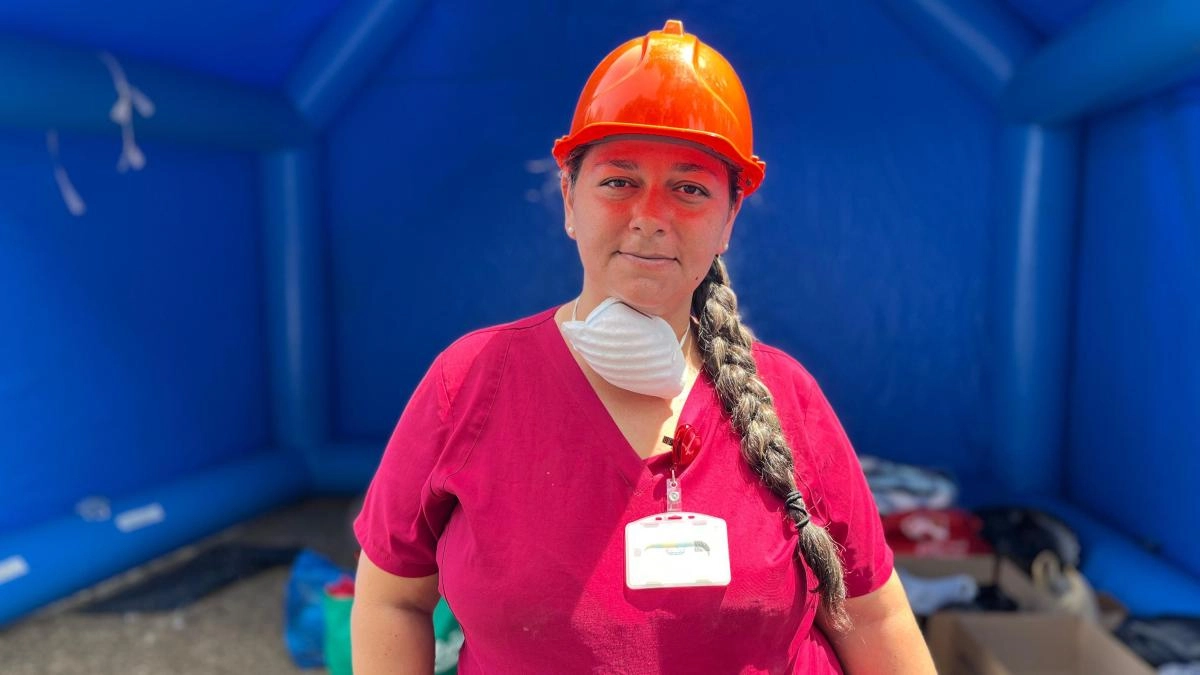

Kelly Díaz believes that her body continues to function because it is in a state of alert, because it is convinced that life has to win.
He responds this way when asked how he finds the strength to look for survivors next to a collapsed building after his daughter's best friend died in his arms.
The tragedy occurred at the Nuevo Edén school in the south of Cali, the third most inhabited city in Colombia and one of the hardest hit by the earthquake.
The dome of the building collapsed.
The girl and a teacher were hit by the debris and died minutes later. Other children suffer serious injuries.
Díaz, a psychologist, is one of many volunteers mobilized around the city.
While authorities and rescue teams arrive at the affected points, Díaz highlights the importance of everyone's help.
Especially in schools like her daughter's, the only building impacted in some blocks that seem intact.
“It is in those places where neither the media nor rescue teams arrive, the smallest ones, the ones that really give dimension to all the pain we suffer,” says the psychologist.
Díaz remembers the tragedy and describes the struggle to find survivors.
“The scene was desolate”
On Monday morning I dropped my daughter off at school.
I was walking back to the house when a small earthquake was felt that in seconds became too strong. That intensity was not common.
I ran back to the institution, thinking only that my daughter could be very scared.
But when we arrived there were many people. The scene was desolate.
They had evacuated one of the school rooms to the outside, as a part of the dome had fallen. It is a small school, with about 14 children per 4-5 classrooms.
Among the rubble there were two people on the ground.
One of them was my 10-year-old daughter's best friend. The other was the teacher of her class.
I immediately went in, as I have first aid training.
I checked my daughter first. Then to other students. I took vital signs.
Then I went to the ground to assist the other girl. There was a pool of blood. He had brain injuries.
She and the teacher showed vital signs, but no help was coming.
Then we didn't know that the catastrophe existed throughout the city.
The tragedy in Cali
According to the mayor of Cali, Alejandro Éder, as of this Wednesday, 74 people had died and 150 were missing in the city.
It is a reduction from the death estimate from just a few hours ago, which placed the figure at 95 deaths.
With also more than 50 collapsed structures and many others evacuated due to the risk of collapse, the capital of Valle del Cauca is one of the areas hardest hit by the earthquake, which has left at least 265 dead throughout the country.
They work non-stop to find survivors.
At night and in the early hours of the day, when it is quieter, rescuers and volunteers make efforts to listen for vital signs among the rubble.
There is expectation and dozens of people next to a destroyed building a few meters from the bullring.
From beneath the rubble come vital signs of Martín, a child trapped with his mother and grandmother.
After the trauma of the first day, Kelly Díaz is part of the workers in the area.
She clings to Martín's rescue alive to expunge some of the pain that has accompanied her since Monday.
“An invisible case”
The ambulances did not arrive.
The only thing that was done was wait for the parents to pick up their beaten children while others treated the injured.
The school board was shocked.
It was us, volunteers, who lifted the bodies.
The seriously ill girl had slight movement and reactions, but it is difficult to determine if she was conscious. In the last minutes there were reflex movements.
He died in my arms. Then we received his mother.
If we had waited for ambulances, we would have been there until dawn.
We were not a priority because it was a small community. It is news that does not appear in the media, that no one distinguishes because it was the only place in several blocks that was not affected.
But other children were injured. One had a scratch on his kidney. Another had a vertebra collapsed.
So far no more deaths are known. We hope the rest of the children are well.
The importance of volunteers
Like Díaz, dozens, if not hundreds, of volunteers work piecework throughout Cali.
They dig with their hands, evacuate debris, distribute food and water, and organize collection centers.
“It is the people who save the people,” says Díaz.
"Here where we are, we volunteers do it a lot. The medical part, the distribution of supplies, the collection center, the distribution of helmets and resources. It is what we can do where the most help arrives," says the psychologist.
Mexican rescuers had already arrived in the area I visited on Wednesday morning, experts in sneaking through cracks to look for people. They call them the Topos of Mexico.
But what arrived were volunteers like Juan A. Carabalí who risked their lives looking for survivors.
He arrived on Tuesday at 11:00 am from the municipality of Suárez, in Cauca, about 70 kilometers from Cali.
"We haven't slept all night. The work has been interrupted by the risks we run, but we are getting closer to possible survivors," says Carabalí.
"We don't stop because we only think about the pain of the families. That's what keeps us alive and functioning," adds Díaz.
As he speaks, heavy machinery removes debris and shattered columns.
Volunteers and rescuers come together. They applaud. They renew their strength to rescue people like the boy Martín.
They are convinced that life has to win.