Sunrise:
Sunset:
°C
Follow Us

Why Greenland is much smaller than many people think

Although on most world maps Greenland appears similar in size to Africa, the reality is very different
Why Greenland is much smaller than many people think
Time to Read 4 Min

President Donald Trump has had his sights set on Greenland for years.

“I love maps.

Since returning to the White House a year ago, Trump has continued to insist that he wants to take control of Greenland, which has been part of Denmark since the 19th century.

The president has clashed with European leaders who oppose his plan, threatening them a few days ago with tariffs. This week he claimed to have reached a “framework for a future agreement” with NATO regarding the island, although he did not provide details.

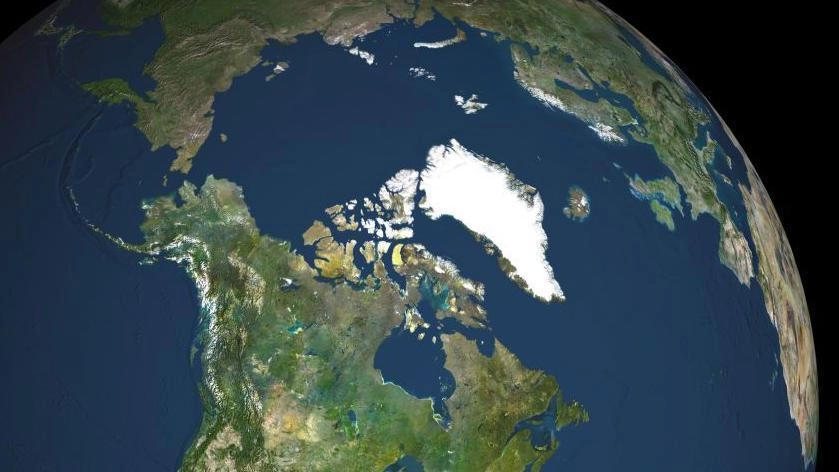
Greenland is not a small island. In fact, with an area of ????2.1 million square kilometers, it is the largest island in the world.

But its size is often misinterpreted when looking at conventional maps, where it appears with an area comparable to that of Africa, when that continent is about 14 times larger.

And there is an explanation for this.

The Mercator projection

For centuries, the most widely used maps in the world have been based on the so-called Mercator projection.

It was created in the 16th century by the Flemish cartographer Gerardus Mercator. His projection shows territories closer to the poles, such as North America and Europe, as larger than those located near the equator, such as Africa and South America. Mercator used this method to solve the problem of representing a three-dimensional, spherical (or oval, as Earth actually is) planet on a flat, two-dimensional surface. The mathematical problem this poses means that all planes of the Earth's surface are necessarily distorted. Depending on the technique used to create them, the size, shape, and location of the continents change.

Cartographers have been aware of this problem for centuries and solved it according to the intended use of the map.

Mercator created his famous projection, which became popular worldwide, with a specific need in mind: navigation.

And he ensured that, using his world map, a navigator could know which direction to head with a compass to get from one point to another.

The problem with the Mercator projection is that it distorts the size of countries as they move away from the Equator.

The Mercator distortion occurs because it is a cylindrical projection, which presents meridians as equidistant parallel lines.

Meridians are actually lines that meet at the poles; That is, the distance between them decreases as they move away from the Equator.

This is the distortion that characterizes the Mercator projection in the size of Greenland and Africa, since the continent has almost 30 million square kilometers, that is, an area 14 times larger than that of the island.

Brazil, for example, is five times larger than Alaska, although on maps based on the Mercator projection they have similar dimensions.

More accurate projections

World maps that follow the Mercator projection are the ones that have most shaped our mental image of the planet for centuries.

They have been the most used in schools, which has led many generations to have an inaccurate understanding of the proportions of the regions on the different continents.

In recent years, some organizations and have carried out campaigns for the use of maps that are closer to the real proportions of the territories.

For example, in the US city of Boston, in 2017 school authorities decided to stop using Mercator world maps and opted for those with the Gall-Peters projection (1971) to correct the “Eurocentric” view of the world's perspective.

On the other hand, the African Union, the organization that brings together all African states, launched the Correct The Map campaign in 2025, which seeks to prevent governments, organizations, schools, and companies from representing the African continent on their maps as smaller than it actually is.

Activists in favor of change have said that the most common world maps reflect the power perspective of northwestern countries. The executive director of Africa No Filter, one of the organizations behind the campaign, describes the Mercator projection as “the biggest disinformation campaign.”

The alternative proposed from Africa is the Equal Earth projection.

Created in 2018, this projection more accurately reflects the size of the continents by correcting for curvature, parallels, and meridians through a system of equations. This projection is based on the Robinson projection, created in the early 1960s, but with some adjustments based on more precise calculations. Ultimately, any projection can preserve size or shape, but not both simultaneously everywhere. However, the Equal Earth, Robinson,and Gall-Peters projections are some of those that have achieved a better balance. 

This news has been tken from authentic news syndicates and agencies and only the wordings has been changed keeping the menaing intact. We have not done personal research yet and do not guarantee the complete genuinity and request you to verify from other sources too.

Also Read This:


Share This:


About | Terms of use | Privacy Policy | Cookie Policy