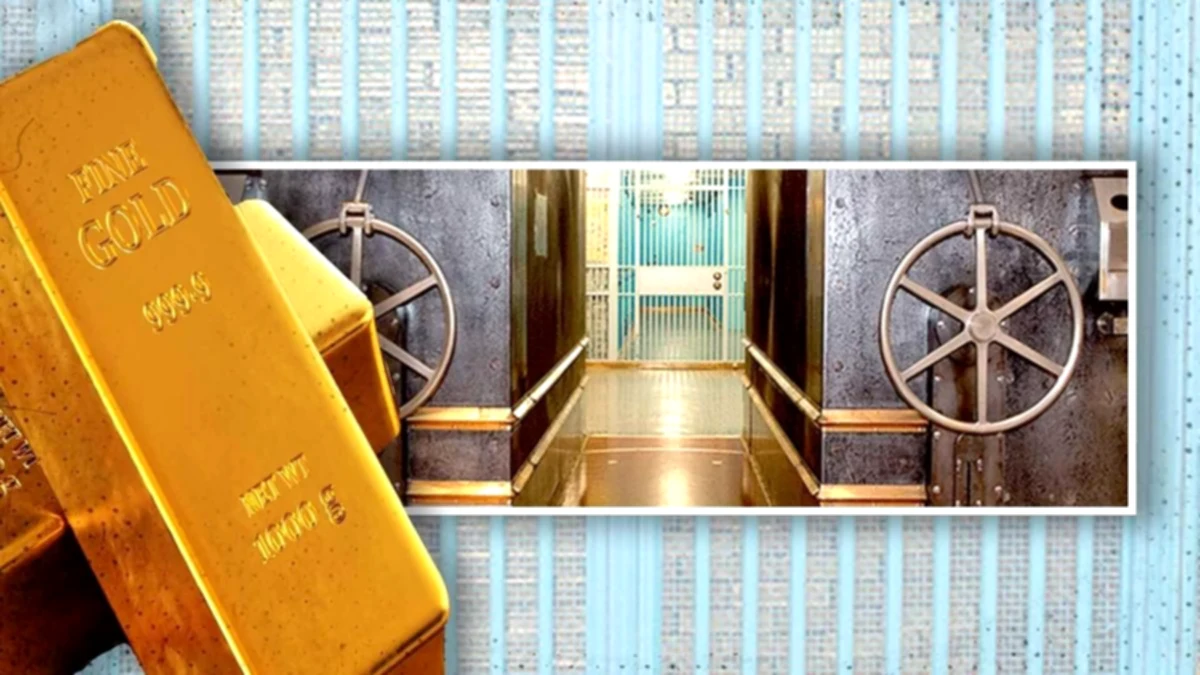

The U. S. Federal Reserve maintains more than 50 million gold coins in the cellar of its headquarters in New York's Liberty Street, which is 25 meters underground. Northern banks, governments, and other institutions around the world have owned them.
A 90-ton steel cylinder holds this equipped chamber open, but the giant lock won't open until the following day.
It is the world's largest known silver station, the Fed's Golden Bowl, and contains some 6, 300 lots of lingot piles whose current value exceeds a trillion dollars, or 4 % of the U. S. Gross Domestic Product.
The Bóveda plays a critical role for the stability of the global financial system, as many countries keep their gold reserves here, the active refuge by excellence with which to support their currencies and deal with other contingencies in crisis scenarios.
The precious metal makes up a sizable portion of the resources of central banks around the world, especially those in Europe, because it was and is still considered a healthy significance in times of financial turbulence, political uncertainty, and the loss of capital value as a result of inflation.
According to Barry Eichengreen, an professional on the global financial system at the University of Berkeley in the United States," It's one of their most important assets because it allows them to behave as last hotel lenders for banks and companies and engage in trade markets. "
The United States and its Federal Reserve have been viewed as the most trustworthy owners of such a significant advantage for decades, mainly by some European nations that were in danger of losing their balance to the influence of the Soviet Union and were accumulating significant amounts of silver reserves.
However, in some European nations the debate has erupted over whether to return the platinum they keep in that country since Donald Trump's return to power.
According to "increasing political instability," the French central bank announced this week that it had moved billions of dollars worth of gold from North America to London.
President Trump’s disengagement of international commitments and his differences with U.S. European allies on issues such as tariffs, Danish sovereignty over Greenland or, more recently, the war against Iran, have sowed concerns about the security of the European gold held by the Fed.
Several European countries still keep their own silver deposits abroad, many of them in the New York Gold Bowl, in contrast to Russia, whose central bank keeps its resources in its own country to shield it from potential effects of Western sanctions.
From the 1950s, German metal started to eke out there.
According to Eichengreen," Germany and other European nations whose economies were recovering were exceedingly exporting to the United States and receiving payments in the form of both metal and money. "
“It costs money to put the gold on a boat or a plane and hire insurance to protect the shipment, so it seemed like a good idea to store it on the Federal Reserve booth, which also doesn’t charge for custody,” Eichengreen said.
The Bretton Woods system, which established a fixed exchange rate for the dollar anchored in gold in 1944, made gold and dollars the most trustworthy assets, and it was useful to the lessening postwar European powers that had the option of storing them without cost in the Federal Reserve of the United States.
The American was the best promise when the Russian threat was present on the other side of the Steel Curtain.
However, Trump's return to the White House has altered the decades-old relationship between Washington and its Western allies because the USSR no longer exists.
Germany has been one of the loudest warnings in the world, having held the second-largest known gold reserves in the world behind the United States, and consequently one of the nations with the highest potential hazards.
According to German media estimates, the German central bank holds about 1,200 tons of gold in New York, which would have a value of about$ 200 billion. Economist Emanuel Mönch, who was the Bundesbank's principal investigator, requested in January of this year for the repatriation of that asset.
It seems difficult to maintain so much gold in the United States, according to Mönch, who believes it would lead to a "greater proper independence" of his nation.
Trump is uncertain and capable of doing anything to make money, according to Michael Jäger, chairman of the German Taxpayer Association. Our metal is no longer protected on the Fed's deck because of this.
What may happen if there was more offense in Greenland? The Bundesbank if repatriate its reserves because it increases the likelihood that it won't be able to access its gold, according to Jäger.
A problem that has also been raised by members of the CDU, the group of Chancellor Friedrich Merz, and different political parties.
Joachim Nagel, chairman of Bundesbank, has made an effort to ease the concerns.
At a meeting of the International Monetary Fund in Washington in October, Nagel said," There is no reason to worry. "
In a press conference in February, he was forced to repeat the phrase," I have total faith in our acquaintances in the U. S. key bank. "
However, neither the Federal Reserve nor the Trump administration have reaffirmed that respect on the other side of the Atlantic.
" I haven't heard any soothing thoughts, and I think it would be appropriate," said scientist Eichengreen.
The Federal Reserve was contacted by BBC World, but it did not respond.
Before Kevin Warsh was elected president in May, the organization experienced weeks of unrest.
Trump's former partner, Jerome Powell, was repeatedly attacked for refusing to lower interest rates, and the Justice Department launched a legal case against him.
Powell claimed that all of this was a result of the executive's" threats and pressures" to make the Fed's democracy and demand that it "follow the government's preferences"
Not just one of the other European nations with silver in New York, is Germany.
Italy and Switzerland frequently come up in the list of nations that keep the most money it.
And some people have now resisted resettlement in the past.
The Netherlands started doing this in 2014, and the Fed will deposit 51 % of its reserves there, a figure that will be lower once its central bank's announcement to move to London was made.
Germany even repatriated a portion of its set, but the majority of them stayed in the Golden Bowl.
The Greek debt and the euro crisis were at a time when Germans wanted to make sure that their money and bank payments were secured by something tangible, according to Eichengreen.
According to several artists, President Charles de Gaulle had made the decision to return to France from the Fed many times before, in the 1960s, out of fear of a sudden devaluation of the dollar, whose value had been anchored to that of gold at Bretton Woods.
He now has the appropriate to do so.
U. S. President Richard Nixon dynamized the global monetary system to put an end to World War II by putting an end to the conversion of the dollar to gold in 1971.
France, which had repatriated resources, performed better than nations that saw their set ' New York-equipped lingots lose a lot of their dollar value overnight.
Less golden is now housed in the Golden Bowl than there was in the past.
The amount of foreign gold reserves deposited in the New York Valley has decreased significantly since 1973, when it reached more than 12, 000 tons of metal, according to Federal Reserve information.
However, there are still proponents of the idea of keeping German metal it.
Repatriating the golden "would simply add fuel to the fireplace of the current situation," according to Clemens Fuest of the IFO Institute for German Economic Research, according to The Guardian.
Some experts point out the costs and logistical and security issues that may arise from the shipment of quite valuable cargo and point out that the Federal Reserve's separation from the Trump administration prevents it from taking punitive measures against gold.
However, doubts about the dependability of the U. S. Federal Reserve as the country's official metal producer threaten to sever a decadent relationship between the earth and itself.
According to Eichengreen, “while its withdrawal would not have significant financial repercussions for the United States, the custody of gold is a global good that the United States has provided for free – just like NATO’s security umbrella or the dollar as a global currency – in exchange for making friends and business partners.”
This government does not believe that the United States may provide services for free, and anything that makes the allies ' concerns about the security of their deposits in the United States worsens that belief, which is essential when you need their assistance for, say, a Middle East conflict.
If other Western nations will approach the Netherlands and accept the golden the United States keeps for them, time will tell.
There are times when the bases that seemed unremovable begin to crumble, according to Christine Lagarde, President of the ECB, in a statement last month.
Caroline Souza of the BBC News World Visual Journalism Team created the photo.
*The shift of gold from the Netherlands to London was announced on March 27, 2026, and this note was updated and republished on September 3, 2018.
Click here to view more BBC News World reports.
Follow us on Facebook, Instagram, TikTok, Instagram, and our new WhatsApp network, where you can find the most recent news and the best content.
Keep in mind that our application allows you to receive messages. Download and install the most recent version.