

Back to school in Boyle Heights with emotions, changes… and flies
Parents and children walk among flies to the first day of school as LAUSD faces a multimillion-dollar shortfall due to overstaffing
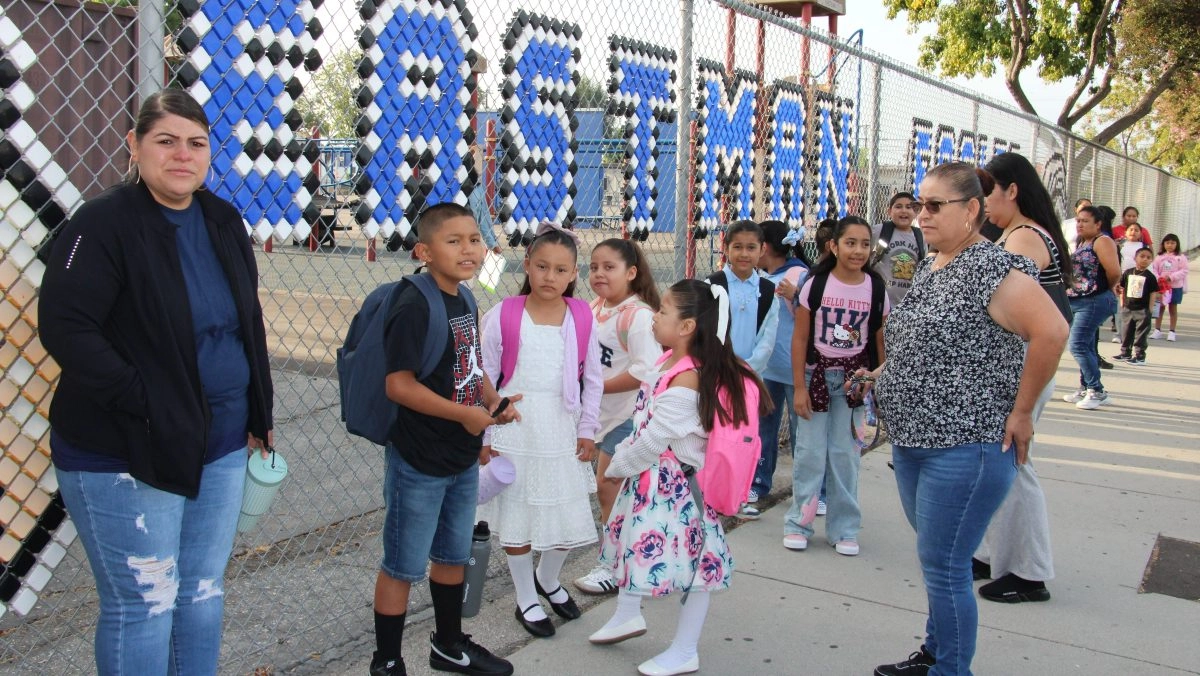

Contrary to what the company Lineage Logistics has been stating, environmental cleanup in Boyle Heights is not good, because hundreds of children who returned to kindergarten and Eastman Elementary this Wednesday had to walk through the filth of flies and rotten food in the streets.
“We are living in a difficult situation,” declared Jorge Andrade, father of little George, five years old, during his journey to school. Andrade, who has lived in Boyle Heights for two decades, took video and photographs that he would show to the school's teaching staff so that they could take measures in case the children went out to the school's recreation areas.
Similarly, Edith Flores, originally from Puebla, Mexico, and mother of six-year-old Jayden Flores, said: “I am worried about the bite of flies; they can cause severe allergic reactions on my child's skin.”
The concentration of flies was evident at the intersection of Union Pacific Avenue and Eastman Street, where rotting chicken meat and rotting onions were the bugs' food. Nearby are the ruins of the Lineage frozen food warehouse, whose fire led to a public health crisis whose effects are still being felt in the community of this purely Hispanic neighborhood.
Cleaning in 54 schools and decrease in enrollment
According to a letter released by the Los Angeles Unified School District (LAUSD), protocols have been implemented to ensure the safety of students and staff in the aftermath of the devastating June fire at the Lineage Logistics warehouse.
The five-page letter, addressed to United Teachers Los Angeles (UTLA), responds to a two-page letter sent Thursday by the president of the union representing the district's teachers, in which 14 requests are made to ensure safety.
In its response, LAUSD provided details about its assessment measures and noted that its strategy was developed by a team of scientists and environmental experts.
"The plan was reviewed with university partners, private sector environmental consultants, and public health officials. Once the results are available, the data will be shared with these experts for review and will also be published. The district will implement additional measures if necessary," the response states, adding that the expanded cleanup efforts focused on 54 schools located within three miles of the Boyle Heights warehouse.
In schools that received a deep clean, air purifiers were installed in all classrooms and filters in all air conditioning systems were replaced.
LAUSD Director of Environmental Health and Safety Carlos Torres stated that his office has led inspections and testing at all campuses and has found no evidence of hazardous conditions that could pose a risk to students or staff.
The Los Angeles Unified School District, the second largest school district in the country behind New York, serves more than 370,000 students from seven different cities in the county, a figure that represents approximately half of the enrollment recorded in 2018.
For this 2026-2027 school year, LAUSD enrollment decreased by approximately 4.5%, which is almost 17,000 fewer students.
Restrictions on digital devices in schools
Between joy and nervousness about returning to the classrooms, Los Angeles students began the 2026-2027 school year knowing that the district will implement restrictions on the use of digital devices during the school day.
Under a policy adopted by the Board of Education in June, the use of digital devices will be eliminated for students in early education, transitional kindergarten, kindergarten and first grade, with limited exceptions.
These restrictions are part of a broader district policy aimed at reducing the time students spend in front of screens at all educational levels.
“During the COVID pandemic, student devices became a necessary lifeline and, virtually overnight, screen time limits were lifted to ensure every child had access to the technology they needed to continue learning and stay connected with their teachers and peers,” stated board member Nick Melvoin.
“Our task now is to readjust the focus, evaluate the role of educational technology in the classroom, and balance access to that technology with the types of teaching and interaction that we know help students thrive.”
Melvoin drafted the resolution to ban cell phone use and reduce screen time during the school day so students could focus on learning. There will be exceptions for district- and state-mandated assessments for students enrolled in the LAUSD Virtual Academy and for those with special needs who require devices related to an Individualized Education Program (IEP) or a 504 Plan.
Likewise, the district will block student access to YouTube, social media, and video streaming platforms unless a teacher authorizes such access.
"My daughter doesn't use social media much; she dedicates herself mostly to her studies," Leticia Mirna, mother of Montserrat, a girl who will be in ninth grade at Francisco Bravo Medical Magnet High School, told La Opinión.
Likewise, it was reported that students will no longer automatically receive digital devices to take home, although families will be able to request them.
The policy encourages teachers to assign assignments that involve reading, writing, problem solving, hands-on activities, and other tasks that can be completed without using a digital device.
LAUSD: multi-million dollar deficit and layoffs
Michael Fine, executive director of the California Fiscal Crisis and Management Assistance Team (FCMAT) for LAUSD, has determined that the school district is overstaffed and faces a serious $3.6 billion structural budget crisis stemming from multimillion-dollar labor commitments and declining enrollment.
In a critique of LAUSD, Fine noted that the school district made approximately $1.2 billion in financial commitments from labor agreements while projecting structural deficits, resulting in infrastructure designed for far more students than it currently serves.
“They are significantly overstaffed,” Fine said. "Our argument is that they should have started a few years ago. Thus, the natural reduction of the workforce (due to retirements or resignations) would have solved the problem on its own. They should not go out and replace someone every time they leave; they should analyze it well before acting."
In February, the LAUSD School Board authorized the layoff of 3,200 non-teaching employees, including administrators and central office staff, although only 657 of them were ultimately let go.
However, having delayed drastic cuts, LAUSD now faces an even greater workforce reduction. Its solvency plan contemplates a total of 5,000 layoffs between 2027 and 2029, in addition to days of suspension of employment and salary, and modifications to health benefit options for employees.
These measures will have to be negotiated with the powerful unions.
The overstaffing issue arose in 2021, during the Covid-19 pandemic, when LAUSD used one-time pandemic relief funds to hire 6,000 new employees. Those funds expired in 2024, but people continued working for the district.
Official School District Report: Safe Schools
The Los Angeles Unified School District Office of Environmental Health and Safety (OEHS) prepared an Environmental Assessment Report to summarize air, dust, and soil sampling conducted at schools potentially affected by the June 2026 Lineage, Inc. industrial fire (Lineage Fire) in the neighborhoods of Boyle Heights and East Los Angeles, California.
Based on the results of this environmental assessment, OEHS concluded that the schools assessed remain safe for occupancy and that the Lineage Fire did not cause widespread residual contamination or create conditions on LAUSD campuses that posed a risk to the health of students or staff.
OEHS recommendations include maintaining routine cleaning and maintenance of heating, ventilation and air conditioning (HVAC) system filters, using portable air purifiers with HEPA and activated carbon filters as needed, and limiting outdoor activities if noticeable odors persist.
In schools where elevated concentrations of lead were detected in the soil, access to the affected areas will be restricted until additional evaluation is completed and appropriate measures are determined.
This news has been tken from authentic news syndicates and agencies and only the wordings has been changed keeping the menaing intact. We have not done personal research yet and do not guarantee the complete genuinity and request you to verify from other sources too.