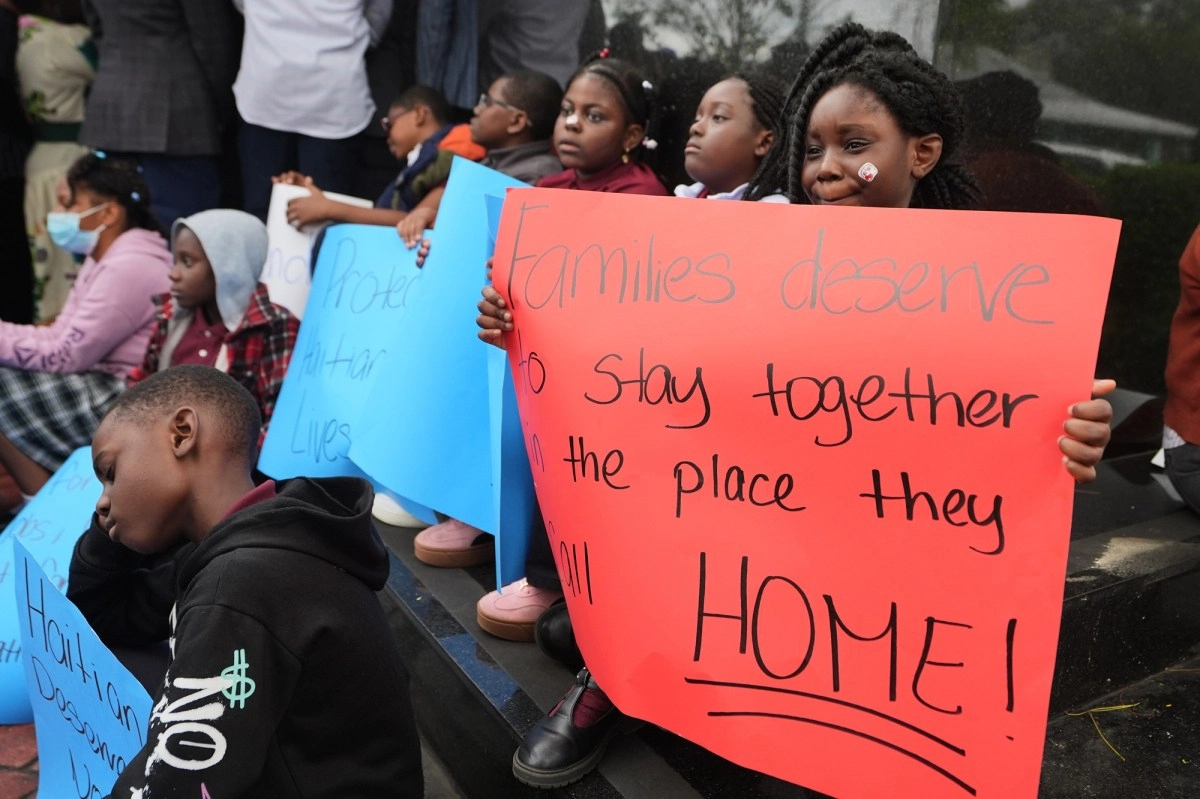

Although the Supreme Court's decision to open the door to the end of Temporary Protected Status (TPS) was for cases from Haiti and Syria, its determination puts 1.3 million immigrants from other countries that have such protection at risk, organizations that defend immigrants revealed.
For now, the TPS that can be canceled in 32 days are those of Haiti and Syria, whose protected people will be left without the corresponding 'parole' or "forgiveness of deportation" and will lose the Employment Authorization Document (EAD).
In comments to reporters at the White House, Stephen Miller, Donald Trump's deputy chief of staff and immigration policy adviser, said people who no longer have TPS could be deported to their country.
“If they no longer have legal status in this country, then they should be deported,” he said briefly.
The decision was on the consolidated cases Mullin v. Dahlia Doe and Trump v. Miot, so in 32 days they could be detained and deported, indicated the American Civil Liberties Union (ACLU).
In the case of Haitians, there are more than 340,000 people with TPS, although the impact per family is greater; while some 6,000 Syrians would be impacted by the decision endorsed by the six conservative judges of the Supreme Court.
The 'Welcome with Dignity' campaign, which integrates several civil rights and immigrant defense organizations, described as devastating the decision on the Mullin v. Al Otro Lado case, which claimed that the Department of Homeland Security (DHS) did not present valid – and supported – arguments regarding the termination of TPS.
"The administration is attacking TPS recipients for the same reason it has attacked other humanitarian protections. Stripping people of their legal status makes it easier to implement Trump's unjust and cruel deportation campaign," said Robyn Barnard, vice president of Refugee and Immigrant Rights at Human Rights First and co-director of the Welcome With Dignity campaign.
The coalition also addressed the decision that limits the request for asylum at the border, preventing a person who reaches the border between Mexico and the United States from requesting asylum, because they have not “arrived” on US territory.
“Today's decisions will have devastating human consequences for families seeking safety, for long-standing members of our community, and for our country for years to come,” Barnard added.
And why 1.3 million people affected?
TPS protection – created by Congress in 1990 – applies to several countries, including El Salvador, Ukraine, Honduras, Afghanistan, Burma, Ethiopia and Sudan. In the case of Venezuela, the program ended in 2025, although the work permit was extended until October 2026.
José Palma, coordinator of the National TPS Alliance, warned why the Supreme Court's decision impacts 1.3 million people.
"This is not the end. As immigrants, we all know that things have never been easy, nor are they. We will continue fighting for a better future for the 1.3 million people who deserve to keep their families together and continue living in the United States," he said.
Ahilan Arulanantham, professor and co-director of the Miñana Family Immigration Law and Policy Center at UCLA School of Law, said that in recent years, the Supreme Court has ruled against the rights of immigrant communities in important cases.
“The decision gives the administration, and the far right of the anti-immigrant movement, an important victory that they have not been able to obtain through Congress for years,” said the expert. "Members of this administration have wanted to eliminate TPS protections through legislation. This victory allows them to achieve virtually the same result without having to go through Congress."
And the racist expressions?
Writing for the majority, Justice Samuel Alito wrote the TPS decision, saying its rules prohibit judicial review by DHS, then led by Kristi Noem. The Court also ruled that Haitian TPS recipients are likely to lose their lawsuit, in which they alleged that Noem ended Haiti's TPS, because the majority of the country's citizens are black. For Alito and the other judges there was no discriminatory expression.
"The Supreme Court's decision also determines that it is not even 'likely' that President [Donald Trump] and Secretary Noem's statements about Haitians were motivated by racial discrimination. This conclusion is deeply troubling not only for immigration cases, but for the state of racial justice in this country in general," Arulanantham added.
Justice Elena Kagan issued a dissenting opinion, joined by Justices Sonia Sotomayor and Ketanji Brown Jackson.