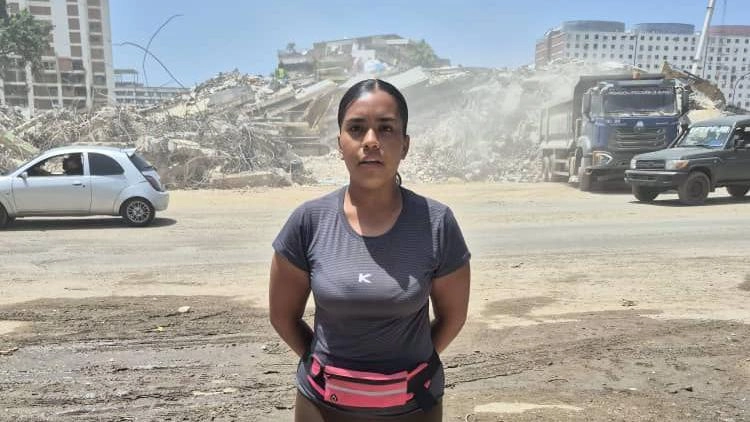

Lorena Laya moved to La Guaira to look for her father, her stepmother and her brothers, after the two earthquakes that shook Venezuela on June 24.
Moving is a way of explaining the routine he has adopted over the past three weeks: staying alert next to the tracked excavator that removes debris during the day and sleeping at his paternal grandfather's house at night.
Only when he needs clean clothes does he return to his home in Caracas.
“We are here from the moment the machine turns on until it turns off,” says the 24-year-old girl from a corner where her phone regains signal, far from the noise of the machines and under the shade of a tree that softens the impact of the Caribbean sun.
"When the machine is working I don't leave there. On two occasions it has happened that if we are not attentive it can take the bodies," says Lorena near a tent that some neighbors left after having found their relatives under the ruins.
This tent serves as a refuge when he no longer has the strength to watch the machines. There he shares, along with the relatives of other missing people, the hope that someone else will be rescued alive.
"If I survived it was to find them. I am giving everything to achieve it."
Survivors of another tragedy
27 years ago, in December 1999, his paternal family's house was left intact when an avalanche of mud, stones and trees rushed down the slopes of the mountain after several days of rain during the Vargas landslide, as the state of La Guaira was then called.
But the family home of his stepmother, Nohelia Iriarte, was not so lucky. She was buried under the mud in Carmen de Uria, one of the towns that disappeared in that tragedy.
The Vargas landslide caused the death of between 10,000 to 30,000 people, while 100,000 reportedly lost their homes.
The Iriartes lived in shelters for years, until the government of former President Hugo Chávez assigned them apartments from the Great Venezuela Housing Mission, a program for the construction of social interest buildings that was initially intended for the relocation of the victims of Vargas.
Nohelia Iriarte received an apartment in building 27 of the OPP housing complex, acronym for Presidential Office of Plans and Special Projects, the agency that built the buildings in the Caribbean sector in the Caraballeda parish, which was devastated by the earthquakes.
Nohelia Iriarte (45) lived on the 3rd floor of OPP 27 with her husband Henry Laya (55) and their children Diego (14) and Giannys (6).
Iriarte's sister, who was also affected in Carmen de Uria, lived on the 11th floor of the same building and survived the earthquakes.
The collapse of more than 100 buildings of the Housing Mission in La Guaira triggered criticism against the Venezuelan government and questions about the quality of the materials used in the construction of the residential complexes.
The hope of the drums
The last time Lorena spoke with her stepmother, she told her that they planned to go to the town of Naiguatá, about 13 kilometers from Caraballeda, to enjoy the drums of San Juan, a local festival celebrated every June 24 to venerate San Juan Bautista.
That day was Wednesday and a holiday. The Battle of Carabobo was also commemorated, the military victory that consolidated Venezuela's independence from the Spanish crown. At 18:05 local time, two earthquakes of magnitude 7.2 and 7.5 shook northern Venezuela.
“At first, I wasn't sure that they were at home because they had told me that they wanted to go to the Naiguatá drums,” says Lorena. “But when I got here and saw that the building had fallen, my heart felt small and my throat felt closed.”
“As if they were worthless”
As soon as she arrived in La Guaira, Lorena began a tour of hospitals and morgues to locate her relatives. “I was looking for them both alive and dead.”
On Saturday, June 27, three days after the earthquakes, he went to the José María Vargas Hospital in La Guaira to look for them among the bodies that were accumulating outdoors in the parking lot.
“I asked a soldier if I could go in to see if any family members were there,” Laya recalls. “With indifference he said yes, he gave me some gloves and told me to hurry up because in 20 minutes they were going to take them away.”
For the first time in her life, Lorena saw bodies piled up. He says most were barely covered with the sheets or towels that survivors or rescuers had used to pull them out of the rubble.
"For me it was shocking to see the pools of blood. They had them piled up there, as if they had no history or family, as if they were worthless."
After visiting other morgues, he became convinced that his relatives must be under the rubble, so he began digging through the ruins of OPP 27 with his own hands.
"Looking for them by myself was not what I imagined. It's very difficult, sometimes you find a foot or a piece like a vertebra."
“She will always be my Negrita”
As the days passed, the manual search became exhausted and Lorena began to worry about the lack of machinery to remove the heavier concrete slabs.
Three weeks after the earthquakes, videos are still circulating on social networks in which survivors and rescuers ask for excavators to advance the recovery of the bodies.
“The machines here belong to the State,” he says. “A police officer lived here and his sister, who is in the military, managed to have enough contacts to have the machines brought.”
Thanks to one of those excavators, Lorena recovered the remains of her younger sister and stepmother on Friday, July 10, 16 days after the earthquakes.
Judging by the furniture they found at the scene, they were in what was once the living room of their apartment.
"We found belongings that were always in that room. Despite the state they were in, their features were still recognizable," he says.
“My stepmother had a bag with her identification documents and my baby was lying on a mattress that we knew was hers,” she says, referring to her sister Giannys.
“I want to talk about my little sister in the present tense because she will always be my Negrita, even though she is no longer with us on this plane,” Lorena says until her voice breaks from crying.
“I'm not going to say that I feel happiness, but I do feel a little peace of knowing where they are, that we have them with us.”
Now Lorena wonders if the bodies of her brother Diego and her father Henry have already been recovered, but she was not able to recognize them.
“They come out very damaged, not only because of the number of days they have spent under the rubble, but also because of the injuries they suffered.”
“I'm afraid of not finding them.”
23 days after the earthquakes, the caterpillar excavator that was removing debris in OPP 27 is paralyzed.
Although the spare parts have already been ordered to repair it, Lorena Laya assures that the debris is so large that only heavy machinery can remove it.
The most recent official report indicates that 4,930 people died in the earthquakes in Venezuela, while 16,740 were injured and 17,907 lost their homes.
The United Nations estimates that there are 50,000 missing.