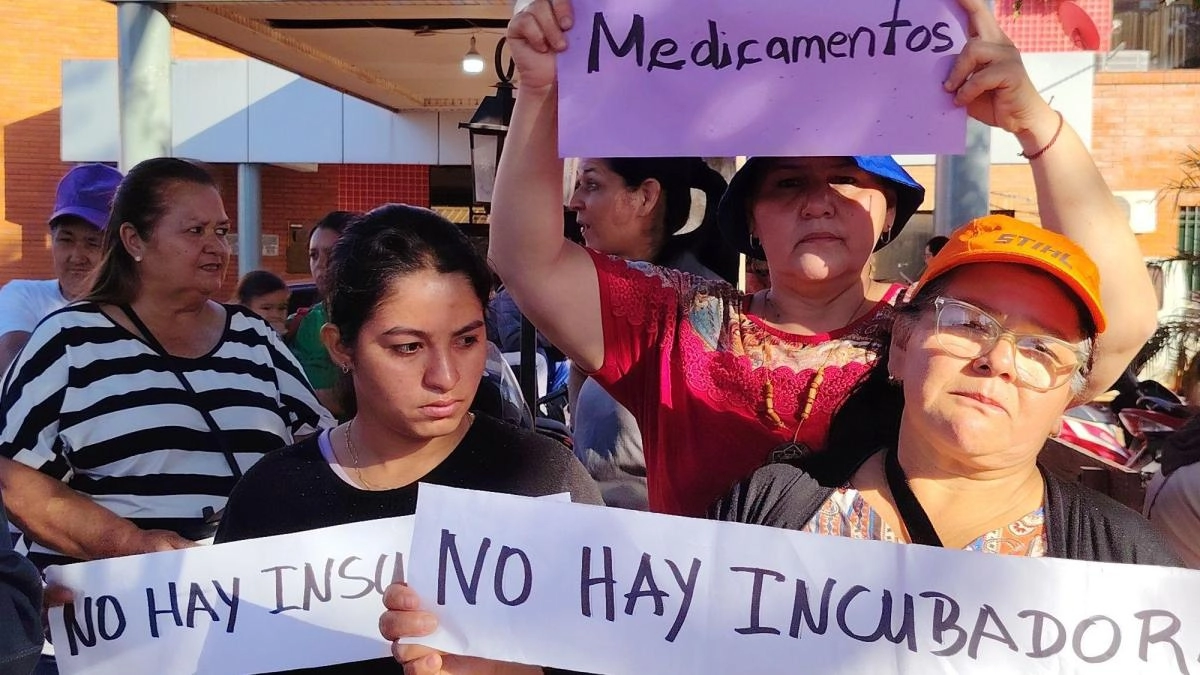

When her daughter María del Pilar was urgently hospitalized, Daniela Benítez had no choice but to walk the streets of Asunción in search of a respirator, a cannula and even the cotton that the medical staff needed to care for her.
The purchase of these supplies and some of the medical equipment exceeded US$800, an expense that the family had to cover on their own. Given the lack of resources, they organized a collection.
María del Pilar was taken to the ward of a public hospital in the Paraguayan capital bleeding from her nose and mouth. He had pneumonia caused by tuberculosis, a disease caused by a bacteria that usually affects the lungs.
“Health in Paraguay is getting worse,” says Daniela, a 62-year-old artisan, originally from the western region of the country, who now lives in Asunción.
The problems in caring for her daughter did not end there. Added to the shortage of supplies and equipment were delays in care and administrative deficiencies.
"Hospitals have few doctors and doctors do not have the necessary supplies to provide the necessary care. In addition, they are overwhelmed by the large number of work hours they face," says Daniela.
After spending a year in the hospital, María del Pilar died.
“He sold everything”
Daniela's story is one of many that reflect the crisis of the Paraguayan health system.
A problem that is not new in the country, but that once again gained international attention when the case of the Paraguay national team goalkeeper, Orlando Gill, became known during the last World Cup.
The soccer player's wife said on her social networks that her husband even had to sell his soccer jerseys to pay for the medical care his newborn son received after a premature birth.
"He sold everything. He sold his U-20 national team shirt, he couldn't keep it as a souvenir. He sold his clothes, his champions (boots). Literally: he sold everything," said Melissa Ávalos on Instagram.
According to Amnesty International, Paraguay is among the countries that spend the least of its public budget on health per capita.
Spending 4% of GDP on health is less than the minimum 6% recommended by the Pan American Health Organization (PAHO) to ensure universal coverage.
“Paraguay has one of the most unfair health systems in all of Latin America,” says Patricia Lima, member of the Latin American Association of Social Medicine (Alames), a civil organization that works for the right to health and is based in the South American country.
For Gustavo Ortiz, director of Service Development at the Ministry of Health, criticism of the public health system responds to the increase in demand for care, a problem that, he says, they are trying to solve.
However, he assures that these are “specific” episodes and not a structural problem of the system.
“We have specific problems, specific complaints, regarding the patient being given a prescription for a medication that has to be picked up at the (hospital) pharmacy and, sometimes, it is missing,” explains the official.
After the mobilizations of October 2025, doctors in Paraguay will demonstrate again on August 24 with a five-day national strike to demand more resources for public health.
The health system in Paraguay
Paraguay's health system has public, private and mixed institutions.
On the one hand, there is the Ministry of Public Health and Social Welfare, responsible for guaranteeing universal access to free healthcare. Its hospitals primarily serve people who do not have health insurance.
The magnitude of the challenge faced by the country's hospitals is enormous if we take into account that almost 70% of the population does not have health insurance and depends on the public system, according to official data from the National Institute of Statistics (INE).
On the other hand, there is the Social Security Institute (IPS), a public and autonomous body, in charge of administering Social Security and which is financed with the contributions of registered workers.
These beneficiaries receive care in the IPS' own clinics or, to a lesser extent, in private centers with agreements with the institute. In addition, there are other medical insurances such as military, judicial and police insurance.
Finally, there is the private sector, made up of insurance companies, hospitals and sanatoriums. People who have expensive private health insurance also have the right to be treated in the public system.
A fragmented system
“The Paraguayan health system is totally fragmented,” says Dr. Rossana González, from the Paraguayan Medical Union.
For González, the health system is often talked about, “but there is no system as such because they are not communicated, they do not work in coordination and on many occasions they double the budget.”
Far from Asunción, the system's shortcomings become even more evident. The percentage of Paraguayans without health insurance exceeds 82% in rural areas of the country, where the peasant and indigenous population lives.
Such is the case of Daniela, who belongs to the Nivaclé indigenous community, which is located in the Paraguayan Gran Chaco, about 600 kilometers from Asunción and near the border with Argentina.
Daniel Ortiz, from the Paraguayan Ministry of Health, assures that care outside the capital "has improved a lot compared to previous years, when it was quite centralized in the metropolitan area."
“We are working on the decentralization of medical care,” says the official.
However, Daniela Benítez is grateful for having been in Asunción and not in Chaco when her daughter was hospitalized.
“If I had been in Chaco, my daughter would not arrive at the hospital alive,” he says.
“Pending matter”
The president of Paraguay, Santiago Peña, recognized in his annual management report this year that public health continues to be the main challenge of his government, despite the investments in hospital construction that are underway.
"In health, I want to speak to you with the same frankness with which I always speak: it is our great pending matter. I am the first to say it," said Peña when presenting his report to Congress in early July.
“As long as there is a Paraguayan whose health is not attended to, I will feel dissatisfied,” he added.
The government, which announced an investment of more than US$500 million in the sector, seeks through the “Healthy Paraguay” plan to renew hospitals, incorporate ambulances, improve medical equipment and digitize health information.
However, for sector experts, these measures are not enough to resolve the lack of medicines and other supplies, nor the overload of doctors.
According to the Paraguayan Doctors Union, although the budget has increased, these resources have not translated into salary updates in line with inflation, nor in improvements in their working conditions.
“We are demanding a salary in accordance with the preparation, the training and also the risks that are run today within the public system,” says González from the medical sector.
The state of public health in Paraguay contrasts with the good performance of the country's economy, which closed 2025 with a growth of 6.6% of GDP, almost triple the regional average.
However, Paraguay is among the Latin American countries that allocate the least resources to healthcare, with public spending of 4.1% of its GDP, far below that of its neighbors.
According to the 2025 PAHO Americas Immunization Report, Uruguay leads in national public spending on health with 6.3% of its GDP, while Argentina is at 5.8%.
The situation becomes even more complex if it is compared to that last country.
There, only 35% of the population does not have health insurance, while in Paraguay the percentage of people who depend exclusively on the public system is almost double.
The Ministry of Health says that there is a "mismatch (in Paraguay) with respect to the region" in terms of investment, but they do not identify the problem in the low percentage allocated to the health budget but in its administration mechanisms.
Given the difficulties faced by the Paraguayan health system, some patients choose to visit neighboring countries to receive care in their public hospitals.
“I am very grateful to Argentina for opening the doors of their health to the patients of my town,” says Daniela, in relation to the care they receive from the province of Formosa, in northwest Argentina, bordering Paraguay.
That reality began to change in May 2025, when the government of Argentine President Javier Milei promoted restrictions on access to health care for foreigners without permanent residence in the country.
For Patricia Lima, from Alames, behind these difficulties there is “a lot of suffering” due to the impossibility of accessing both basic treatments and other more complex or higher demand treatments.
Low taxes, low investment
Paraguay is known in the world for its low tax burden.
It is its tax system, with the well-known 10-10-10 rule, that has made the country an attractive destination for investors from different parts of the world.
This formula means that the three most relevant taxes – value added tax (VAT), personal income tax and business income tax – have the same rate of 10%.
This scheme makes the tax pressure in Paraguay the second lowest in Latin America after Panama, according to the Organization for Economic Cooperation and Development.
For this reason, in the midst of the health system crisis, this tax model was questioned again and a debate was held on whether greater collection could contribute to improving the financing of the country's health system and reversing its deterioration.
However, there is no simple solution.
The representative of the country's Doctors' Union says that the issue is very sensitive for Paraguayans, given that increasing taxes does not guarantee a direct improvement in the quality of health care.
"I believe that no Paraguayan would refuse to pay more taxes if they really guaranteed medical care. But our biggest problem is corruption," says González.
The Ministry of Health official responds to this criticism by arguing that there are “internal control mechanisms” where “people can make their complaints or reports in an open and very anonymous manner.”
For the union representative, in Paraguay “there is resistance to taxes because we know that these resources are not necessarily going to be used to improve the situation.”
“In the end, we could end up the same: with hospitals without medicines, without equipment and without beds, but more impoverished,” he adds.
The Vice Minister of Comprehensive Health Care, Saúl Recalde, reported in April that Paraguay accumulates debts worth US$1,000 million with its suppliers, among them, the pharmaceutical companies that supply the medications.
Polls, raffles and donations
But patients cannot wait for political times.
For this reason, in many cases, it is their relatives who organize everything from “polladas” (which is how the community and solidarity sale of grilled chicken is known) to raffles and collections to avoid going into debt.
For Patricia Lima, Paraguay's health system is not only segmented and fragmented, but also generates more precariousness, "because a person can fall into poverty due to a health problem."
"In Paraguay, there are many people who go into debt to be able to pay for medical treatment. Therefore, the risk of the person becoming poor due to chronic treatment, acute treatment or an accident is very high," he points out.
In Daniela's case, her son was in charge of organizing a raffle to raise funds to cover his sister's treatment.
To do this, he resorted to donations from his co-workers, friends and neighbors, who offered their personal belongings to help the family.
“Some of them donated their gold chains so that we could raise the money and recover what we had borrowed to buy the cannula and the complete equipment,” says Daniela.
Specialists warn that the problem is not limited to the most vulnerable sectors.
“We are all exposed in Paraguay to falling into debt or becoming impoverished due to an illness,” says Patricia Lima.
While waiting for something to change, Daniela turned her own experience into a help network for other patients and their families going through similar situations.
Their contribution is to open the doors of the Nivaclé organization of artisans, artists and weavers in Asunción to those who arrive from the Chaco to receive care in the capital, while they wait to return to their towns after medical treatment.
"Here, no one asks for beggars, but we demand what is due from them. We have already been through a lot, we fight too much, but we are no longer silent," he says.