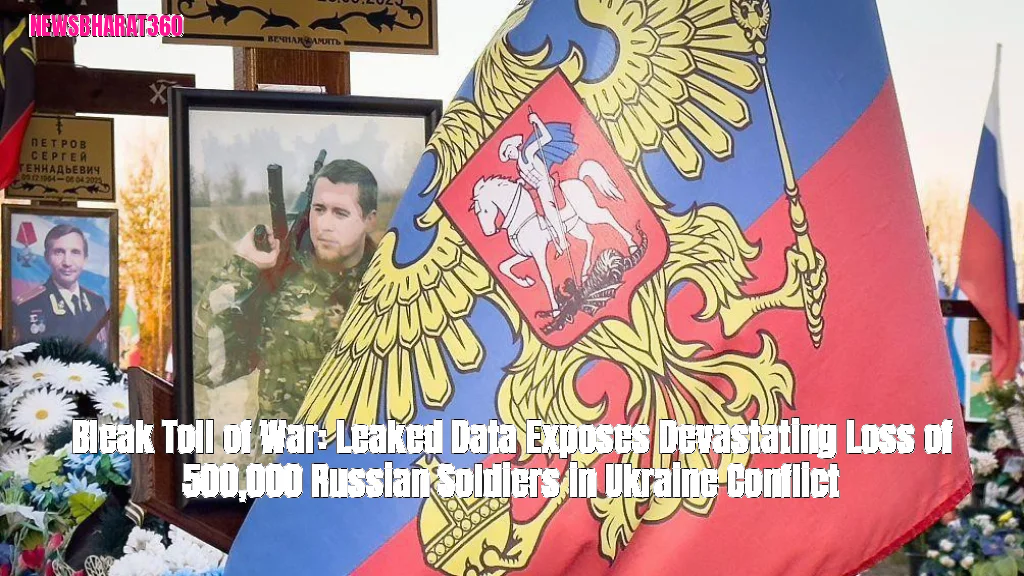

Official Russian government statistics, obtained by the BBC, indicate that at least 490,334 Russian soldiers have been killed in Ukraine since the beginning of the conflict in 2022.
Recent data from Rosstat, Russia's federal statistics service, indicates a significant shift in mortality patterns in the country, attributed to the prolonged and large-scale conflict in Ukraine. The ongoing war, which Vladimir Putin initially predicted would be brief, has now lasted nearly five years, resulting in substantial human losses.
The Russian BBC Service has obtained access to over 11 million death records spanning from 2021 to September 2026, following a data leak resulting from a cyberattack attributed to the Belarusian group Cyber Partisans BY and the Ukrainian collective Silent Crow.
Russia's official statistics agency has acknowledged a cyberattack, however, it has refuted claims that sensitive data was compromised as a result.
A joint investigation by the BBC's Russian Service and independent Russian media outlet Mediazona compared Rosstat's data with a database of deceased Russian military personnel compiled from open sources since the start of the Ukraine invasion, revealing matching records in 90% of the cases.
Military experts suggest that the reported death toll of 290,012, compiled by the BBC from official sources, social media, monuments, and tombs, may only account for 45-55% of the total number of fatalities. This would indicate a significantly higher overall death toll, estimated to range between 527,295 and 644,471.
According to official records, a significant majority of young Russian citizens between the ages of 18 and 24 who lost their lives in 2025 were casualties of the conflict.
According to available data, cardiovascular diseases are a leading cause of death among Russians aged 25-34, accounting for 59 percent of fatalities within this age group. Notably, cardiovascular diseases claim more lives among Russians aged 45-54 than conflict-related deaths.
Recent data highlights the significant losses incurred by Russian forces in targeted regions of Ukraine. Approximately 20,000 Russian soldiers lost their lives in an effort to capture 10 Ukrainian villages, which collectively had a pre-war population of 12,000 residents.
In the Donetsk region, a significant loss of life occurred during clashes in the village of Andriivka, situated south of the city of Bajmut, resulting in the deaths of 1,122 Russian personnel.
Russia has not disclosed official statistics on the number of casualties incurred since the conflict commenced in February 2022. Additionally, two years prior, Russia's statistical agency, Rosstat, ceased publishing data on deaths resulting from external causes, which were previously utilized to gauge the extent of military losses.
According to official records from Rosstat, only 70% of fatalities among soldiers from the occupied regions of Donetsk and Lugansk in eastern Ukraine who were serving in the Russian military have been documented.
According to the latest statistics from Rosstat, the data aligns with our previous observations and counts.
In July, Ukrainian President Volodymyr Zelensky reported estimated losses of approximately 50,000, whereas an alternative assessment compiled by the anonymous UA Losses website, utilizing open sources, suggests a significantly higher figure of 115,952.
According to available data from Rosstat, the Russian statistical agency, records of deceased individuals include demographic information such as age, place of residence and place of death, as well as details regarding the circumstances surrounding the death.
To initiate the analysis, records are initially sorted by geographical location, with only those related to Ukraine and the Russian border regions retained, where Ukrainian forces have been known to conduct incursions.
An analysis of available records revealed 425,174 instances where the cause of death was directly attributed to military-related factors, including explosions and gunfire during combat operations.
The count in question is limited to exclude individuals who are not within the 18 to 65 age range, thereby excluding both male and female civilians outside this demographic.
Individuals who resided and passed away in the four Ukrainian regions under Russian occupation are initially considered ineligible for civilian status, unless they have a documented military service history associated with their record.
A comprehensive review of military records revealed 14,093 additional entries through employment analysis, while a court-ordered database update added 51,067 deceased personnel, primarily those who had been missing in action for over six months in combat zones without their remains being recovered.
The count of fatalities only includes those who died within the conflict areas of Ukraine and Russia, excluding civilian casualties outside these zones.
An analysis of records by the Russian BBC Service indicates that the average age of those killed in the conflict during its initial year was 34 years. By 2025, following the incorporation of prisoners and conscripted soldiers into the military ranks, this average age had risen to 40 years, or 38 years according to an alternative assessment.
Eastern Siberia's poorest regions bear a significantly disproportionate burden of Russia's losses.
Residents of Tuvá, Buriatia, and the Transbaikalia Krai are disproportionately affected by war, with their mortality rates being significantly higher than those in larger urban areas such as Moscow and St. Petersburg, with a risk increase of 20 to 25 times.
According to Rosstat data, the distribution of deaths in most regions aligns closely with the BBC list, with a difference of less than one-tenth of one percent.
Data from the Rosstat archives indicates that at least 5,017 foreign nationals have lost their lives while fighting for Russia, with the largest contingents comprising citizens of Uzbekistan, numbering 1,031, and Tajikistan, totaling 720 individuals.
A total of 133 individuals from Colombia and 66 individuals from Cuba were listed in the database.
A conservative tally is used, as individuals with dual citizenship are recorded as Russian nationals in the database, and there is no information available on North Korean casualties resulting from the Ukrainian incursion into Russia in 2024.
A recent analysis of satellite images and official photographs of a newly built monument in Pyongyang by the BBC has revealed the names of 2,304 North Korean soldiers who died, as commemorated on the monument.
While Russia's statistics may be incomplete, combining them with the findings of the BBC's Russian Service investigations provides valuable insights.
Russia's casualty figures are notable in the context of a four-year, ten-month conflict, particularly when compared to the Soviet Union's experience in Afghanistan, which concluded in 1989.
The estimated death toll from the 10-year conflict includes approximately 15,000 Red Army soldiers and roughly one million civilians.
Russian authorities have released further details regarding the situation.
The original article was composed in English and underwent translation using artificial intelligence technology. Prior to publication, a BBC journalist reviewed the translated text to ensure its accuracy and quality.