
Ecuador is intensifying its trade ties with China. Argentina has renegotiated a currency agreement with China, valued at $19 billion. Meanwhile, ByteDance, the Chinese parent company of TikTok, is planning to establish a data center in Brazil, with a significantly larger investment. Additionally, Mexico's president has described the country's relationship with China as entering a new era.
China has maintained a significant and far-reaching influence in Latin America, often operating discreetly, despite efforts by the United States to contain its presence and expand its own control over the region.
The Asia-Pacific Economic Cooperation Forum (APEC) summit, held in the Chinese city of Shenzhen last week, provided a notable backdrop for this situation.
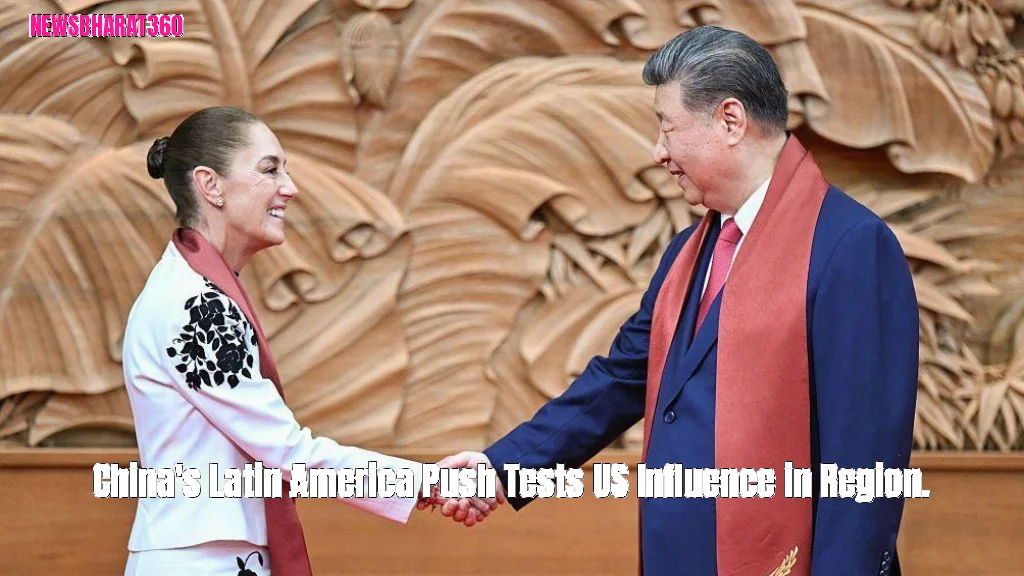
Chinese President Xi Jinping conducted bilateral meetings with the leaders of Mexico, Chile, and Peru during his visit, specifically with Claudia Sheinbaum of Mexico, José Antonio Kast of Chile, and Keiko Fujimori of Peru.
Latin American leaders expressed support for strengthening economic ties with China across multiple sectors, despite Mexico's existing free trade agreement with the US. Notably, Chilean President Gabriel Boric's ally, Kast, and Peruvian President Dina Boluarte's ally, Fujimori, both maintain right-wing ties with the US.
The Chilean president emphasized that their role represents the interests of the state, rather than a specific political faction, given Chile's significant trade relationships with countries including China, its primary trading partner, as well as Peru and several other regional nations.
China's significant presence in Latin America has become increasingly entrenched over the past several decades, with its economic interests deeply intertwined with those of the region, making it challenging to disentangle or disregard.
The recent development has sparked concerns about the extent of President Donald Trump's approach to counter China and assert the United States' dominance as a sole superpower in the region. This strategy appears to involve leveraging agreements with other nations, as well as employing economic sanctions and the potential use of military force to protect US interests.
Margaret Myers, an expert on American-China relations at Johns Hopkins University in the US, notes that there is no evidence to suggest a significant decline in China's economic influence in the region.
How did Beijing do this?
China is currently grappling with the complexities of its relationship with Latin America, a region presenting both internal and geopolitical challenges, according to Myers, a senior analyst and advisor to the Inter-American Dialogue, a Washington-based think tank.
Beijing has shifted its focus in terms of foreign direct investment and large-scale infrastructure projects, with the region no longer being a priority compared to other areas of the world.
According to the analyst, China's shift in focus towards high-end manufacturing, renewable energies, and electric transmission in Latin America does not necessarily indicate a response to the US or a complete withdrawal from the region. Instead, it suggests a concentration of Chinese interests in areas that may receive less attention from the US.
China is focusing on grassroots partnerships, engaging in various projects across multiple industries and sectors at the provincial, state, and municipal levels, rather than pursuing high-profile agreements with central governments.
Chinese electric vehicle manufacturers have established partnerships with various Brazilian states to facilitate local production.
ByteDance, the Chinese parent company of popular social media platform TikTok, is establishing its first data center in Latin America in the northeastern Brazilian state of Ceará. The facility, which will be the largest outside of China, is expected to involve a substantial investment of approximately $39 billion, with the project being developed in multiple phases.
The move by Brazil's leftist government, led by President Luiz Inácio Lula da Silva, to welcome Chinese investments may be a response to this openness.
Conservative and politically aligned governments in the region, which have historically maintained close ties with the U.S., have also been engaging with Beijing in recent times.
Ecuadorian President Daniel Noboa joined other world leaders in visiting China this year, where he and Chinese President Xi Jinping agreed to strengthen bilateral ties through enhanced cooperation in trade, technology, and investment.
Ecuador has solidified its position as China's second-largest trading partner, following the US, through a bilateral free trade agreement that took effect in 2024. The country's exports to China experienced a significant surge of 23% in the first half of the year, compared to the same period in 2025. Conversely, Ecuador's imports from China increased by 29% during the same time frame.
China's exports to Latin America have outpaced imports from the region over the past decade, reflecting the country's efforts to diversify its markets and overcome trade barriers in developed countries by selling a wider range of goods.
Argentine President Javier Milei's stance on China has been marked by a notable shift in his pragmatism, particularly in contrast to his earlier views. Prior to assuming the presidency, Milei publicly expressed reservations about engaging with China, stating that Argentina would not form alliances with communist nations.
Argentina has strengthened its financial stability this year by expanding its currency swap with China by approximately US$19 billion. Additionally, the country has implemented a new regime allowing the importation of thousands of electric vehicles from China with zero tariffs. The Argentine president, Javier Milei, has also described China as a significant trading partner, making this designation during a speech in Davos, Beijing.
Latin American governments with right-wing, center-right, and radical-right ideologies have limited flexibility in their dealings with China, according to Carlos Malamud, a senior researcher at the Real Instituto Elcano in Madrid.
Since his return to the White House two years ago, Donald Trump has aimed to reassert the United States' dominance in the Western Hemisphere, as outlined in the country's National Security Strategy released in December.
The document emphasizes the need for a hemisphere that is safeguarded against hostile foreign interventions and the unauthorized seizure of critical assets.
The move was perceived as a response to China's increasing influence in Latin America, although the country was not explicitly mentioned.
The United States has been characterized as an updated version of the Monroe Doctrine, with a twist referred to as the "Trump corollary." This concept is based on the 19th-century policy established by then-President James Monroe, which aimed to prevent external powers from intervening on the continent.
On January 3, former US President Donald Trump made a statement asserting that the United States' authority in the Western Hemisphere would no longer be challenged. This declaration coincided with a military operation in Venezuela, which resulted in the capture of Venezuelan President Nicolas Maduro. He is now facing prosecution in New York on charges of alleged drug trafficking.
The US's recent actions have had a ripple effect on China, which has established significant business ties with the Venezuelan government, including multiple agreements and investments in the country. The shift in control of Venezuela's oil production, now under US oversight, has implications for China's interests in the region.
Under mounting pressure from the US government, Panama has terminated its agreements with a Chinese company responsible for managing the ports at both ends of the country's interoceanic canal.
In response to a recent Panamanian judicial action, China has taken the step of detaining a significant number of merchant vessels registered under the Latin American flag for inspection purposes in its ports.
The United States successfully pressured Chile to halt a Chinese initiative to lay a submarine fiber-optic cable connecting Valparaiso and Hong Kong through the imposition of sanctions and warnings regarding potential security threats.
US President Trump has established a coalition with regional governments, known as the Shield of the Americas, aimed at countering the illicit drug trade. In September, the coalition announced its intentions to enhance economic cooperation, implement investment controls, and safeguard critical mineral supplies to bolster regional economies.
Latin American nations are navigating a delicate balance in their relations with China and the United States, aiming to maintain economic ties with China while avoiding actions that could be perceived as provocative by Washington, particularly in sensitive strategic or security matters.
US and European companies, primarily driven by profit margins, face challenges in competing with Chinese companies in certain sectors due to a fundamentally different investment approach. Chinese companies are guided by strategic, long-term considerations aligned with the Communist Party's priorities, rather than shareholder interests.
China's influence in Latin America is increasingly rivaling that of the United States, with the region's affinity for Washington beginning to wane.
According to the Latinobarometer survey released in October, a significant shift in public opinion has been observed among Latino Americans, with a majority now viewing China's influence as positive, at 65%, surpassing the percentage of those who perceive the US favorably, at 57%, for the first time in the survey's history.
A significant majority of respondents have expressed dissatisfaction with the manner in which Trump handles international relations, with nearly 60 percent disapproving of his approach.
A study has revealed a significant disparity between the perception of Latin America held by former US President Donald Trump and the region's current reality, as described by Marta Lagos, director of Latinobarometer. According to Lagos, Latin America has become an open market where China has established a significant presence, extending beyond commercial interests.
China has maintained a low profile in the United States' recent efforts to strengthen ties with Latin America, avoiding any signs of tension or conflict, and is perceived as a cooperative and friendly partner in the region.
Chinese President Xi Jinping has successfully downplayed the criticisms associated with the country's communist regime, with the negative aspects of the system now receiving relatively little attention.
The BBC World Service has launched a new mobile app, providing users with a comprehensive platform for accessing global news and content. The app features news alerts, documentaries, and in-depth analysis, all accessible from a single interface. Notably, the new app is currently unavailable for download in the United Kingdom and the United States.
To stay up-to-date with our latest news and updates, you can also follow us on various social media platforms, including YouTube, Instagram, TikTok, Facebook, and X, as well as our WhatsApp channel.
To stay up-to-date on our latest news and features, we invite you to subscribe to our weekly newsletter, which will be delivered to your inbox every Friday.