
California is moving forward with the construction of its largest reservoir in almost half a century, a work designed to capture water during rainy periods and store it for dry years. However, the megaproject faces a paradox that threatens its viability: it may not receive enough water to function as planned.
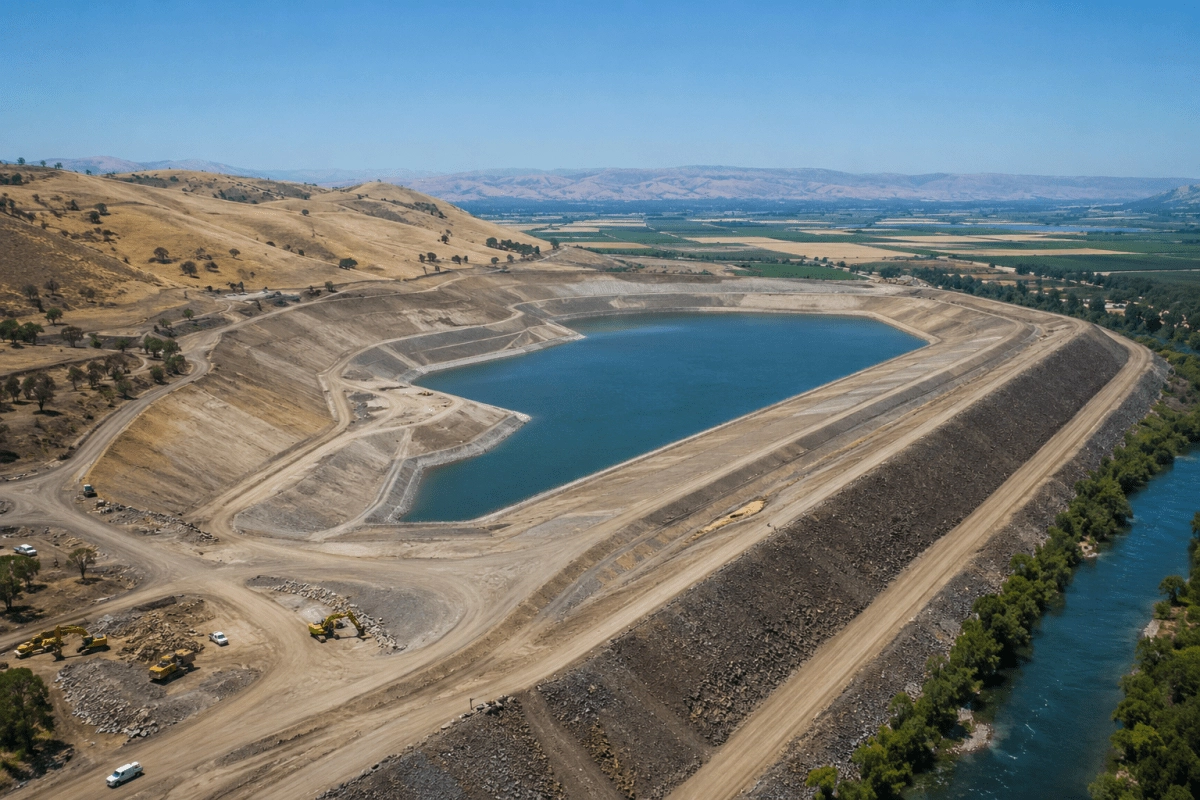
The Sites Reservoir would have the capacity to store about 1.5 million acre-feet of water and would rise in the Sacramento Valley, west of the town of Maxwell, between Colusa and Glenn counties. Unlike traditional reservoirs, it would not directly block a river, but would instead receive water diverted from the Sacramento River when flows were high.
The work, whose cost is estimated between $6.2 billion and $6.8 billion, is presented by its promoters as a central piece of the state strategy to face a warmer climate, longer dry periods and increasingly concentrated rains.
You can see: California inaugurates the world's largest animal bridge over a highway
Restrictions could reduce available water by half
The main obstacle appeared during the process to obtain the state right that will allow water to be extracted from the Sacramento River.
The State Water Resources Control Board issued preliminary approval, but added conditions aimed at limiting withdrawals and protecting fish, natural habitats and the river's deteriorating ecosystem.
Those responsible for the project maintain that these conditions could reduce the amount of water that the reservoir would be able to capture by up to 50%. In this scenario, the agencies that would finance and use the work could consider that the investment is no longer profitable.
Sites Reservoir will depend primarily on heavy rains and high winter flows. The plan includes diverting water between November and June, as long as there is sufficient availability and the environmental limits set by the state are respected.
The challenge is determining how much can be removed without compounding problems in a river system already facing declining populations of salmon and other species.
A reservoir to store water from major storms
The promoters explain that Sites Reservoir is not designed to be filled every year. Its function would be to capture part of the water that circulates during major storms, when the Sacramento River transports abundant flows to the delta and the ocean.
That reserve could later be used during droughts, emergencies or seasons with low rainfall.
The California government estimates that its maximum capacity would be equivalent to the annual consumption of millions of homes, although the amount actually available would depend on weather conditions, operating restrictions and the water that must be reserved for environmental purposes.
The project would use existing irrigation canals, including the Tehama-Colusa Canal and the Glenn-Colusa Irrigation District Canal, as well as new pipelines and facilities to transport water to the reservoir.
Newsom supports the megaproject
Governor Gavin Newsom believes the new reservoir is necessary to modernize California's water infrastructure.
In June 2026, his administration announced nearly an additional $269 million to boost the project. With this disbursement, the accumulated state investment exceeded $1,360 million.
Sites Reservoir advocates maintain that California's water system was designed for a climate that no longer exists. Rainfall is now more variable and a greater proportion of precipitation falls as rain, rather than being stored as snow in the mountains.
For that reason, they argue that the state needs more capacity to capture large volumes of water when intense storms occur.
Urban and agricultural agencies interested in funding the reservoir include agencies serving Southern California, the Bay Area and agricultural regions of the Central Valley. However, their financial commitments will depend on how much water they can ultimately receive.
Environmentalists warn about the Sacramento River
Environmental organizations and some tribal communities oppose the project or demand strict limits on its operation.
Although the reservoir will be built outside the channel, it will need to draw water from the Sacramento River. Critics warn that such diversions could affect flows needed for salmon, other native species, and the health of the Sacramento–San Joaquin Delta.
They also question the possibility of the authorities making the permit conditions more flexible to improve the economic profitability of the project.
From this perspective, the lack of water would not be a problem caused by the restrictions, but rather a sign that the river does not have enough additional flow to sustain a work of such size without causing new environmental damage.
When would construction begin?
The schedule still depends on final permits, financing and agreements with participating agencies.
According to official planning, construction could begin between the end of 2026 and 2027. Entry into operation is projected for around 2033 or 2034.
The final decision on the water right is expected in November 2026. Until then, the authorities will have to decide how much can be extracted from the river and under what conditions.
That definition will be decisive. Sites Reservoir could become one of California's biggest water projects in decades, but it could also prove too costly if it only manages to store a fraction of the planned water.