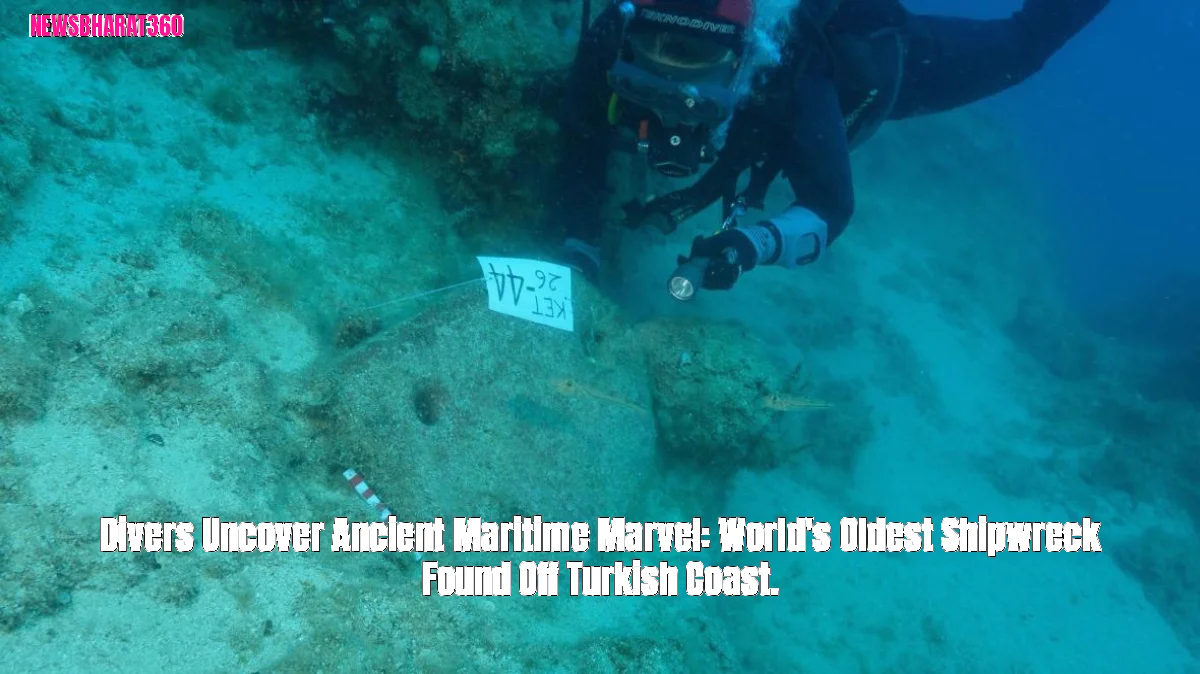

A team of archaeologists has announced the discovery of the world's oldest shipwreck, located off the coast of Turkey.
Archaeologists estimate the ancient site to be approximately 4,400 to 4,700 years old, placing it within the Early Bronze Age. This timeline aligns with the construction period of the Great Pyramid of Giza, which is also believed to date back to the same era.
Despite the wooden hull of the ship being destroyed, the ceramic tiles it transported have remained intact on the ocean floor, remarkably retaining remnants of their original contents.
Archaeologists have discovered a 10-meter-long merchant vessel that traversed the Mediterranean Sea, transporting goods across the region.
Professor Hakan Öniz, leading the Mediterranean Archaeology Association's expedition, described the shipwreck as a submerged time capsule containing historical artifacts and relics.
Remains of a shipwreck have been discovered off the coast of Kekova Island in Antalya, Turkey, at a depth of approximately 30 meters beneath the surface of the water. The submerged site is situated on a submarine slope, where artifacts are scattered.
Archaeologists have uncovered a significant collection of ancient artifacts, including three substantial stone anchors and over 30 ceramic amphorae, which were used for storing food.
The absence of any remaining wooden components from the ship has rendered radiocarbon dating, a method used to determine the age of organic materials by measuring a specific form of carbon, inapplicable for determining its age.
Archaeologists focused on analyzing the shape of the amphorae, utilizing the fact that ceramic styles evolve over time and are characteristic of distinct historical periods.
The ceramics from Kekova are characterized by distinctive features, including two wing-like protrusions, a central nervure, and a flat base.
Archaeologist Öniz stated that the design of the amphora corresponds with other vessels discovered in Egypt and the Middle East, which are estimated to be approximately 4,400 to 4,700 years old.
Preliminary analysis of the decoration techniques suggests that the discovered remains date back to the Early Bronze Age with a high degree of certainty.
A series of dives successfully recovered the ancient vessels, which are now being meticulously preserved on the surface following their prolonged submersion for thousands of years.
An archaeologist from Macquarie University in Australia, Karin Sowada, conducted an examination of the recovered amphorae. The analysis revealed that some of the vessels remained intact, with a notable discovery that they still contained a thick, vibrant residue.
A witness described a shocking scene after inspecting the area, nearly fainting at the sheer volume of waste present. The extent of the debris was staggering, with widespread destruction and a significant amount of remaining material.
Archaeologists are currently conducting further research to determine the contents of the amphorae discovered during the excavation.
Researchers are considering various substances, including olive oil, wine, and tree resins, as potential alternatives.
The large size of the bottles suggests they may have been reused, potentially leading to the accumulation of waste over time, as individuals would have emptied them and used them for multiple years.
Archaeological findings from the shipwreck are providing significant insights into the commercial activities of the ancient world.
Archaeologists have determined that the ancient vessel originated from a location along the eastern Mediterranean coastline.
Archaeologists propose that the individual was involved in the transportation of goods to either the ancient city of Troy, located in the northwest of modern-day Turkey, or the Minoan settlement on the island of Crete.
The maritime route surrounding Kekova Island has long been fraught with peril, due to the presence of hazardous currents and unpredictable winds that have claimed numerous vessels over time.
The Mediterranean Archaeology Association has identified a significant number of remains in the region, with a focus on locating and analyzing these artifacts.
During his dives among the wreckage, Öniz reflects on the personal connections of the individuals associated with the ship, their lives and relationships.
A team of archaeologists and researchers has made history by becoming the first humans to physically interact with artifacts that have lain undisturbed for 5,000 years.
Historical accounts have long focused on the sailors who produced the amphora, as well as the laborers who transported them to the boats and the women who anxiously awaited the return of their husbands, often left behind due to their absence.
The institution is under the ownership of the Turkish Ministry of Culture.
The Turkish government has announced plans to display the recently recovered artifacts at the newly established Mediterranean Submarine Archaeology Museum in Antalya, which is expected to open in the near future.
The Kekova discovery has been ranked as the world's oldest shipwreck, holding the top position on the list.
The previous record was held by an artifact discovered off the coast of Dokos, a southern Greek island, which dated back approximately 4,200 years.
Archaeologists have discovered the oldest known intact piece of preserved wood in the Black Sea, located off the coast of Bulgaria.
The original article was composed in English and translated using an artificial intelligence tool, with subsequent review by a BBC reporter to ensure accuracy prior to publication.