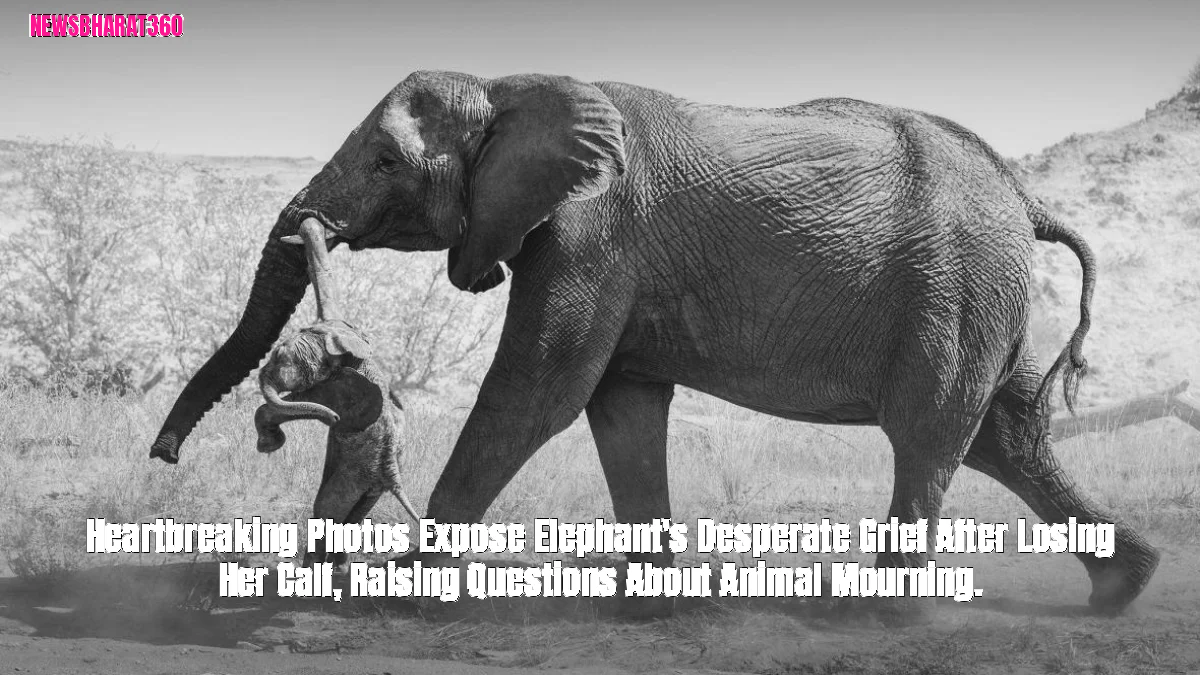

In September 2025, Italian photographer Federico Veronesi captured a harrowing scene while documenting a herd of elephants traversing the arid bed of a river in Namibia's desert landscape.
A conservationist witnessed an elephant with a stillborn calf, whose tiny legs were entwined around the mother's reproductive tract, while the mother's lifeless body hung suspended in mid-air.
Veterinarian Veronesi vividly remembers a poignant moment when he observed a newborn breed that was still in its early stages of development. The animal's skin was completely intact and extremely soft, indicating that it had likely been born during the preceding night or shortly thereafter.
A poignant moment unfolded, evoking the deep emotional distress often associated with a mother's loss.
Further investigation by Veronesi revealed a more intricate sensitivity than initially apparent, with the unusual behavior taking a surprising turn.
A photographer spent several hours tracking a flock, resulting in a series of striking images, one of which earned the top prize at the 2026 Wildlife Photographer of the Year contest, sponsored by the London Natural History Museum.
According to Veronesi, an elephant spent several hours loading a herd of elephants, periodically setting them down to rest, eat, or drink before resuming its task and continuing on its journey along the Huab River.
Witnesses described the scene as deeply distressing, but acknowledged the necessity of it being witnessed.
The image powerfully conveys the extent of the elephants' suffering and highlights the intricate emotional experiences often overlooked in animals.
Italian anatomist Ugo Veronesi made a significant discovery, finding that elephants do not carry their own offspring.
Christin Winter, director of the conservation program at Elephant Human Relations Aid, a non-profit organization dedicated to safeguarding Namibia's desert elephants, has stated that the individual in question is not the mother of the elephants being protected.
A 14-year-old girl has experienced the devastating loss of her own child, a tragedy that occurred two years ago.
According to Winter, the elephant has been observed on four separate instances, transporting young elephants that were born dead, marking the first documented instance of this behavior in the region.
The discovery has significantly expanded our understanding of the emotional complexity of these animals, according to Veronesi.
Observations of a female's behavior following a significant loss are particularly poignant, as she appears to be attempting to reconnect with her offspring, a gesture that underscores the enduring impact of her emotional pain after an extended period.
The prolonged duration of elephant breeding efforts has sparked various hypotheses among experts.
Research suggests that this behavior could be linked to an individual's emotional processing mechanisms.
A mother's behavior in response to the death of her offspring can be attributed to her unresolved trauma stemming from the loss of her previous child, which has left her emotionally vulnerable and unable to cope with the situation.
The body may have been shielded from scavenging predators, according to Winter.
Photographer Veronesi's work provides a unique insight into the lives of 150 elephants residing in Namibia's arid desert, where they inhabit areas along five river streams and undertake extensive migrations in pursuit of sustenance and hydration.
Researchers have identified an eco-type of elephant population in the arid environment, characterized by learned behaviors that enable it to thrive in the harsh conditions, analogous to the desert-adapted lions found in Namibia's Skeleton Coast.
Experts warn that the unique knowledge held by certain individuals is both a valuable asset and a significant liability, as its loss can be irreparable and difficult to restore.
The population has experienced a significant decline over the past two decades, primarily attributed to a combination of environmental stress resulting from prolonged droughts and escalating conflicts with humans.
The core issue at the center of the conflict is centered on water resources.
Elephants have been entering farms, where they disrupt operations by rolling over water storage deposits, dislodging pipes, and damaging water tanks, resulting in a low tolerance for their presence among local residents.
The alarming rate of newborn elephant deaths has sparked widespread concern among conservationists and wildlife experts.
The situation is extremely severe and highly concerning.
Over the course of eight years, from 2014 to 2022, a total of 16 puppies were born, but unfortunately, only two of them survived.
According to Winter, a key factor contributing to the high mortality rate of offspring is the premature birth of young, which he attributes to the physical limitations of females being unable to terminate pregnancy.
The observed behavior may be a result of prolonged exposure to stress caused by interactions with humans.
Studies indicate that elephants can develop symptoms of post-traumatic stress disorder (PTSD) following exposure to violent conflicts.
Researchers have observed that dead-born elephant calves are typically significantly smaller than their healthy counterparts. According to their findings, a normal newborn elephant typically weighs between 100 and 120 kilograms.
Infants born still, typically weigh between 60 and 65 kilograms.
The Elephant Human Relations Aid has partnered with Daniella Chusyd, a renowned elephant expert and associate professor at Indiana University Bloomington, to investigate the potential impact of environmental factors and chronic stress on Namibia's desert-dwelling elephant population.
Researchers are currently gathering fecal samples to identify the presence of heavy metals and persistent chemicals, including PFAS, as well as conducting analyses of thyroid hormone and elephant cortisol levels as part of an ongoing project set to conclude in 2028.
Researchers aim to establish the level of endogamy within this population relative to others, and to identify whether offspring who survive have distinct parental ancestry compared to those who perish.
Renowned elephant expert Joyce Poole, founder of the non-profit conservation organization Elephant Voices, characterizes Veronesi's photographs as remarkably scattered.
A woman in Kenya observed a comparable emotional response from an elephant after it gave birth to a stillborn calf.
According to Poole, the individual did not attempt to move the woman but instead remained by her side for two consecutive days, providing protection.
The photographer hopes that the images will serve as a visual representation of the emotional experiences of elephants, highlighting their capacity to feel pain and endure suffering.
Research suggests that elephants exhibit behaviors indicative of grief when a member of their social group passes away, demonstrating a complex emotional response to loss.
Researchers have documented a behavior in which certain individuals visit the remains of both family members and non-group members, exhibiting prolonged periods of physical proximity and apparent observation.
Namibia's desert elephant population is at high risk of extinction, threatened by both climate change and government-issued hunting permits.
The international community must take further action to prevent the ongoing distress of those affected.
Veronesi described the interaction between the elephant and the dead fetus as exhibiting almost human-like behavior.
He recalls the moment as truly remarkable.
Conservation efforts should prioritize not only the preservation of the elephant species but also the well-being of each individual animal, underscoring the importance of understanding and protecting these creatures.
The photographer aims to capture intimate and emotive images that offer a glimpse into the elephant's inner world and convey the depth of its emotional experiences.
The Wildlife Photographer of the Year contest, produced by the London Natural History Museum, will remain on display until July 2027.
The original article was written in English and translated using an artificial intelligence tool. Prior to publication, a BBC reporter reviewed the translated text to ensure its accuracy.