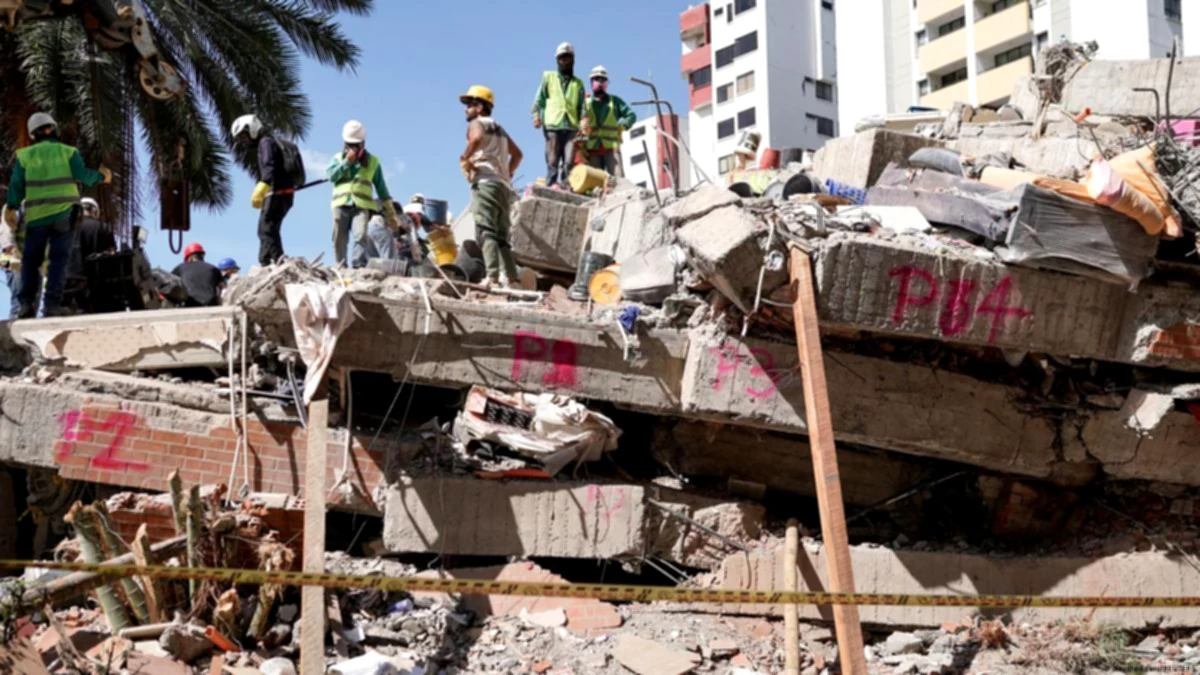

Colombia advances this Sunday in the removal of the rubble left by the powerful earthquake a week ago, with little chance of rescuing survivors among more than a hundred missing people.
The noise of backhoes, cranes and trucks echoes in the areas most affected by the 7.4 magnitude earthquake that destroyed thousands of houses, buildings, hotels and hospitals last Monday.
Almost 300 people have died and the disaster relief authority reports at least 140 missing, mainly in cities that today look desolate, with uninhabited homes and abandoned commercial premises.
In Pereira (west), one of the most devastated cities, machines have already turned tons of rubble into small mountains of bricks and rods.
Rescuers no longer allow volunteers to enter buildings.
The hope of finding survivors “is already much lower,” says Andrés Cano, a 30-year-old nursing student who is showing signs of exhaustion.
“You feel exhausted, it's a mental fatigue more than anything,” he tells AFP with a group of friends dressed in orange vests and helmets.
The noise of the machines filled the silence requested by the relief brigades to detect signs of life under the ruins left by the deadliest earthquake of the century in Colombia.
The earthquake represents the first major test for the government of right-wing Abelardo de la Espriella, who was faced with the emergency just three days after taking office.
On Saturday he asked his American ally, Donald Trump, to temporarily suspend tariffs to help his country.
on the street
Nearly 27,000 homes were destroyed and many victims have nowhere to go.
The shelters display QR codes so that those affected can report their missing loved ones or damage to their homes.
Dozens sleep in small cabins or mattresses.
Yeiny Sánchez, a 28-year-old candy seller, spends her days with an injured chick she rescued. “I have felt very alone and helpless,” she says.
In the most destroyed cities, several buildings were marked with a red “X” to warn of the risk of collapse and the prohibition of passage for pedestrians.
Jorge León, evacuated from his apartment in Cali (southwest), tells of the “pain” that “starting everything over again” entails. He walks next to a yellow truck loaded with his belongings.
“It seems like I'm living a movie or a dream, I can't assimilate it,” the 41-year-old lawyer tells AFP.
The mayor of Cali, Alejandro Eder, estimated that the reconstruction of Colombia's third largest city will cost at least $3.2 billion.
Colombia has received millions in aid from countries like the United States and organizations like the World Bank.
Volunteers do not resign
On a wall of a five-story building that collapsed after the earthquake, a rescuer marked it with a red “V” crossed by a horizontal line, a sign that indicates the completion of the search for possible survivors.
But volunteer rescuers refuse to give up on finding life, although it is considered that after 72 hours the chances of survival fall drastically.
“Even though they have told us that many days have passed, we continue looking for life because we want to continue betting on life,” says Professor Juan Carlos Tabares, 58, who leads the rescue point called “Valentía” with several volunteers.