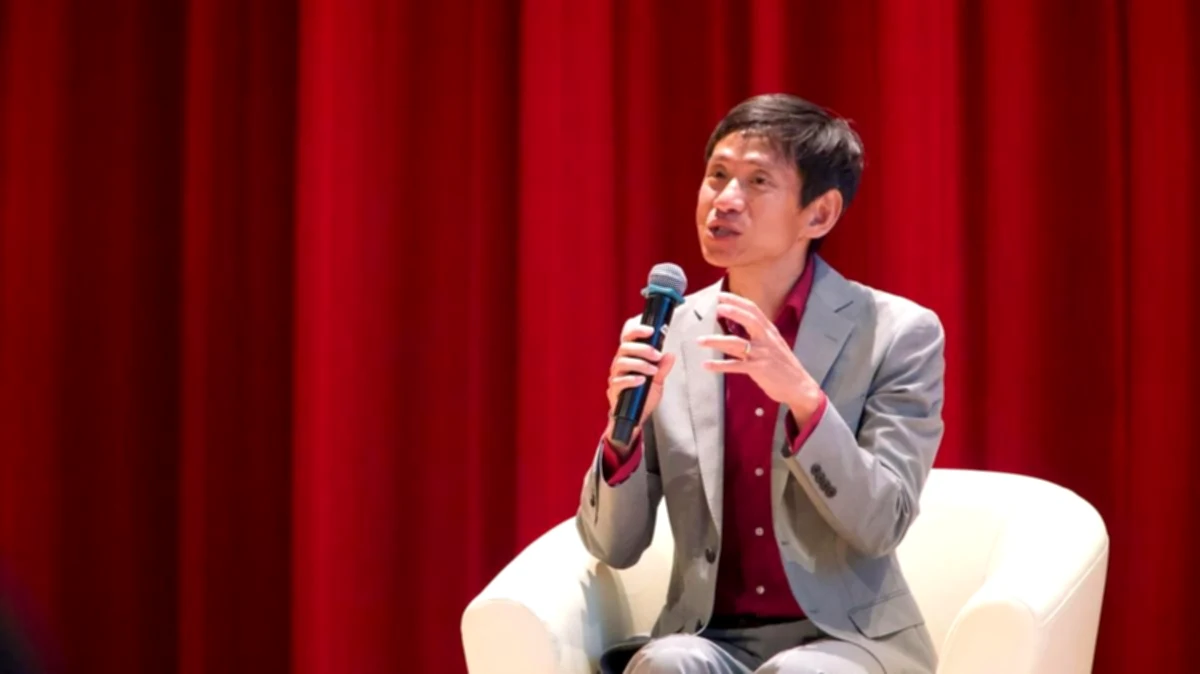

The young Chinese have a new “idol,” but it is not a pop singer or a movie star.
It has become an unexpected guide for a generation increasingly disappointed by the topics it deals with: anxiety and how to deal with it.
“A star sent from the sky,” so describes Zihan Han the man he has recently become a great admirer of.
China’s economy and technology have grown at a dizzying rate, but there are many things that worry Generation Z, from employment to the prospects of a couple relationship, to the enormous pressure to stay up to date.
“The transition from school to the real world generates a lot of uncertainty, and people tend to feel anxious because they don’t know how to deal with it,” says a 23-year-old Chinese graduate who preferred not to reveal her name for fear that talking to foreign media could affect her chances of finding work in her country.
“People need a point of support in their lives, and their words make us feel that there’s someone who understands us.”
She and Zihan were among the 500 people — mostly members of the Chinese diaspora — who recently gathered in a Singapore auditorium.
Xiang spoke for more than an hour before answering questions.At the end, dozens of people ran up to meet him and take photos with him, who described the event as “an academic meeting with fans.”
The academic has been interviewed by leading Chinese media and has traveled to prestigious universities in the Asian country to give talks, including his alma mater, the prestigious Beijing University.
One of his talks earlier this year was broadcast live because the auditorium was full. According to Chinese media, the expression “in case of doubt, ask Biao Xiang” has become a popular saying.
In Singapore, Xiang spoke about the recognition young people seek in today’s China, where they often resort to approval systems — from competitive exams to safe jobs — and how that approval becomes a measure of self-esteem, which can be exhausting and damaging.
As he suggested, it’s healthier to seek meaning and understanding in others and use that to better understand ourselves.
These solutions are not fast. But in a country where discontent can be politically delicate and heavily censored, he is an exceptional public figure who addresses what he calls the “critical point of a whole era.”
“Everyone knows where the problem is, but they resist confronting it.Sometimes it’s too painful to look at it, or they don’t have a way to do it,” he told the BBC while taking tea in Singapore.
“But, as an academic, it’s not terrifying if you can describe it; that’s how it’s analyzed and managed.”
He currently resides in Germany, where he directs the Max Planck Institute of Social Anthropology and studies social changes in China and other parts of Asia.
Xiang believes that Chinese society is at a turning point, where people seek meaning to life while trying to understand the rapid social and economic changes.
He observes contradictions: an insecure youth in a powerful and determined country; disappointment despite enormous advances.
Chinese leader Xi Jinping also acknowledged this: he stated that the “main contradiction” lies “between the people’s growing needs for a better life and unbalanced and insufficient development.”
Xiang has ingenious names to describe what is causing this. “Floating” is how he describes people who work restlessly just to survive, like a colibri who continues to beat his wings to stay in the air.
“Near” refers to what surrounds us immediately. Xiang argues that people care about the “very close” (they themselves) and the “very distant” (the world), while neglecting the intermediate space, “the near”. This, according to him, creates a sense of disconnection.
This seems to be deep silence among young people looking for answers.
One RedNote user writes: “He always analyzes problems from the vulnerable perspective, attributes personal stress to macro causes and encourages people to actively participate in life; it’s really wonderful.”
Another commented: “Never release empty and superficial phrases; instead, face the real-life dilemmas with us.”
Zihan states that everything is reduced to Xiang’s willingness to speak openly about these topics: “Those who have said similar things are not as brilliant as Professor Xiang, but people as brilliant as him have not said such things.”
Born in 1972, Xiang reached majority age during another crucial time, when China emerged from the brutal chaos of Mao Zedong’s regime to trade with the world. The country urbanized, ordinary citizens became entrepreneurs and, for the first time in the communist nation, took off.
Xiang grew up in Wenzhou, a city that became an industrial port, and was a direct witness to it. “It was a vast landscape of small businessmen,” he remembers. “Most people didn’t care too much about education; they focused on practical matters, specifically how to make money.”
And many did. His children grew up in a golden era of two-digit economic growth. But the economy slowed during the pandemic and has not recovered. The old formula of “hard work = safe employment” no longer works, and they are looking for a new landscape, Xiang says.
Youth unemployment reached 21.3% before the government stopped publishing data by mid-2023. Those who have “good jobs” (public officials, business employees, engineers) are worried about losing them.
They are constantly complaining on the internet about the long and exhausting working days, the toxic environment at the office and their fear of the “curse of the 35”, the limit age of many job ads, after which it is more difficult to find a new job.
Because of censorship, it is difficult to know the true extent of this feeling. But that feeling of oppression is filtered into public discourse in other ways. That anxiety quickly turns into anger in online debates, whether about college entrance exams, marital gifts, or food security scandals.
Terms associated with this mood have been a trend for years. The most famous are “disconnect,” when people choose to completely abandon the rat race, and “involution,” a somewhat ugly term now commonly used to describe an intense competition that generates little reward.
Xiang believes two factors have exacerbated this anxiety: the real estate market and the higher education system.
The rise in real estate, driven by the dependence of local governments on the sale of land, linked the family’s sense of security and success to the value of their homes.
In addition, the rapid increase in university tuition raised the level of academic demand, intensifying competition.
The result, according to him, is a universal formula: get a good university degree, find a stable job, get married and buy a house.
“When 1.4 billion people compete in the same race, that’s involution.”
About three years ago, when he learned that a camp for digital nomads where he had given a talk had raised prices after his visit, “he realized that he was no longer known only in academic circles.”
According to him, many of his colleagues prioritize the publication of research and are quite indifferent to their methods.
But Xiang feels encouraged by his popularity.
“If someone calls me influencer, I take it as a compliment because the real influence I can have is to make people think for themselves.”
This article was originally written in English and we use an artificial intelligence tool to translate it. A BBC reporter reviewed the text before it was published. Find out more about how we use it.