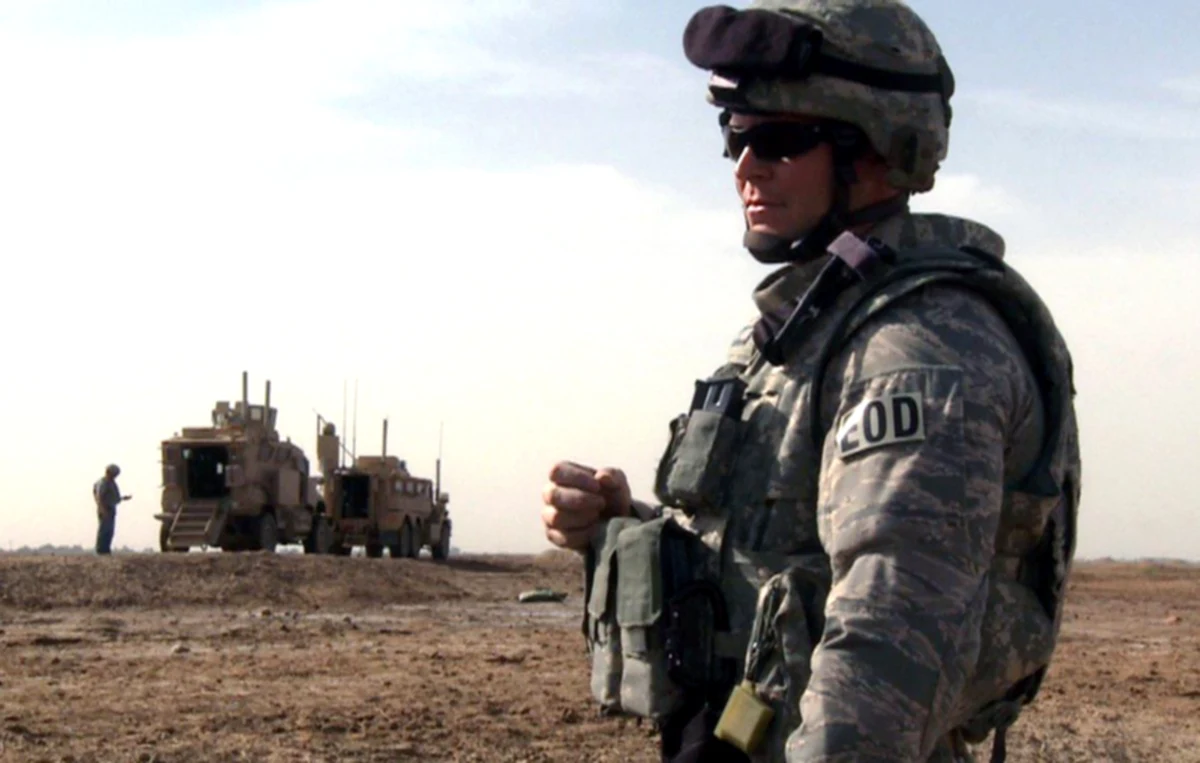

Iraq on Wednesday celebrated the withdrawal of U.S. troops deployed as part of the international coalition against Islamic State (IS), with official events and celebrations in Baghdad that marked the closure of a military mission started 12 years ago and the transfer of security responsibility to Iraqi forces.
“We have become masters of our destiny after our decisions were taken hostage by the United States,” said Mahmud Ibrahim, a 45-year-old Iraqi professor, who described the day as “this historic day” in which the country “consolidates its sovereignty and the withdrawal of all foreign troops.”
The Iraqi government declared September 30th as “Sovereignty Day” and organized events in ministries and public dependencies. Baghdad was decorated with national flags and Tahrir Square became one of the main venues for the celebrations.
The Iraqi Prime Minister, Ali al-Zaidi, said that with the end of the mission begins a new stage “characterized by the sovereignty of Iraq, the strength of its institutions, the preparation of its forces and the unity in decision-making.”
The withdrawal completes a process agreed by Washington and Baghdad in 2024. Both governments then set a timetable to gradually end the coalition’s mission and move forward towards bilateral security relations. The plan envisaged a second phase of transition that would end in September 2026, according to the U.S. State Department.
U.S. troops had returned to Iraq in 2014, at the request of the Iraqi government, in the face of the rapid advance of Islamic State, which came to control approximately a third of the country. Iraqi forces, backed by the international coalition, recovered the occupied territory and Baghdad declared the jihadist group’s territorial defeat in 2017.
Foreign military presence, however, continued during the following years to train and advise Iraqi forces and fight remaining ISIS cells.
For members of the Army, the exit also means a change in decision-making. An Iraqi First Lieutenant, who asked to keep his identity in reserve, assured that the operations would now be fully under national command.
“Now, when we are assigned a mission, we are not seeking the approval of the coalition forces or what is called the ‘friend band’. Now the decision is purely Iraqi, and I firmly believe that the security situation will improve,” he said.
The closure of the mission does not mean, however, the end of military cooperation between Washington and Baghdad. The United States and Iraq plan to maintain a bilateral relationship on security, including training and intelligence exchange, while Iraqi authorities assume the primary responsibility of dealing with the remnants of Islamic State.
The withdrawal also does not close the debate about foreign presence. Turkeyins forces in northern Iraq linked mainly to its operations against the Kurdistan Workers' Party (PKK), while Iranins influence over some Iraqi armed factions.
Sabah Ramadan, a 32-year-old Iraqi unemployed, believed that sovereignty cannot be limited to the exit of the coalition and called for the withdrawal of other foreign forces.
“I hope the government expels all foreign forces, not just those of the coalition. “I demand that the government expel the Iranian advisors and I hope that the Turkish forces and the Iranian opposition also leave the Iraqi territory,” he said.
The day thus closes a stage started in 2014 with the advance of Islamic State, but leaves Baghdad facing a new challenge: to demonstrate that its forces can preserve security, contain the jihadist remains and keep under state control the various armed groups without the operational support of the international coalition.