
The film is brief in its duration.
On the Chinese part of the Nepal-Tibet border, a black walls appears behind the Gyirong houses. It initially appears to be a dark cloud. Therefore, it changes in shape and speed: stones, rocks, ice, mud, and mud that travel through the valley at all speed.
Security camera footage has gone popular.
It provided the first physical proof of the scale of the damage that was developing for some.
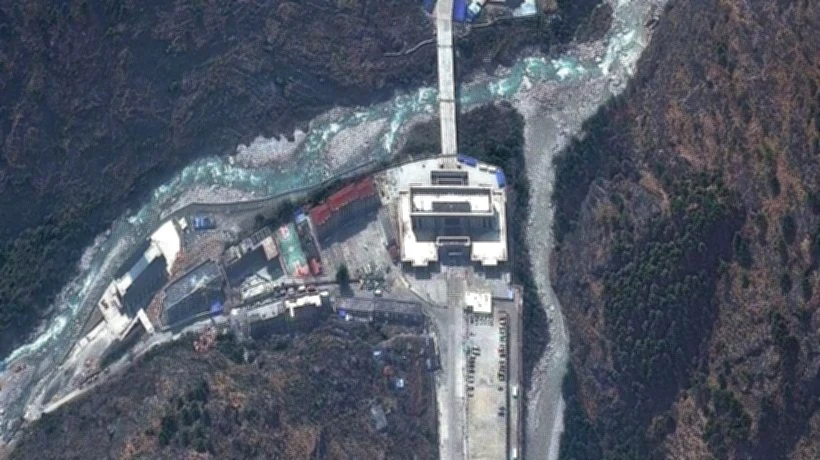
It's still difficult to fully understand what transpired in the following days. However, fragments of picture and satellite images reveal that a large portion of the border complex had been destroyed and that the structures that previously occupied the valley's base had just vanished.
As well as the details of its one and only surviving worker, the electric emigration records of the Rasuwagadhi frontier post in Nepal are useful in some areas.
The cross was exceedingly crowded when the storms arrived, according to Tika Ram Pokharel, who was unintentionally present in Kathmandu that day for an investigation.
“This is a historic travel route between Kathmandu and Tibet. The area is geologically vulnerable, characterized by deep slopes and sharp rivers that flow at high speed, carry heavy sediments and can drag huge rocks,” says Ajay Dixit, a hydrologist resident in Kathmandu.
It is a location where travelers who travel to Mount Kailash cross paths with people who live along the border, including truck drivers, customs leaders, visitors, and travelers who travel between Nepal and China.
More than 100 Indians could have been on or around the cross as of the day of the disaster, according to India's Foreign Ministry. At least 275 Indians are also missing in Nepal.
The immigration department of Nepal has been attempting to repair those who passed through Rasuwagadhi in the lead up to the hazard.
Four people registered their entrance into Nepal while 89 Bangladeshi and foreign nationals had passed the immigration controls to Tibet, according to the electronic records.
Less than 10 minutes before the mud stream appeared on Gyirong security cameras, the immigration system had its last record at 8:35 :03 local time ( 10:52 Tibet time ).
During the storms, four immigration officials vanished, including the head of the Rasuwagadhi department. His figure was later found in the valley. The person who kept the previous trades records is also missing.
32 Indians, 12 Chinese, and 9 Americans were among the immigrants who had left Nepal that night, as well as Italian members of the United Kingdom, Canada, Australia, and Italy.
The digital records just contain a small portion of what transpired at the border that day, according to Tika Ram Pokharel, Rasuwagadhi's surviving immigration assistant.
A little commercial settlement close to the border crossing, Ghatte Khola Bazar, located about 1. 5 kilometers northwest of Timure, was where the immigration office was. From there, the Bridge of Friendship, which marks Tibet's boundary, was reached in 2 metres. There were stores, resorts, and parking lots where people and automobiles gathered along that area before crossing.
According to Pokharel, the Nepali multiculturalism office opened at 8:00. Travelers may proceed to the frontier or delay in the area before crossing through immigration control.
When Pokharel called a coworker at 8:20 in the morning to say that the borders cross was unusually crowded, he was informed. He claimed that 300 to 400 people were waiting to abandon Nepal for Tibet, and that there were even people from the Chinese side there.
According to Pokharel," I think those who finished the immigration process that morning had never end their migration procedure on the Chinese side. "
From the Nepali immigration business to the gate, according to Pokharel, it took between 15 and 20 hours once the passengers had crossed the immigration power.
Travelers arriving late in the afternoon sometimes had to wait until the frontier reopened the following night, while those traveling by bus or by group often had to wait until immigration control was cleared before moving forward.
That makes it difficult to determine the location of those 89 people at the time of the disaster.
At 8:37, less than two minutes after the immigration system completed its last record, seismic instruments detected movement in the mountains situated above the border, according to a chronology drawn up by the Nepal Water Resource Hydrology and Research Center. Subsequently, the researchers attributed the signal to the partial collapse of a glacier that caused the flood.
China claims that the flood traveled from its point of origin for about seven hours to the border crossing.
Individuals waiting in Ghatte Khola, waiting in Ghatte Khola, or getting ready to enter Chinese facilities were all at the crossroads. The precise names of each individual people are still undetermined.
Ghatte Khola was much more than a waiting place. According to Pokharel, there were between 50 and 60 homes, as well as four electricity firm offices, hotels, and local businesses.
It served as a meeting place for motorists, assistants, tour guides, and goods workers awaiting the customs business as well as the last stop of the buses leaving Kathmandu. Travelers traveling to Tibet used to have a catch-up there the day before.
Pokharel claimed that "my 40 or 50 closest associates are missing. "
According to Pokharel, between 2, 000 and 2, 500 people could have been trapped by the storm, which would be much higher than the official figures. This number is based on an estimate made by someone else and has not been independently verified.
According to Pokharel, the immigration department was about 100 feet above the creek. However, it appeared that the water would climb even more during the storm. He had hoped that the two of his lost companions could have escaped to nearby pastures.
The night had almost started quietly for some of the Indian travelers at the border. They called their family at home, and they sent them videos that showed them the mountains while the Chinese immigration department was waiting.
Subhrasree Chakraborty, Subhrasree Bhattacharya's family, sent messages to Subhrasree, who was accompanying a group of more than 60 people. She received a photo of the return mark on her passport at 7:57, Nepal time, indicating that Nepal's immigration control had ended.
He sent a second communication at 8:03, saying" We are waiting to enter China. "
A group of 77 travellers connected to the Isha Foundation who had just come back from Mount Kailash were among the people who were at the Chinese immigration facility. Following the storms that hit the area, they and three other team people vanished.
When a 21-member Chinese rescue team arrived at Gyirong on August 28, one of the rescuers declared to Chinese state media: “Until it reached sight, there were only ruins.”
The cross had just recovered from a significant flood. Storms forced Rasuwagadhi to shut for six months in July 2025. After China constructed a transitory gate, it reopened its doors on January 1.
Traffic had resumed. Chinese border officials say more than 100,000 people had passed through Gyirong by June, while Nepali immigration records show 53.742 arrivals and departures in Rasuwagadhi in the year until mid-July. Both figures are based on different reporting periods and counting systems, which makes direct comparison difficult.
The Indians were the most numerous group registered at the Nepali immigration point, followed by the Nepali and Chinese.
Gyirong had also become one of the main arteries connecting Nepal and China.
Posh Raj Pandey, president emeritus of Kathmandu-based South Asia Watch on Trade, Economics and Environment, says Rasuwagadhi is one of Nepal’s two main trade points with China, along with Tatopani, and accounts for approximately a third of Nepal’s $2.950 million trade with its northern neighbor.
Between 60 and 70 trucks transited daily through the wreckage, transporting electronics, machinery, vehicles, fruits, clothes and other goods to Kathmandu. Pandey says this route also handled 80% of Nepal’s electric vehicle imports from China.
Its closure has caused Nepal to rely more and more on Tatopani, which Chinese authorities have also temporarily closed due to the risk of landslides on the Nepali side, according to the Kathmandu Post.
The intersection is also located along the proposed route for the railway that will connect the region with Kathmandu, as part of Nepal and China’s plans to develop a transhimalayan rail network.
“Nepal should develop an alternative trade route with China and reconsider its broader development strategy, including the large concentration of hydropower projects along the same river system,” Pandey said.
“We have deposited all our reservations here.We need to develop an alternative border port.”
On the other side of the border, Pokharel thought about the conversations he had with his colleagues who were now missing.
The floods of the previous year had made the staff of Rasuwagadhi’s immigration office fully aware of the danger. At night, he says, they sometimes “feel vibrations” and went out to check the state of the river. They had even talked with each other about the possibility of taking refuge in a higher area if another flood occurred.
“But my friends didn’t have that chance,” he said.
This article was originally written in English and we use an artificial intelligence tool to translate it. A BBC reporter reviewed the text before it was published. Find out more about how we use it.