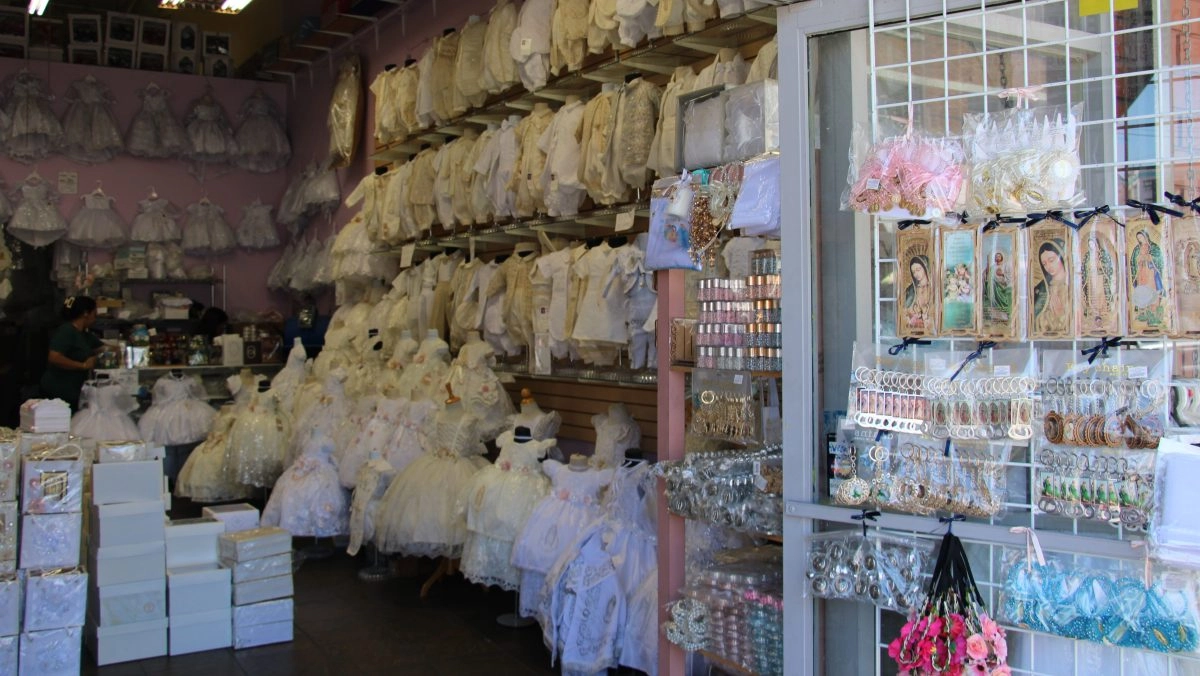

In the Fashion District of downtown Los Angeles, the platforms are half empty, there are no large clientele in the stores and some businesses even lowered the curtains forever: they could not survive after the two weeks of raids in June 2025.
"Everything is very bad. There are no sales," said Sandra F., whose business is located on the corner of Pico Boulevard and Wall Street. “People don't come anymore, they're afraid of ICE.”
The magnitude of the commercial disruption was immediate following the aggressive attacks by masked Immigration and Customs Enforcement agents in nine Latino commercial corridors in Los Angeles County, according to a new study by the UCLA Latino Policy and Policy Institute (LPPI), conducted in collaboration with the organization Inclusive Action for the City.
Although Sandra was not part of the report, in the two weeks following the immigration enforcement operations led by the infamous Greg Bovino (former Border Patrol Commander) and Kristi Noem (former Department of Homeland Security Director), she continues to resent the loss of income more than a year later.
“It doesn't even go towards rent,” added the merchant originally from Michoacán, Mexico. “Look, many businesses have already closed.”
In fact, at the entrance to the so-called “alleys” in the Fashion District, galvanized steel curtains are below.
The geographical areas affected
The UCLA report notes that eight of the nine locations (Fashion District, Warehouse District, Westlake, Cypress Park, Paramount, Huntington Park, Pacoima and Ladera Heights) saw a decline in business visits and the magnitude of those declines varied. The exception was the Whittier area.
The nine locations featured diverse demographic characteristics, ranging from neighborhoods with large immigrant and Latino populations to a historically African American community (Ladera Heights) and downtown business districts; It should be noted that the commercial effects of immigration control operations were not limited to areas with a Latino majority.
The report combines mobility data from all businesses near the nine intervention points with surveys and focus groups conducted with 75 Latino business owners from across the county.
The research authors further discovered that among the 989 formal sector businesses located within a half-mile radius of the nine documented intervention points, there were 46,000 fewer customer visits and cumulative revenue losses estimated at $3.16 million during the two weeks following the immigration enforcement activity.
In Paramount, 14 days before the immigration operations, visits to businesses were 43,711. Two weeks later, the number decreased to 38,916 (-11.0%).
For downtown Los Angeles' popular Fashion District, the numbers were set at 942,795 visits before ICE arrived; two weeks later, the influx dropped to 919,889 (-2.4%), while in Huntington Park, from 105,981 visits, the presence of immigration agents caused a decrease to 103,484 (-2.4%).
The City of Paramount saw the largest decline (-11.0%), followed by Ladera Heights (-4.8%), the Warehouse District (-4.3%), and Cypress Park (-3.0%).
The magnitude of the percentage drop did not always correspond to the scale of the estimated economic loss. The Fashion District recorded one of the smallest decreases in footfall (-2.4%); However, it is estimated that it was the area that lost the most revenue ($1.52 million dollars), representing almost half of the total estimated loss in the nine locations.
On the other hand, in Paramount—where the biggest drop in attendance was recorded—it is estimated that the loss was smaller ($367,000), while in the Westlake area it was $620,000 and in Huntington Park it was $332,293.
The difference in losses reflects, in part, the number of businesses located within the radius of influence of each one.
“Our data shows that there were more than 550 businesses within a half-mile radius of Ambiance Apparel — where ICE conducted an operation on June 6, 2025 — compared to 18 businesses located within a half-mile radius of the Paramount location,” the report's authors indicate.
Many economic losses and nightmares
“So far I have lost half a million dollars and have barely recovered a quarter of it,” he estimated. “60% of my clients who came before the raids still need to return.”
Fernández, originally from Mazatlán, Sinaloa, said that the business is affected by high costs, such as rent and salaries, which amount to $5,000 per month. He mentioned that he “survives” thanks to weekend sales.
In the same way, Lorraine Brice, manager of the Sinaloa-style seafood restaurant, “La Doñita”, stated that she assumed quite a few losses, but that they are already recovering.
“The escalation of federal immigration enforcement has devastated our communities and our economy,” said Rudy Espinoza, executive director of Inclusive Action for the City.
"Small businesses and commercial corridors have been left empty, as owners and workers struggle to get by and families suffer. This [UCLA] research highlights the terrible impact of these policies and gives members of our community a platform to share their reality."
The authors of the report found that financial pressure on business and deterioration in health fed off each other. Fear, prolonged uncertainty and economic pressure affected the health of entrepreneurs, which in turn limited their ability to work, manage their businesses and recover.
“I now want to sell all the merchandise I have,” the man born in the department of La Libertad told La Opinión. "The American dream is over after 30 years; I now want to leave everything and leave the United States. What I am living is the American nightmare."
Their stressful situation is due to the fact that their sales barely totaled $300 dollars over the weekend, $40 on Wednesday and nothing on Thursday.
"I already spent $80,000 to cover the rent for the premises each month; it was my savings, and now it is difficult for me to pay the $3,500 per month. I have problems with the owner, but I now want to close forever."