
The drama continues to get worse six days after the avalanches and storms that ravaged Nepal and Tibet. Authorities in Nepal only are concerned that the death toll will rise in the days ahead, rising to 900 already.
According to statistics released by Nepal's National Authority for Disaster Risk Reduction and Management, the number of missing individuals has increased over the past 24 hours, from 2,502 to 4,247.
933 employees are unknown among those whose names are associated with various hydraulic projects, both in function and in building, that are located in the region most affected by the disaster. About a third of the number of missing people overall is that.
Many of them, according to authorities, were stranded in underground caverns that diverted water from the Himalayan rivers to hydroelectric plant turbines.
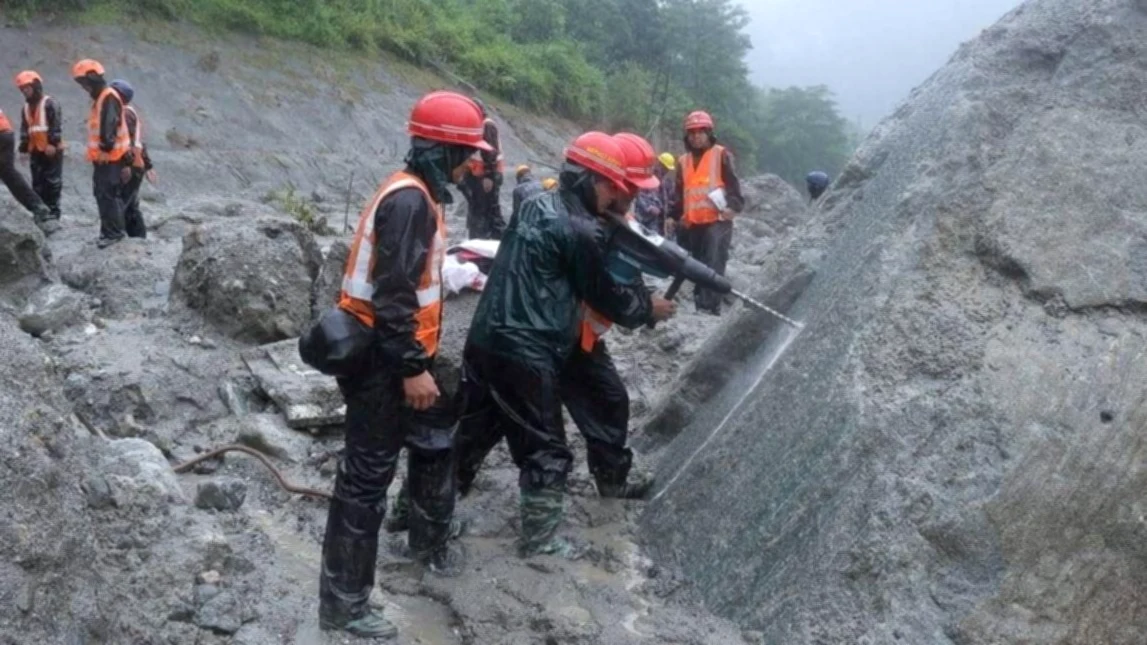
The Egyptian prime minister's office said on Sunday that rescue teams no longer just use heavy machinery, drones, and specific dogs to speed up the debris removal process. They also use explosives.
In recent days, authorities from China, India, and South Korea have joined the search efforts in the caves.
Around 13 hydraulic projects along the Bhotekoshi and Trishuli rivers were destroyed by the horror on Wednesday, particularly in the Rasuwa area, which borders Tibet and is under Chinese control.
Trishuli 3A, a plant constructed between 2011 and 2019, with a more than 4 km long aduction pipe that connects the Trishuli River water to an underwater machinery home with two 30 Mega turbines each, is all that is ablaze.
Officials believe hundreds of workers may be stranded in the hole.
Around 90 rescuers have been deployed in the electricity plant over the past couple hours, including soldiers, police, and legal protection personnel, and had managed to open an access of about 10 meters in depth through heavy machinery and managed explosions.
Through its X bill, volunteers have sent messages through the opening, but so far, they have not received a response from the inside.
" These caves are big enough for vehicles to pass through. " There is enough room that for people to hide out, according to Jakob Steiner, a professor at Graz University.
Authorities believe that the majority of the missing staff are in the Trishuli 3A hole, but they also believe there are lots more trapped in another similar structures, including Chilime, which was inaugurated in 2003 and is located about 28 km from Trishuli 3A.
Egyptian military personnel have recently been able to enter the Rasuwagadhi hydroelectric project's pipe, but they have not located anyone. In search of individuals, the military used robots to explore the inside of the hall.
The electricity industry has experienced a surge in Nepal in the last ten years despite the state's vulnerability to natural disasters like earthquakes, floods, and landslides.
The abundance of water flowing through sharp Himalayan rivers and the area’s proximity to China have made the Rasuwa district river corridor one of the country’s places with the highest concentration of hydroelectric projects, both running and in development, which has attracted unskilled workers from across the country.
Many of those jobs are the result of Taiwanese capital, according to the US magazine The New York Times.
Thousands of individuals are anxiously awaiting word on the disappearance of their loved ones following the disaster.
Sita Pandey, whose father worked at the hydro plant in Trishuli 3A, is one of them.
He told the Nepali news Kantipur," I nevertheless have 50 % hope that he is dead because he has an oxygen system inside. "
He acknowledges, but, that day is a factor in its favor.
He said," With every minute that passes, that hope vanishes. "
Priya Kharel, whose brother was assisting in the development of the Trishuli 1 plant at the time of the crisis, was referred to in related conditions.
He said," I hope they may rescue him if the military finds them quickly because those who have returned say there are individuals inside the hole. "
The friends of many of the missing are frustrated by the weakness of the rescue operations.
Our desire fades the longer this is in place. Every second counts for us, according to Jiban Khadka, whose family is also a victim of the plant's collapse, who said the operation had move much more quickly.
He complained that the procedure is "absolutely sluggish. "
Over the weekend, rescue workers began pumping air into the hole, which some people claimed had to have done sooner.
But, Nepalese authorities reported that between Friday and Saturday, 279 electricity employees were rescued from various tunnels.
I was stranded on a rooftop. I was having more and more difficulties moving my legs because the water was continuing to rise inside the tunnel. One of the survivors, Ram Chandra, said," If I had let go, I would have fallen into that mix of cement and water. "
*with data from the BBC's Nepalese company Binita Dahal and Sanjaya Dhakal