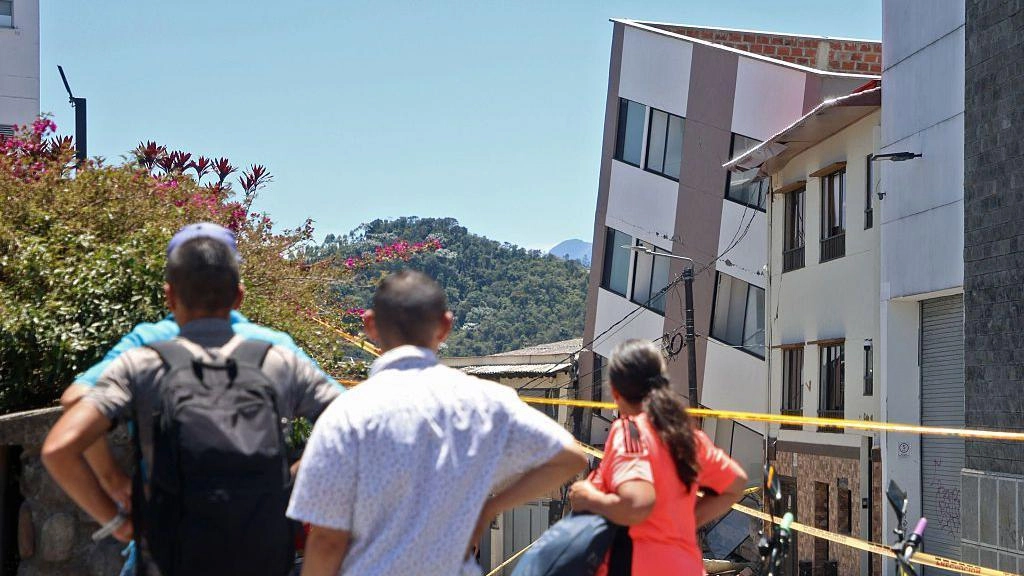

"My office, everything was gone. Nothing was left."
This is how Paula Mejía laments, a dentist from Manizales, one of the cities most affected by the 7.4 magnitude earthquake that shook Colombia this Monday.
The police allowed him to enter to see what he could save from his clinic, but he tells BBC Mundo that he still does not dare to calculate the losses.
The earthquake, recorded at 7:34 in the morning, had its epicenter about 20 kilometers from San José del Palmar, in the department of Chocó, and at a depth of 96 kilometers, according to the United States Geological Survey (USGS). And the Colombian Geological Service described it as “the largest recorded in Colombia during the last decade.”
And although Manizales, capital of the department of Caldas, is located about 90 kilometers away, on the other side of the Western mountain range, its mayor, Jorge Rojas, has described the situation in the municipality as “complete chaos.”
So far, the official death toll in the city is five, while the national total exceeds one hundred, and the structural impact is extensive.
In the absence of a complete x-ray, “because the priority is to address the emergency,” the mayor announced that there are more than 15 buildings completely collapsed and close to a hundred with partial damage.
“It is a critical and difficult moment for our city,” he told RCN Radio. The earthquake “here was impressively strong and we have gigantic damage.”
fallen buildings
It is not the first time that Manizaleños have faced an earthquake.
Already in 1999 they felt the impact of the 6.1 magnitude earthquake, which had its epicenter in Córdoba, in the department of Quindío, 21 kilometers deep, and which left 1,185 dead, 8,536 injured and more than 35,000 homes destroyed or uninhabitable in the region.
This Monday, while waiting for conclusive official figures, one of the images of Manizales that has perhaps been most widely spread from Manizales is that of the cathedral, with its northeastern tower tilted due to the earthquake and the evangelists that it used to have at the top of the spiers fallen.
But a tour of the city makes evident the destruction of the infrastructure beyond.
One of the collapsed buildings was located on Santander Avenue, in front of the Catholic University, and was generally occupied by students.
At the close of this report, the area remained cordoned off and relief agencies continued to work there, as in other sectors of the city.
To be a working Monday, the shops should be open and the avenues full of cars and buses, and yet, the roads look empty.
José Barreto works at the Patty fruit store, in the popular El Cable sector, one of the most affected. A wall of an adjacent store collapsed and had to close.
"We are left without water and electricity for the moment. Sales are serious, until they let us reopen," he says.
About 100 meters to the east, on Santander Avenue itself, is the Parque Médico building, a complex of medical and insurance companies that is usually very busy at the exact time it shook.
From my building I could see how a huge part of a wall of the complex fell off, falling to the street and burying a parked red vehicle.
On the north side of the Medical Park, and on Juan Antonio Toro Avenue, is the Area Cable building. In front of the entrances to their parking lots, another piece of wall from the offices of an insurance company fell. Among the rubble are forms with the letterhead of Seguros Bolívar.
Jorge García was on duty as a security guard, just four meters away. "First the facilities shook. Then I heard a very loud noise, which was the wall of Medical Park. Thank God there were no vehicles entering or leaving, nor pedestrians," he said.
Outside, at Café Tostao, a pergola also fell.
The security guard says that two people were injured by shrapnel. Now he works from the street, while engineers finish the review of the building.
“What follows is critical”
Mayor Rojas called on the population to stay away from the affected structures.
"We ask people not to get into the rubble, please, because that is a risk. That everyone stays in their homes and that no one takes out the vehicles to be able to continue working," he said in his interview with RCN Radio.
He also reported that a contingent of 500 members has been organized to respond to the emergency, and that a shelter has already been set up in the city's main coliseum and that two more are planned to be opened.
He reported the suspension of classes and called on the population to stay at home and not buy massively in supermarkets, “because there will be no shortages.”
Likewise, "we are doing all the administrative tasks to move resources for what comes next, because what comes next is very critical. We cannot leave buildings half collapsed for weeks. That has to be addressed in the next two or three weeks," he stressed.
And he clarified that the municipal authorities are coordinating with the general director of the Risk Management Unit and the Minister of the Interior, and that the president, Abelardo de la Espriella, is aware of the situation in the city.
For his part, the president, who took office on Friday, indicated in X that he ordered the installation of a Unified Command Post that brings together different institutions to coordinate decisions in caring for the victims at the national level.