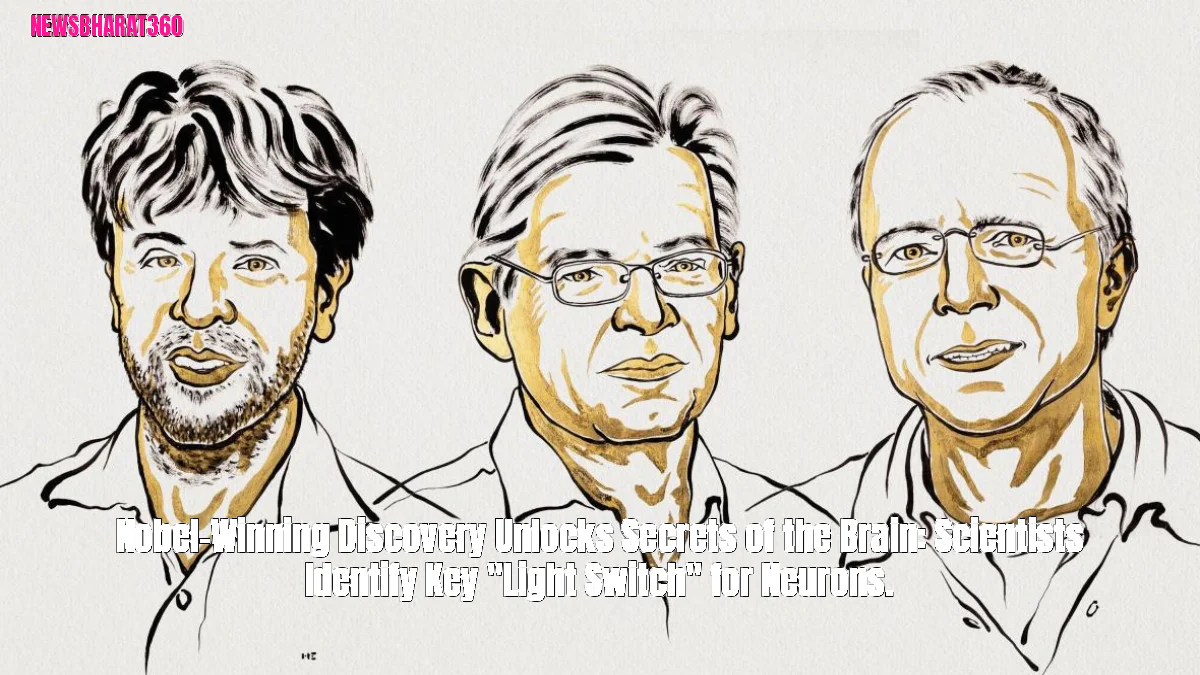

The Nobel Prize in Physiology or Medicine was conferred upon American psychiatrist and neurologist Karl Deisseroth, in conjunction with his German colleagues, Peter Hegemann and Georg Nagel, in recognition of their groundbreaking contributions to the field of optogenetics.
Neuroscientists utilize this field of study to gain insight into the roles that distinct cell types play in complex behaviors, including learning, fear responses, addiction, and motor functions.
Researchers are optimistic that advancements in this field may soon yield effective treatments for neurological and sensory disorders, including Parkinson's disease and epilepsy.
The Nobel Assembly has acknowledged the significant advancements made possible by optogenetics, enabling researchers to uncover the complex neuronal circuits underlying specific memories, emotions, and behaviors associated with neurological and psychiatric disorders.
Researchers are currently investigating the potential of this technology to restore vision in individuals with visual impairments through clinical applications.
The Nobel Prize organization has recognized the discovery made by scientists Peter Hegemann and Georg Nagel of a protein called channelrhodopsin in a unicellular alga.
Karl Deisseroth later transformed the technology into a light-activated switch that enables the control of neurons, marking a significant milestone that paved the way for a new era in neuroscience.
The concept of a neural switch has garnered significant attention in the scientific community, prompting a deeper exploration of brain function. Understanding the neural switch is crucial in advancing knowledge of how the brain processes information and regulates various physiological and cognitive processes.
Researchers Hegemann and Nagel identified the therodopsin canal on the surface of a phototrophic unicellular alga in the year 2000.
A specific protein responds to blue light by creating a pathway for ions to pass through, resulting in the production of an electrical impulse.
Scientists discovered that when the light-sensitive trait was incorporated into various cell types, those cells gained the capacity to react to light-based signals.
Stanford researcher Deisseroth engineered the rodopsin channel to function as a light-activated switch for neurons, enabling the selective activation or deactivation of specific neurons in the brains of mice using a blue light beam.
Researchers have developed a technique that enables the detection and modification of neural circuits linked to memory and behavioral patterns.
Researchers have successfully developed a method allowing for the manipulation of memories in mice through the application of light stimuli, enabling both the removal and recovery of memories.
Researchers are utilizing optogenetics, a cutting-edge field that enables precise and efficient interventions. This approach allows scientists to selectively activate specific groups of neurons at high speeds, mirroring the natural communication patterns of these cells.
Advances in precision have paved the way for researchers to explore complex phenomena, including memory and addiction, as well as debilitating diseases such as Parkinson's disease and depression.
Researchers have developed a method utilizing light to selectively activate or inactivate specific neuronal circuits in the brain, enabling them to revive memories, induce sensations, influence behaviors, and investigate the types of neurons associated with various psychiatric and neurological disorders.
The committee has also gained valuable insights into the complex interactions between the nervous system and cells from other bodily systems, including the cardiovascular and gastrointestinal systems.
The committee noted significant progress in the application of optogenetics as a potential medical treatment, marking the beginning of its exploration in therapeutic contexts.
Researchers are conducting ongoing clinical trials aimed at restoring vision to individuals affected by retinitis pigmentosa, a degenerative condition that progressively damages the retina's cone cells and rod photoreceptors.
Researchers have developed a novel treatment for vision loss by introducing a protein derived from algae into damaged eye tissue. This protein is then activated by light-emitting glasses, allowing patients to partially restore their vision.
Three researchers will receive a prize totaling 12 million Swedish crowns, which is equivalent in value to approximately $1.192 million.
Stanford University's Deisseroth, Humboldt University's Hegemann, and the University of Würzburg's Nagel are based in California, Berlin, and Germany, respectively.
The award recipients expressed their gratitude, describing the experience as truly exceptional and stating that it was a privilege to share the recognition with their colleagues and friends.
The Nobel Prize in Medicine for 2025 was jointly awarded to American researchers Mary Brunkow and Fred Ramsdell, as well as Japanese scientist Shimon Sakaguchi, in recognition of their groundbreaking discoveries in the field of peripheral immune tolerance.
Scientists have pinpointed a specific subset of immune cells known as regulatory T cells, which play a crucial role in preventing the immune system from mistakenly targeting the body's own tissues.
The announcement of the awards began this week, with the first award being revealed, followed by the Physics award on Tuesday and the Chemistry award on Wednesday.