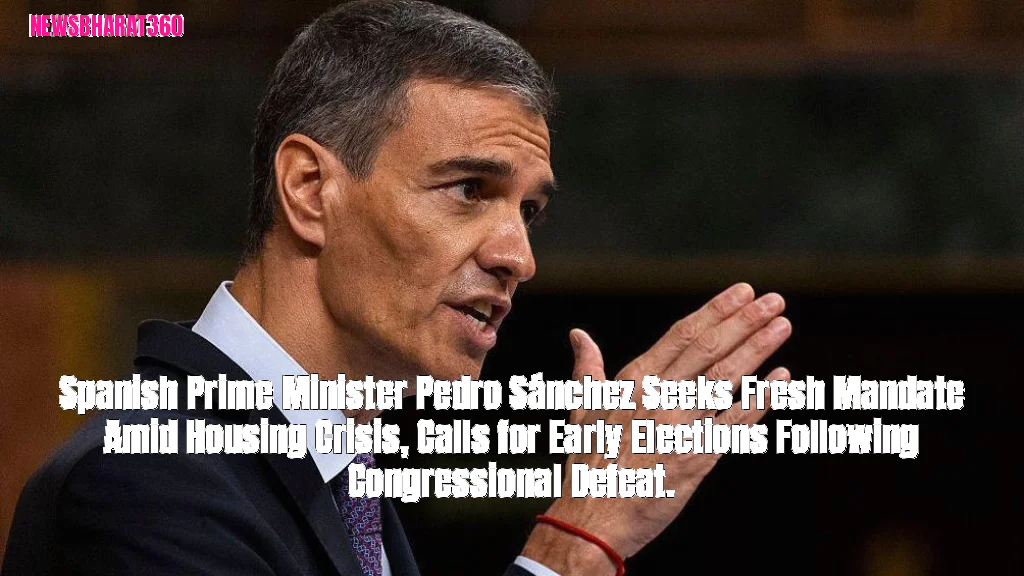

Spanish Prime Minister Pedro Sánchez announced at a meeting from the Moncloa, the government palace, that he has scheduled general elections to take place on November 29.
The speaker acknowledged that their organization has made errors and fallen short of its intended goals.
Significant social disparities and unmet needs persist in various areas, including income inequality, public services, and affordable housing, necessitating continued efforts to address these pressing issues.
It is now up to the Spanish people to determine the course of their nation's future, making a choice that will shape their own destiny and that of their country.
Spanish Prime Minister Sánchez stated that his country has achieved the highest economic growth and job creation within the European Union, with notable declines in inequality and poverty levels, albeit with remaining high rates.
The government has made significant efforts to create a more improved global environment.
Spain has established itself as a global model for peace, feminist values, and economic prosperity.
Large crowds of protesters gathered in cities and towns across Spain over the weekend, calling for enhanced rights and protections for renters, following the government's inability to pass a critical housing crisis bill in Parliament on Friday.
Following widespread public outcry, the left-wing coalition government led by Sánchez introduced measures on Friday in response to the eviction of 87-year-old Maricarmen Abascal from her home due to an unaffordable rental increase.
A recent dispute over a retired woman's home in Spain ultimately led to a resolution, allowing her to return to her residence. However, the incident prompted widespread protests across the country, with demonstrators calling for reduced rents, an end to evictions, and a ban on investment funds, commonly referred to as "butter funds," from acquiring properties.
The loss of confidence vote by Sánchez in Congress on Friday has prompted him to consider calling for early general elections.
Alberto Núñez Feijóo, president of the Popular Party, welcomed the positive developments in the election polls following a statement by Sánchez.
The Spanish people will collectively make a decision, encompassing the entire nation, rather than a select few or a single individual.
The outcome of the election is not merely a victory for the PP, but rather a significant shift in Spain's political landscape, with Sánchez emerging as the winner and embodying the country's new direction.
Vox party leader Santiago Abascal has expressed support for the proposal to hold early elections.
In an appearance on Antena 3's Public Mirror program, he observed that the upcoming elections will be marked by significant uncertainty, despite current polling trends suggesting otherwise.
The individual has developed a sense of self-awareness and caution, recognizing the importance of avoiding situations that may lead to adverse outcomes and refraining from taking premature action.
During the 2023 elections, Vox and the Popular Party initially held a strong lead in the polls, yet it was Prime Minister Sánchez who ultimately formed a coalition government.
Senior officials within Sánchez's government have issued statements in response to the recent announcement.
Second Vice President and Minister of Labour Yolanda Díaz expressed confidence in a social media post, stating that her party will achieve victory with increased momentum.
The government aims to increase rental income by reducing the number of days required for rentals, while continuing to rise the Special Municipal Income tax, in an effort to boost local revenue with a sense of optimism and renewed hope.
Spanish Health Minister Mónica García stated on the social media platform X that the Spanish people will rise to the challenge and overcome the international community's negative perceptions and hatred.
On November 29, a group took to the streets to assert their right to housing and protect freedoms from those who would seek to undermine them.
Spanish Justice Minister Félix Bolaños expressed optimism regarding the upcoming November elections.
Pedro has returned to his classic form, abandoning PPVox in a state of disarray and without government oversight.
The Spanish Socialist Workers' Party (PSOE) is poised to emerge as the leading force following the November 29 election, as citizens will cast their votes in favor of those who prioritize their protection and well-being over those who may pose a threat.
Catalan regional leader Salvador Illa emphasized the need for decisive action, stating that the time has come to choose between progress and regression.
The official expressed his backing for the Spanish Prime Minister Pedro Sánchez, stating that Catalonia will stand with him.
Madrid residents polled by Reuters expressed support for the decision to hold early elections.
Manuela Feria expressed her opinion that the current situation is unacceptable, stating that elections are urgently needed to address the country's problems, which she believes are being exacerbated by the current state of affairs.
The meeting could have been held sooner, according to Ramón Díaz.
Youth in the country face uncertain prospects, and there is a desire for a left-wing administration to be established.
Florencio Díaz has hailed the demand for elections as a significant victory.
A significant milestone was achieved in the ongoing struggle for social change. Until recently, the prospect of this outcome was unforeseen. However, last Friday's events starkly highlighted Congress's disconnect from the everyday challenges faced by citizens, particularly the escalating cost of living and the pressing issue of housing abuse.
Many individuals, such as Sandra, are clinging to their visions of what the future holds.
Concerns about the current government's effectiveness have been expressed, with some individuals fearing potential consequences of inaction.
Congress rejected a pair of legislative measures on Friday, breaking them down into two separate decrees.
Key measures introduced include a moratorium on evictions of vulnerable tenants until 2030, a two-year extension for rental contracts set to expire prior to 2028, increased taxes on tourist apartments, and a restriction on the acquisition of residential properties by "utre funds.
The second decree contained provisions for the automatic renewal of rental contracts, a key demand of many left-wing members and the Rental Union.
Deputies overwhelmingly rejected the initial decree with a vote of 178 against 172, and the second decree was also met with strong opposition, with 184 deputies voting against it and 166 in favor.
Ahead of the vote, the conservative Popular Party and the far-right Vox had expressed opposition to both proposals, placing the minority government in a vulnerable position, reliant on the support of smaller nationalist parties in Catalonia and the Basque Country.
On the eve of the parliamentary session, the right-wing independentist party Junts per Catalunya (JxCat) had expressed its opposition to the initiative, effectively dooming it to failure.
A series of decrees was drafted last week amidst a significant protest movement, which culminated in the establishment of a campsite in Madrid's central Puerta del Sol on September 26.
A pivotal event, the eviction of Abascal, served as the catalyst for widespread protests, shedding light on the severe housing crisis plaguing the European nation.
A disturbing scene unfolded in Madrid's city center, where images of Abascal being transported by paramedics on a camel from his long-time residence, a home he had rented for 70 years, sent shockwaves throughout the nation.
Despite a resolution being reached with the property owner, allowing for a return home, the underlying issues that led to the situation remain unresolved.
The recent controversy has reignited a long-standing public concern in Spain, with affordable housing emerging as one of the issues that consistently ranks highest in public opinion surveys.
A recent report by the Foundation for Social Studies and Applied Sociology (FOESSA) indicates that in 2024, nearly 25% of Spanish families reported difficulties in accessing or converting their homes.
The issue of housing in Spain is a complex one, driven by multiple factors, despite ongoing increases in property prices.
A significant number of vacant homes are scattered throughout the nation, with the majority located outside of urban areas, where housing demand is typically higher.
Approximately 750,000 residences are believed to be without a permanent dwelling.
The rate of new housing construction remains low, primarily due to several factors including the limited availability of land in major cities, rising material costs, and a shortage of skilled labor.
Investigative reporting by a team of journalists, including Alicia Hernández, Ella Kipling, and Juan Francisco Alonso, provided key insights into a significant news story.