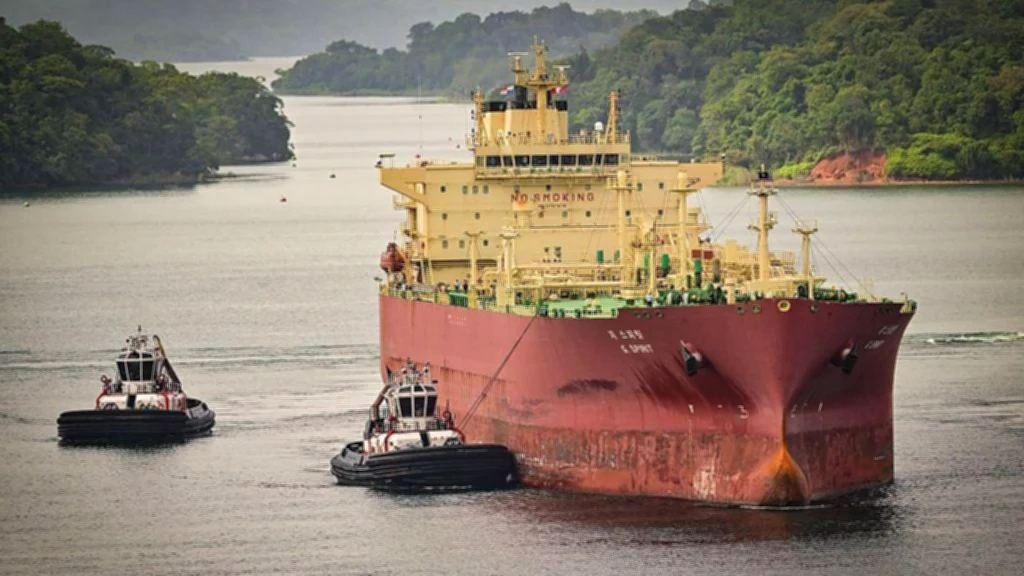

“We are facing a new challenge.”
With these words, the Panama Canal Authority (ACP) headed an entry on its website to describe the reduction in rainfall, aggravated by the El Niño phenomenon, which again forces to limit the number of ships transiting the most famous interoceanic route in America.
From this Thursday, the number of ships crossing the Canal will pass from an average of 36 daily to 34.
The decision, the ACP said, is necessary “to support the long-term sustainability of transit operations.”
El Niño, which this year is recorded with a great intensity, is a natural climate pattern associated with warmer temperatures than usual in the waters of the central and eastern areas of the tropical Pacific Ocean.
In some areas of Panama, including the Canal Basin, this has resulted in a reduction in rainfall, a trend that could worsen in the coming months.
“Al Panama is in rainy season, the precipitation observed in the basin has been lower than expected,” the ACP said in an email sent to BBC Mundo.
Any alteration in the operation of the Canal can affect both global trade and the Panama economy.
Through this route it transits about 6% of world trade and generates more than $3 billion annually for the Panama State, Carlos Arauz García told BBC Mundo.
“When disruptions occur, we see a disruption in the world’s supply chains and logistics connectivity,” the expert said in an interview prior to the start of the restrictions.
This is not the first time the road faces such a scenario.
Three years ago, one of the worst droughts in its history forced the ACP to restrict traffic. Some ships remained waiting for weeks and shippers came to pay millions of dollars to get a quote.
The current episode also occurs at a time of severe alterations in international maritime transport. The war in Iran has reduced shipping through the Strait of Hormuz, another of the main routes of world trade.
But what does the Panama Canal have that makes it especially vulnerable to the lack of rain?
The answer lies in a fundamental feature of its construction, which distinguishes it from other channels in the world.
The Panama Canal connects the Atlantic Ocean with the Pacific Ocean and shortens the distances of sea travel, preventing ships from having to surround entire continents.
But unlike other channels, such as Suez, where ships sail at sea level, in the Panamanian system they must climb about 26 meters to cross Lake Gatun, environmental consultant and researcher Manolo Zárate told BBC Mundo.
The reason lies in the origin of the work.
At the end of the 19th century, a French company attempted to open an interoceanic route by excavating the Panama mountain range to create a passage at sea level.
But the magnitude of the challenge, combined with financial and health problems, caused the project to fail and led the company to bankruptcy.
When the United States resumed construction, it opted for a different solution: it created Lake Gatún and the Alajuela Basin and built a system of slopes to raise the ships up to the lake and allow them to complete the journey between both oceans.
“The locks function as water lifts,” explains Ilya Espino de Marotta, sub-administrator of the ACP who will take over as the first woman to lead the entity this September.
The system can be understood as a series of concrete cameras.
When a ship enters one of them, it is filled with fresh water and the boat rises to reach the level of the next.
Once the vessel arrives on the other side of the Channel, the opposite happens: the cameras are empty and the vessel descends until it reaches sea level again.
All works by gravity.The water that enters the shells is not pumped, says Espino de Marotta.
The operation is “simple” to understand, Zárate says.The challenge lies in maneuvering the ships inside the slopes.
To do so, in two of the slopes the Canal uses trailers: small, but enormous-powered vessels, which help to manoeuvre and stabilize the ships when entering the chambers.
In other three, it uses locomotives that, as if they were trains, guide them through the locomotives.
Each transit through the Canal, which has a length of 80 kilometers, can take between eight and ten hours.
And each exclusion process requires between 51 and 55 million gallons (between 193.1 and 208.2 million liters) of freshwater from Lake Gatun.
One part of this huge amount of water is reused; another ends up in the sea.
Lakes are the key to the Channel’s vulnerability to droughts, because the water that feeds them comes entirely from rain.
In August, the Panama government declared a state of emergency due to the lack of rainfall associated with the El Niño phenomenon.
Between April and August, the cumulative rain deficit in the Panama Canal basin reached 35.8% of the historic average. June was the dryest month of the year, with 44% less precipitation than average, and there are no signs of a short-term recovery, the ACP said.
Until the publication of this note, Lake Gatun level remained at 84.2 feet (25.66 meters), below the 85 feet (25.91 meters) that the ACP considers optimal.
Although the difference may seem small, the problem is not only in the current level of the lake, but in the amount of water that can continue to enter the system.
The ACP says that, because the rains of the last months have been below expectation and to the weather projections on the intensity of El Niño, the Canal decided to adjust its operations in a planned way.
In a statement, the government of Panama warned that conditions associated with the El Niño phenomenon could worsen between October this year and March 2027.
The Panama Canal is not only key to world trade.
Its lakes also supply drinking water to two million people from Panama City to Colón and La Chorrera, as well as supporting essential services such as hospitals and schools, and economic activities including airports and.
“By 2023 we will restrict the number of ships so as not to impact the consumption of the population. That’s something we want to avoid in the future,” ACP deputy administrator Ilya Espino de Marotta told BBC Mundo last May.
During the water crisis of 2023 and 2024, the number of daily transits was reduced to 24.
According to Espino de Marotta, this caused a 21% drop in annual ship transit and meant about $900 million less in contributions to the Panama State.
And, of course, the impact transcended the borders of the country.
According to a 2024 report from the United Nations Conference on Trade and Development (UNCTAD), the drought in Panama coincided with the Houthi rebels' attacks on commercial vessels in the Red Sea, which altered navigation through the Suez Canal.
The combination of both crises raised shipping costs, raised fleet tariffs and generated global inflationary pressures.
The restrictions can also have long-term consequences for the interoceanic pathway, commented economist Carlos Arauz García.
“It’s not a monopoly,” the analyst warns, so shipping companies can opt for alternative routes if the Canal fails to guarantee a smooth transit.
One of the most sensitive connections is the one that connects Asia, especially Chinese production, with the east coast of the United States, continues.
To reduce its vulnerability to future droughts, the ACP is pushing for the construction of a new reservoir by repressing the Indian River in the Colombo province.
However, the project, whose construction is scheduled to begin in 2027, would require the resettlement of more than 30 communities, a measure that faces opposition from some inhabitants of the area.
The Indian River dam would give the Canal about 50 years of water security, ACP says.
Consultant Manolo Zárate agrees with the project, but considers that it will not be enough.
He also believes that Panama should economically develop the country’s interior and create development poles that reduce migration to areas near the Canal, where the population is concentrated in search of better employment opportunities and increases the demand for drinking water.
Arauz García also considers the construction of the reservoir to be urgent.
He adds that communities that could be displaced should receive financial and educational support to facilitate their relocation and make it possible to give a longer life to the Canal, a work that, in his opinion, does not only belong to the Central American nation.
“Incidentally, it’s in Panama, but its global impact is transcendental,” he concludes.
Graphic by Daniel Arce-Lopez, of the BBC World Visual Journalism team.