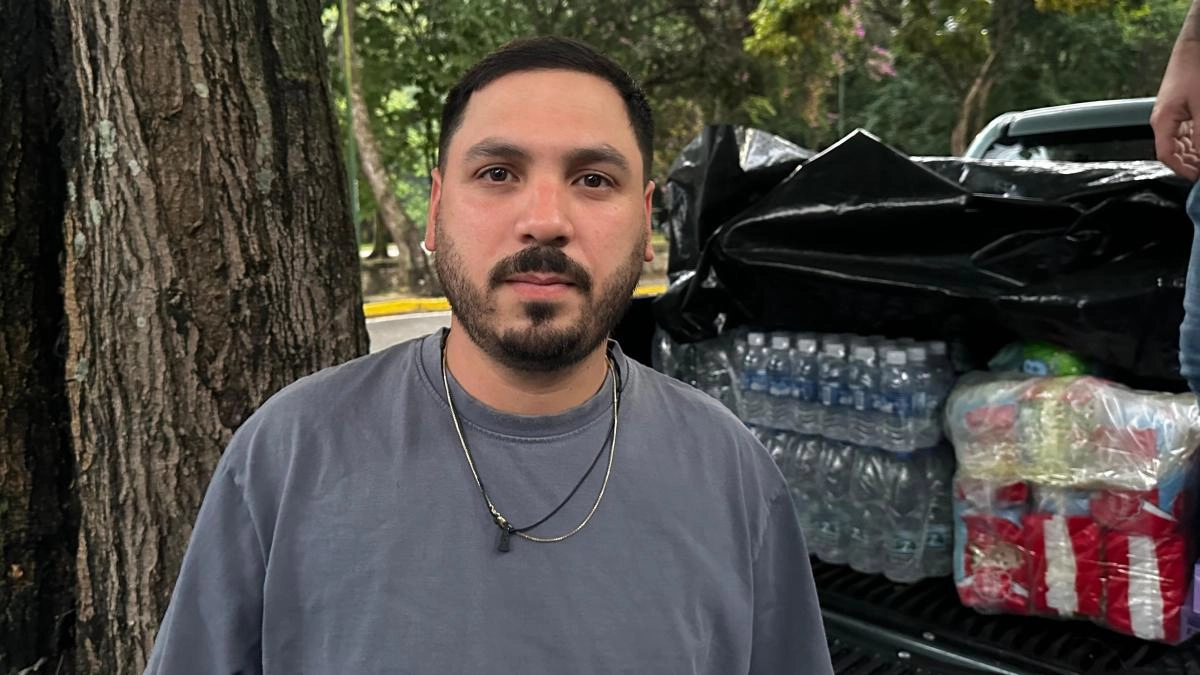

On June 25, Victor Andrea D’Orsi was with his friends at their Al Giorno restaurant in Maturín, about 500 kilometers from Caracas, when he learned of the level of destruction left by the double earthquake that struck northern Venezuela the previous day.
“I had read something during the night, but we hadn't heard about the whole tragedy. The power had gone out in many places. There was no signal or social networks for hours after the earthquake," he tells BBC Mundo.
He says the images moved him immediately. Together with four friends, he decided to act.
“We wondered how we could help. And the truth is that we don't know anything about pickaxes and shovels, we only know how to cook," he adds
He explains that his goal was to "do our bit for those who were on the street without eating."
At one o'clock in the morning on Friday, he gathered pots and other belongings from his house and hurried to take the road to Caracas.
After a journey of a day and a half, in which he says that they were injured and "everything" happened to them, they finally arrived in La Guaira.
His first stop was the José María Vargas Hospital in La Guaira, where he says they distributed food and medical supplies to the children.
“There was chaos, because a lot of people wanted to help and didn't know how. It was desperate. No one knew what to do,” he recalls.
On Tuesday, authorities reported that at least 3,685 people had lost their lives to earthquakes, nearly 17,000 had been injured, while tens of thousands were still missing.
Victor's decision is just one example of the many expressions of solidarity that have taken place in Venezuela since the earthquake shook the country two weeks ago.
Victor's initial plan was to cook in La Guaira, but the sanitary and logistical conditions - and the state of the area - forced him to change his mind.
He wanted to settle in Caracas, but he wasn't sure where. He also didn't have a place to stay.
He started cooking in the middle of the street, in an affluent neighborhood east of the capital, with a gas tank loaned to him by a neighbor.
But soon the complaints came. The residents of the street told him that he could not cook there, in the middle of the public road.
Eventually, someone lent him an evicted house that would become his center of operations.
Little by little, more people joined his initiative.
"I didn't know this woman and she has become a hand of God: we all call her ‘aunt'," she says, pointing to a woman who prepares vegetables in the kitchen. He says that humor is necessary to cope with long days.
During the day they peel vegetables, skin and chop meat, cook, serve food in plastic containers, clean and receive products that come from other parts of Caracas.
At nightfall, they go to La Guaira to distribute everything.
They come back early in the morning to get up at 10 in the morning and start again. Some sleep on a mattress on the floor.
150-400 meals per day
It's Friday and the menu of the day is rice with chicken.
Eight people collaborate while Venezuelan music plays in the background.
Some chop vegetables, others prepare dressings. There are also those who wash the dishes. Outside in the courtyard, “Chef Victor,” as they call him, stirs the chicken boiling in a giant pot over a large stove.
“A friend told me that there was a group that had arrived from Maturín and was cooking for our people in La Guaira. I contacted them a couple of days after the earthquakes and I put myself to the order," says Crismary López, the "aunt" of the group.
She also spread the word and some of her coworkers have joined in.
Victor explains that each day he works with a different group. Some take turns based on their availability.
He, his friends from Maturín and Crismary, on the other hand, are there every day.
He says that they have distributed thousands of meals, "sometimes 200 or 400 per day, although the first days we did up to 700," depending on how much it yields.
They give them to Civil Protection officials, many of whom have been working without rest and with few hours of sleep, as well as to affected people and, above all, to children.
"We have brought soup, stewed ribs, pasta, rice... We bring good food," he says proudly.
As word of his work has spread, people from other areas of Caracas contact him and send him arepas, bread, water and other supplies for him and his group to transport to La Guaira along with the food they prepare.
Overwhelming solidarity
Venezuelan solidarity in La Guaira since the June 24 earthquakes is overwhelming. You see people who have come from different states of the country.
Some have no relatives in the rubble, or even a direct link to the area. The goal is to help.
While Victor and his team cook in Caracas, many in La Guaira are engaged in removing debris in collapsed buildings whose names they don't even know.
Some transport water and supplies from the capital to the most affected areas. Others collect clothes.
There are even those who offer what little they have: they prepare oats and take them along the coastal state on motorcycles, or they dedicate themselves to distributing coffee.
They also approach the house from where Victor operates to deliver arepas, children's toys, diapers and medical supplies sent by other Venezuelans.
They load everything into the truck and go to La Guaira.
“At first we didn't know who to feed. We would arrive, see the chaos and give it to the first people we met. Now we take it directly to collection centers," he explains.
He says that as a Venezuelan and as a human being it is difficult for him to assimilate the level of devastation.
"I break down inside, because people receive food with enormous happiness. These are people who have lost everything. My skin bristles every time we deliver food,” he adds.
"The number of victims is so great that ours is just a grain of sand," he insists.
"Sometimes we come to a place with 200 arepas or meals and they tell us that there are two thousand people. Obviously it's not enough for everyone."
He also says that he has spoken with rescuers in Spain and Mexico who have told him that this is the first time they have seen a catastrophe of this magnitude.
According to the authorities, about 200 buildings totally collapsed and about 800 were affected.
Once the day is over and I return to Caracas, Victor and his team rest while they talk about what they are going to cook the next day.
"Today he didn't perform much, only 150 came out," laments his partner Luis Silva.
"Maybe tomorrow we shouldn't make chicken but ribs, which are more expensive, but yield more."
The next day the stove is turned back on.
Amidst the devastation, every dish remains a boon to the more than 17,000 victims in the region.