
Although I grew up in Caracas, I was born in La Guaira, a place to which I always returned and from which I have some of my happiest memories. Therefore, coming back now and seeing the destruction caused by last week's earthquakes left a deep impression on me.
I remember on weekends how excited I was as a child when my mother woke me up early to tell me that we were going to spend the day in La Guaira, at my grandmother's house.
It was, as for many Venezuelans, synonymous with beach, sun and fun. For me, furthermore, it was about family, and even about the place where we spent Christmas.
Later, as a teenager, my relationship with La Guaira changed. I was no longer alone with my mother, but with friends.
We were looking for a way to get down from the Caracas valley to the beach: any way to make that 45-minute trip when we couldn't drive yet. We bought what we needed to spend the entire day and returned at nightfall, trying to take advantage of every minute of sunshine.
A couple of times I left without asking permission; When I returned, my mother looked at me out of the corner of her eye when she saw my tan. I wondered where he had been, but I already knew the answer.
Even after I left the country, La Guaira remained present. The Maiquetía airport is the main entry and exit door to Venezuela, so the first thing I see when returning to the country is that: the sea and the great mountain that separates La Guaira from Caracas.
Therefore, being here today is difficult to assimilate for me and for any Venezuelan.
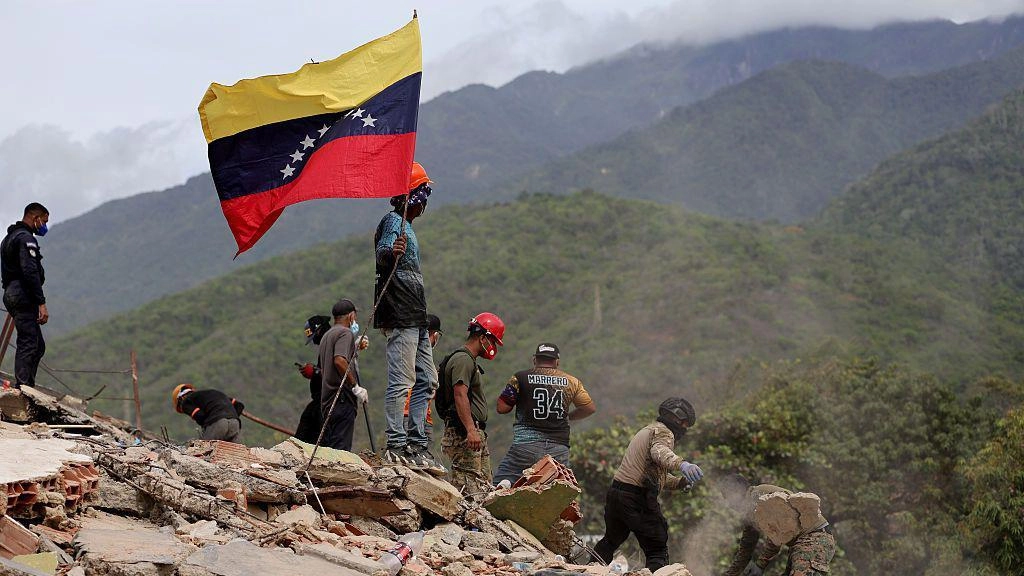
The magnitude of the destruction is impressive. Very little remains of La Guaira that I knew, just vestiges of a city completely transformed by two earthquakes that, in less than a minute, changed everything.
Hundreds of buildings collapsed in the region. The government speaks of thousands of victims and there are estimates of tens of thousands of missing people. But the reality is that the figure remains uncertain. Some speak of more than 50,000 missing people.
The UN resident coordinator in Venezuela, Gianluca Rampolla del Tindaro, noted this Tuesday that, although survivors are still being rescued from the rubble, they are already in the process of acquiring 10,000 body bags.
Another Venezuela
One of my most recurring childhood memories—and one that still gives me peace of mind today—is that of Sundays in La Guaira. After spending the entire day playing with my cousins, we returned to Caracas late at night. I was so tired that I would fall asleep as soon as I sat in the car seat, and my mother would wake me up when I got home.
That was another Venezuela. Another Guaira.
It was no longer the “Saudi Venezuela” of the oil boom of the 1970s—when the currency was so strong that many traveled to Miami to spend excessively—but the country still carried some of that prosperity.
Black Friday and the crisis that followed had passed, but during the 90s there were still traces of a more stable life. I still have memories of that.
It was a country with less insecurity, where you could travel at night without fear, something that would change drastically years later.
And it was a Guaira that had not yet been hit by the Vargas tragedy of 1999, when torrential rains caused landslides and floods that left thousands dead. To date, the exact number of victims is not known and estimates range up to 50,000.
It is also not known precisely how many people lost their homes, although there is talk of tens of thousands. My grandmother was one of them.
We never spent Christmas again in that house overlooking the Caribbean Sea, so present in my childhood.
The Guaira of my memories had not yet been hit by the economic, political and social crisis that would arrive a decade later and that today has left deep marks on the country.
When many Venezuelans were beginning to recover from it, this new tragedy threatens to deepen it.
Humor and solidarity
While reporting on the earthquakes, something unexpected happened to me. Walking through a field of victims, I recognized a face. She was the daughter of one of my grandmother's neighbors. Now he has two children.
He told me that he had seen me minutes before, but that he had been embarrassed to approach me. It's a pity that I saw her there. To see what his life had become after the earthquakes and years of crisis.
He spoke with a lightness that would surprise many, but not a Venezuelan. I have realized that even in the face of so much adversity, many of us resort to humor to talk about the hardest things. So as not to break down, to get ahead.
I have confirmed that during my visits to La Guaira these days. Several of the people I interviewed—some with family members still under the rubble—didn't hesitate to laugh at their own appearance after spending days without sleep.
One of the places I visited was Playa Los Cocos, where many Caracas residents went every weekend. I remember its restaurants, its hotels, the parties.
Today only rubble remains. Exposed beams. Concrete reduced to dust. And the emblematic beach is evidently deserted.
The tragedy has not erased the character of the people. Beyond the pain, anger and loss, what has marked me most is how it has reinforced a characteristic that many associate with Venezuelans: overwhelming solidarity.
I have spoken to people who have traveled from other regions of the country to remove debris from buildings whose names they do not even know. They are not looking for anyone in particular. They just want to help.
Others, who cannot do it physically, collaborate as they can. There are groups that get up at dawn in Caracas to cook hundreds of arepas and distribute them in La Guaira. Others carry coffee, water, clothes.
The José María Vargas Dome, formerly the venue for sporting events, has become a large collection center. There, hundreds of people who lost everything now sleep in tents or on mattresses. Many repeat the same thing: the important thing is that they are alive.
Another form of solidarity is also seen there: women who try to encourage the affected children, many of whom lost their parents. With games and words they try to make them smile. Sometimes they succeed.
“Why does this happen to us if we are a good people?”
I was nine years old when the Vargas tragedy occurred in 1999 and I experienced it closely. My family participated for days in the efforts to help the victims. I remember my mother going down every day with a tense and exhausted face, bringing food to many of those affected, friends and family. At that age, I stayed at home following events on television.
But this time there is something different. This tragedy occurs at a time when Venezuela was trying to rise from a deep crisis that has forced millions to emigrate and has deteriorated the lives of those who stayed. And that makes the blow feel even stronger.
I arrived a day and a half after the earthquakes and quickly became extremely busy, trying to sustain myself. But every day it weighs more.
The seventh morning after the earthquake, I heard a journalist from a local media on the radio who burst into tears live on air. “Why does this happen to us if we are a good and hard-working people?” he asked while trying, unsuccessfully, to hold back his tears. She said that she was a young woman who had been struggling for years to get ahead, but that she feels that it is one tragedy after another.
That moment disarmed me.
The smell of death
I went to Los Silos, an iconic 36-meter structure that dominates the skyline of the historic center of La Guaira and was intervened by the kinetic artist Carlos Cruz-Diez. Given the number of dead, it was set up as an improvised morgue.
Upon entering, the smell of death invades everything.
Hundreds of people arrive in search of their relatives. The bodies lie on the ground, exposed and covered with plastic bags, rapidly decomposing in the sun. Outside, someone whispered that this looked like a horror movie.
Relatives were trying to identify the victims, but many are now unrecognizable.
Not just the smell. The sounds of La Guaira have also changed.
Before, you could hear the waves of the sea, sometimes mixed with conversations and, at other times, with salsa or reggaeton that came from the restaurants and bars in the area, or from the cars and buses that transported vacationers and locals along the coast.
Now the noise of the machinery dominates, the screams of those looking for their relatives. And, in many moments, silence, which is a tool: rescuers stop to listen for signs of life under the rubble.
But other times the silence is pure shock.
I have toured hospitals where families desperately search for their loved ones.
I have also spoken to survivors who spent hours trapped and now live in fear. There have been hundreds of aftershocks.
I felt one myself. On the morning of June 29, an earthquake woke me up at 7:00 in the morning. I spent hours on alert, doubting even my own senses and whether I had just felt another one.
Many friends who lived through June 24 still feel in bed that the world is moving.
A 35-year-old woman told me that she ran out with her two daughters when the shaking started that Wednesday. Its building was fractured, but it still stands. He was one of the few in the Caraballeda area, in La Guaira, who did not give in.
She told me that she tries to stay strong for her girls, like her mother did for her during the 1999 tragedy, when she was only 9 years old.
La Guaira, which was always an escape for the people of Caracas, today is a place marked by anguish.
“We will rise up, as we did after the Vargas tragedy,” they tell me.
I was 9 years old then.
Today, seeing the level of destruction, I wonder how long it will take this time to get up. And what will happen to the thousands of people who no longer have a home, in a country where crises and tragedies happen.
I have never seen my country suffer like this.