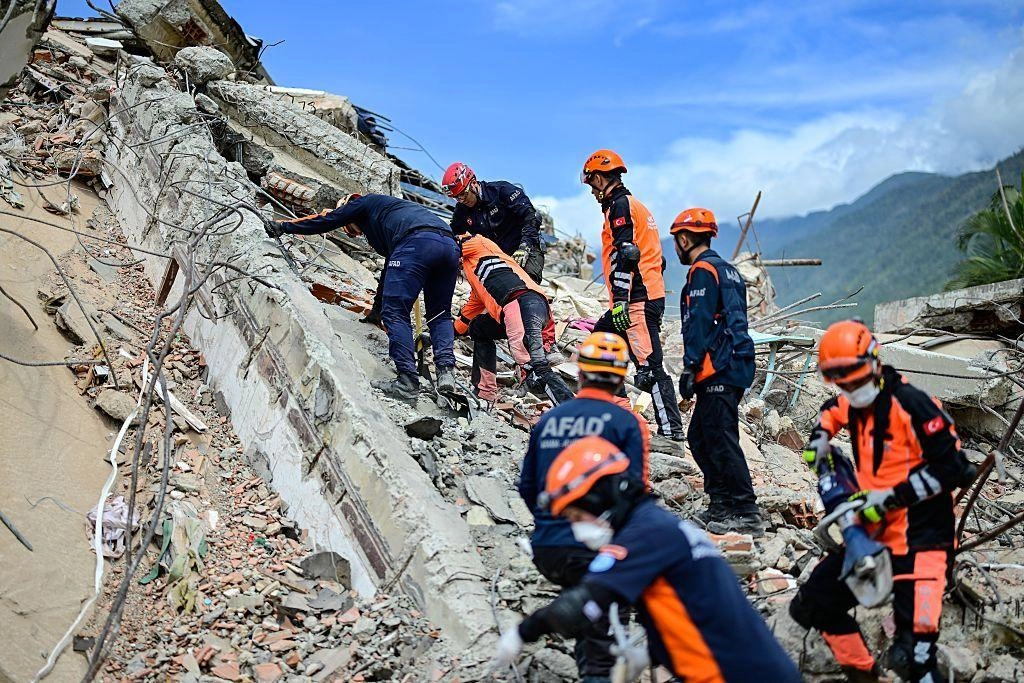

Rescue teams are accelerating their pace to try to find survivors who may still be trapped under the rubble after the two earthquakes that shook Venezuela on June 24 and that, so far, have left some 1,719 people dead, a figure that is expected to continue growing.
The 96-hour period in which there was the best chance of finding survivors ended Sunday night.
However, on the ground, teams remain hopeful of finding people alive and continue search efforts “with the same level of thoroughness as the first day,” according to Lee Ivory, a search and rescue expert, told the BBC.
Ivory is the deputy national coordinator of UK International Search and Rescue (UK ISAR), one of the foreign rescue teams that collaborate with local forces in Venezuela.
Equipped with tools ranging from sniffer dogs to sound detection devices and cameras, rescuers employ a variety of methods to reach those still alive.
Search dogs
Trained search dogs are used to detect where potential victims might be, says Ivory, who has participated in earthquake relief efforts in Haiti, Japan and Nepal, and currently helps coordinate efforts in Venezuela from the United Kingdom.
They are capable of identifying a person's scent even when they are buried under up to 10 meters of debris; When they identify someone, they make a “very loud and sustained bark” to alert rescuers to the presence of a possible survivor.
Dog training is done using toys infused with human scent, Ivory explains. Later, when they locate a person on the ground, their guide gives them the toy as a reward.
Search dogs are also very useful during the technical phase of rescue operations, says Sakthy Selvakumaran of the British charity Search and Rescue Assistance in Disasters (SARAID), which deploys personnel to large-scale disaster situations around the world.
They can find difficult-to-access routes through the rubble to follow a trail or identify different access points to the victim, Selvakumaran explains to the BBC.
sound detectors
One of the most effective ways to locate victims is to “listen very carefully,” says Ivory.
Rescuers shout toward the rubble — identifying themselves and using phrases in the local language — to try to detect if anyone is trapped inside.
They also use seismic and acoustic listening devices — resembling small containers or cans connected via cables to monitoring equipment — to try to locate survivors.
“Essentially, if someone was just scratching at a piece of concrete, we would be able to pick up that sound,” he explains, “even if the person is buried under the rubble of the building.”
Thermal imaging cameras and equipment
Technical search cameras are especially useful because they can be inserted into spaces that are difficult to access.
There are several models, but Selvakumaran — who was deployed to Turkey with SARAID after the 2023 earthquake — notes that they often come in the form of small devices that attach to the end of long poles.
Some cameras offer a 360-degree view that can be recorded and viewed on another device. Video cameras are also used so rescuers “can talk directly to victims,” Ivory says.
The UN humanitarian affairs chief, Tom Fletcher, has noted that microdrones, nicknamed “cockroach drones,” are also being used on the ground in Venezuela.
On the other hand, some rescuers carry thermal imaging equipment that allows them to locate people who “are not directly in the field of vision,” says Selvakumaran.
He explains that the body heat of the trapped person can heat the debris around them, allowing rescuers to “see through certain types of walls.”
Hand tools and heavy machinery
Tools ranging from disc cutters to saws and hand-held angle grinders are used to carry out technical rescues.
“Anything that makes the process of breaking and breaking easier—whether it's going through large blocks of concrete or just breaking through furniture, filing cabinets, or refrigerators—any tool that helps cut through all of that,” Selvakumaran explains.
He says some teams have power tools or diesel generators to power the devices.
Heavy machinery is essential for rescuing people trapped under multiple layers of debris.
For example, excavators, backhoes and cranes can be used to move three concrete floors and locate a trapped person, Selvakumaran explains.
Often, it is local teams that try to coordinate access to heavy machinery to perform the larger tasks of moving and lifting loads, he adds.