
In 1528, a man originally from Morocco arrived on the coast of what is now Texas more dead than alive.
He had spent the previous month adrift in the Gulf of Mexico with a group of Spanish sailors, aboard a precarious raft improvised with tree trunks, horse skin, and the remains of their torn clothes.
When a storm stranded the castaways on a barrier island near Galveston, they unwittingly became the first people from the Old World to venture into the American West; and as they did so, they were all hungry, exhausted, and naked.
In the weeks that followed, the survivors of the shipwreck began to die one by one.
Many succumbed to hunger, others to inclement weather, and some to attacks by indigenous tribes.
Of the approximately 600 men who had set sail from Spain a year earlier on that ill-fated expedition to conquer present-day Florida and the Gulf Coast in the name of the Spanish Crown, only four survived: three Spanish captains and, to some extent, the enslaved Moroccan.
For the next eight years, that man would become the de facto leader of the group and would undertake one of the most extraordinary survival journeys in the history of exploration.
However, we don't even know his real name.
Known variously as Esteban de Dorantes, Esteban el Moro or — more commonly — Estevanico, this enigmatic individual was one of the first documented Africans, Arab speakers and Muslims to set foot in what is now the United States, arriving almost 40 years before the first European settlement.
Between 1528 and 1536, he traveled on foot some 3,620 kilometers westward from Florida to the Pacific coast of Mexico, completing what is widely considered the first recorded crossing of North America and the Caribbean in history, almost 300 years ahead of Lewis and Clark's overland expedition to the Oregon coast.
Along the way, Estevanico was captured by Native Americans, learned their languages, and became a healer, before traveling another 2,100 kilometers south—along with the other three survivors of the shipwreck—from the Gulf of California to Mexico City.
He then set out on an independent 1,500-mile odyssey north and became the first known non-Native American to venture into present-day New Mexico and Arizona.
“Estevanico is one of the most extraordinary, if least recognized, figures in the early history of what would become the American Southwest,” said Hsain Ilahiane, an anthropologist and professor at the University of Arizona who has spent years studying this explorer.
“It helped open routes and trails, and generate geographical knowledge that later served as the basis for Spanish incursions [in what is now the western United States],” he added.
However, most people have never heard of it, even in the US.
Now, as the country celebrates its 250th anniversary and reflects on its origins, a growing number of museums, tours and monuments across the country are highlighting its hitherto little-known legacy.
Estevanico's odyssey
Since Estevanico left no written records, historians have reconstructed his life primarily from the preserved accounts of Spanish survivors who traveled with him.
Born at the beginning of the 16th century in Azamor, he was enslaved by the Spanish nobleman Andrés Dorantes de Carranza, who took him with him on the Narváez expedition to America.
As Muslims were prohibited from traveling to the New World on official Spanish expeditions, Dorantes baptized him and gave him the name Estevanico.
The expedition, consisting of five ships and 600 people, set sail in June 1527 and was a disaster from the beginning.
Some 140 men deserted during a stopover in Santo Domingo and, while they were resupplying in Cuba, a hurricane sank two ships and killed another 50 sailors.
The crew eventually attempted to sail to Mexico, but storms diverted them to present-day St. Petersburg, Florida, in April 1528.
The leader of the expedition, Pánfilo de Narváez, then ordered Estevanico and several hundred men to march north to explore the interior of Florida.
After trudging some 500 miles through mosquito-infested swamps to present-day Saint Marks, Florida, and being ambushed by native Appalachian people, Estevanico and the surviving Spaniards were so decimated and desperate that they slaughtered and ate their last horses, built five makeshift rafts, and sailed along the coast in hopes of reaching present-day Mexico.
As the men drifted west, they became the first non-Indian travelers to sight the mouth of the Mississippi River.
However, the same storms that ended up capsizing their rafts near Galveston caused the death of two-thirds of the remaining Spaniards, including Narváez himself.
Like many of the castaways, Estevanico was captured soon after by Native Americans.
Somehow, the lowest status person in the Old World managed to survive in the New World.
"When the order of the Old World collapsed, Estevanico had certain advantages. Unlike [the Spaniards], he was used to speaking other languages," said Laila Lalami, whose novel The Moor's Account (a finalist for the Pulitzer Prize) is based on the figure of Estevanico.
“Since Azamor was an Amazigh city controlled by the Portuguese, we know that he probably spoke Amazigh, Arabic and Portuguese languages,” Lalami said.
“And, having been a slave to a Spaniard, he also spoke Spanish,” he added.
During the approximately five years he spent doing forced labor for the Karankawa natives, Estevanico learned their spoken language and the sign language shared by other groups in the region.
Later, he secretly coordinated his escape with a rival Karankawa tribe alongside Dorantes, and helped free the two remaining Spaniards.
The leader of the group
Over the next two years, the four survivors walked from the Gulf Coast to the Gulf of California, using Estevanico's language skills and cultural adaptability to move from one indigenous community to another.
“He was the leader of the group: the translator, the mediator, the explorer,” Ilahiane noted. “They were moving through a new world without knowing where they were going, but Estevanico had one advantage: information.”
In the course of his travels, Estevanico met an indigenous merchant and arranged a stay in his community.
While there, a sick woman approached the visitors to ask them to cure her.
By combining Christian rituals from the Spanish with indigenous practices that Estevanico had observed, the men managed to convince the woman that she had been cured.
As news of the men's supposed healing powers spread, indigenous communities began searching for them and even following them on their journey westward.
Estevanico went ahead of the Spanish to announce his arrival; She often wore shell bracelets on her arms and bells on her ankles, as well as carrying a rattle made from a dried gourd.
“It reminds me of a rural Moroccan Sufi with knowledge of medicine who travels from village to village, but who also adopts Native American [cultural] aspects and uses them as a gateway to other tribes during his journey,” Ilahiane said.
“In the end, that would be a bit tragic for him,” he recalled.
The Seven Cities of Gold
After conquering the Aztecs in 1521, Spain had established a colony in what is now central and southern Mexico.
When the four travelers approached Culiacán, in the current state of Sinaloa, they met a group of Spanish horsemen who led them 2,100 kilometers south, to the capital of New Spain (today Mexico City).
There, the four survivors of the shipwreck told stories about golden cities located somewhere in the northern desert; stories that the native tribes had shared with Estevanico, probably to keep outsiders away from their villages.
Determined to locate these so-called Seven Cities of Gold, the viceroy of New Spain sent Estevanico in 1539 to guide a group of Spanish friars northward, entering the current territories of New Mexico and Arizona.
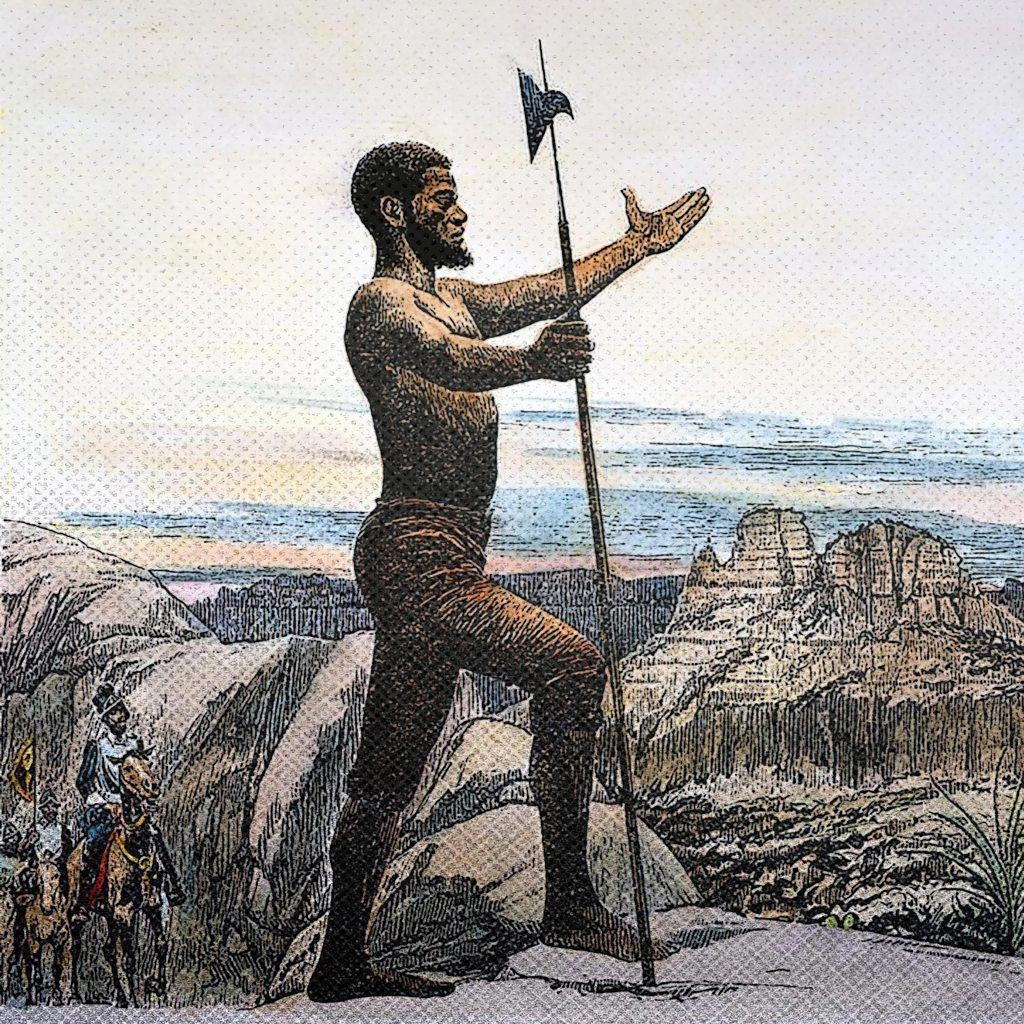
With turquoise jewelry around his neck and feathers in his hair, Estevanico walked at the forefront of the group, acting as the lead scout to gather information about these legendary cities from the native tribes.
If the information obtained was of moderate importance, he sent a small cross to the Spanish by messenger; if it was important, he sent a medium-sized cross; and if it was of great importance, he sent a large cross.
One day, shortly after becoming the first known outsider from the Old World to enter the territory of the Zuni people, Estevanico is said to have sent a cross that was said to be “the height of a man.”
Enthusiastic, the Spaniards rushed to join him, but discovered that, while attempting to enter Hawikuh—the southernmost of the supposed Seven Cities of Gold—he had been killed by the native Zuñis.
Although the Spanish never found golden cities, Estevanico's final voyage led them to what would become known as the New Land, territory that would later prove pivotal to Spanish expansion into the American Southwest.
“Estevanico contributed to shaping the geographical imagination of the Spanish Empire in North America,” said Ilahiane.
"Their travels spread knowledge about routes, towns, and possibilities for expansion into regions that would become Texas, New Mexico, Arizona, and beyond. This final foray into Zuñi territory in 1539 triggered the Coronado Expedition of 1540 [which paved the way for Spanish expeditions and settlements throughout the southwestern U.S.]," the anthropologist explained.
From the introduction of devastating diseases and the displacement of native populations to the establishment of Catholicism and cultural and culinary practices, this Spanish expansion would profoundly shape the future of the nation to come.
“Something in the middle”
For centuries, Estevanico was little more than a footnote in Spanish chronicles and a forgotten figure among Americans.
“That's because its exploration is not tied to the founding myth of the US,” Lalami said.
“It's one of those things that doesn't quite fit into the story of the country's founding that is taught in schools, centered on the 13 colonies and people fleeing persecution in England,” he said.
In the last decade, however, museums, monuments, and tours across the U.S. have increasingly begun to recognize their role in the continent's early history.
"He starred in one of the most amazing journeys into the unknown in history. Someone should make a movie about him now," said David Anderson, owner of Discover Florida Tours.
Since 2017, this company has organized historical guided tours in Saint Petersburg—where Estevanico landed—and recounts his epic odyssey.
A 7-foot-tall bronze statue of Estevanico was erected in 2016 at the Texas State Capitol in Austin to commemorate his role as the first African to set foot on Texas soil.
The El Paso History Museum, in West Texas, has narrated Estevanico's odyssey since 2022 on its interactive digital wall; Likewise, the explorer occupies a prominent place in both the New Mexico History Museum, in Santa Fe, and the Coronado National Monument, in Arizona.
“He is someone who accomplished an extraordinary feat,” said Diana Abouali, director of the National Arab American Museum in Dearborn, Michigan.
"At the museum, we featured it at the beginning of our Coming to America exhibit to show that Arabic speakers are not new to this country. The Arabic language and culture have been present in what is now the U.S. for a very long time," he said.
For Lalami, what makes Estevanico so important is not just what he did, but what he represents.
“He was the first African to cross North America, but what makes him so fascinating is his position,” he said. "He did not come to the United States as a conqueror, nor was he part of the conquered peoples. He was something in the middle."