
Alejandra Gómez looks around the three floors of her house in the north of Lima.
Mirsa Amasifen, her aunt, watches from the door. These two women symbolize the generational effort that went into building the home.
"Building the first floor took ten years. The second six. The third between six and eight. In total, 25-30 years. We have lived here for three generations," say Gómez and Amasifen.
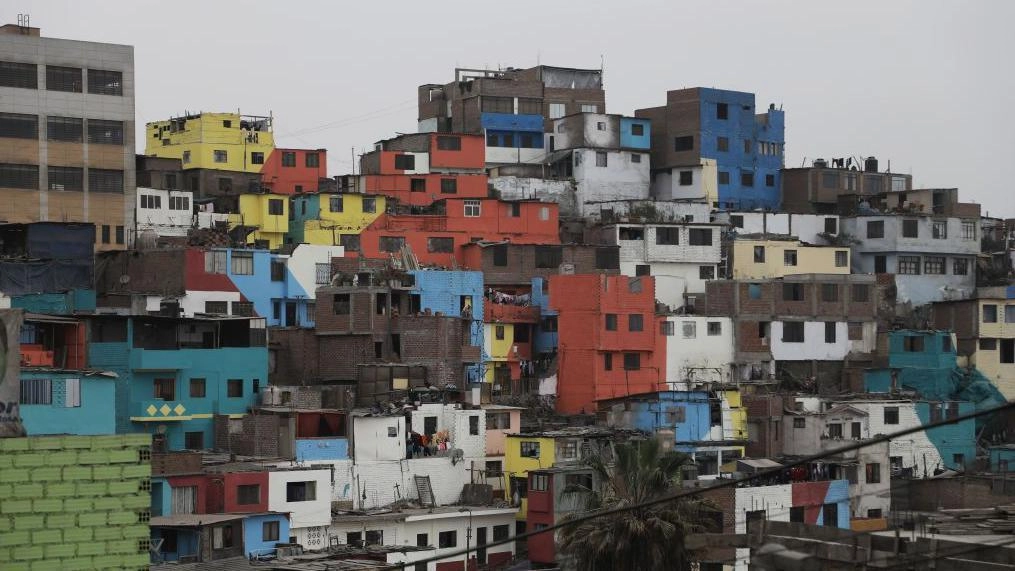
Finished in green and yellow, with glass windows and iron doors, the house stands out in a neighborhood where half-finished homes are the norm, with ceiling beams pointing nowhere and unpainted opaque brick facades.
The scene occurs in Los Olivos, but could be repeated in almost all of the 43 districts of the Peruvian capital and other cities in the Andean country, where concern about the state of tens of thousands of properties has been revived after the deadly earthquakes in Venezuela.
In Peru, countless unfinished properties dominate the landscape, except for the middle and upper class neighborhoods.
“Peru is a country that never finishes being built,” reflects Wiley Ludeña, urban planner at the Pontifical Catholic University of Peru.
He gives the capital as an example. “It's like a giant informal city, as if it were an entire neighborhood under permanent construction,” he says, referring to the informal settlements in which millions of citizens live and that were integrated into this city of more than 10 million inhabitants.
Ordinary Peruvians repeat to me a reason for unfinished homes: "It is profitable. While they are under construction, they pay less taxes."
The reality is more complex. Behind this phenomenon are few resources, families that grow faster than households, policies that encourage more than they solve, and an overwhelming weight of self-construction.
It is estimated that 7 out of 10 houses are self-built in Peru, one of the highest rates in Latin America, according to the Development Analysis Group (Grade), a Peruvian private research center.
After the earthquakes that claimed thousands of lives in Venezuela and destroyed the homes of many others, Peruvian media and experts wonder what would happen if such a tragedy occurred in Peru, where the lack of technical advice and the absence of the State has marked urban growth for decades.
The aesthetics of the neighborhood
Unfinished houses and the prevalence of that aesthetic became accentuated starting in the 60s of the last century.
“Industrialization attracted millions of migrants from the countryside to the cities, creating a housing deficit,” says Ludeña.
“The government thought of self-construction as a solution without the State providing economic resources,” adds the urban planner.
This is how he arrived and later completed his Amasifen house in Lima. He came from the mountains and settled in what were then cornfields and other crops.
"It was populated as an invasion. The neighbors fenced their land. The first houses were made of adobe. Then, over time, concrete could be used," he says.
Although it was born as a neighborhood, Los Olivos is today mostly formal, but the expansion and regularization processes continue. Also the agglomeration of unfinished projects.
"In the beginning, the neighborhoods were a paradise. People built and to this day they continue to build according to their economic possibilities. One year a floor, later another, then the room, another the facade," explains Ludeña.
But over time, says the urban planner, an "authentic urban hell lacking services was generated. A city sickened by the state's neglect of technical advice."
This is reflected in an aesthetic of unfinished construction that, unlike other countries in the region where there is also a notable number of informal and self-built homes, in Peru it is more visible and is not limited to the peripheries or rural areas.
Lack of resources
According to 2023 data from the National Foresight Observatory of Peru, 44.6% of the 34 million Peruvians live in slums, informal settlements or inadequate housing. In 2007 that figure was 49.9%.
Tania Herrera, who has a doctorate in geography from the Université Paris Cité, in France, warns that the numbers could be underestimated and that it is difficult to quantify the families that live overcrowded due to incomplete spaces.
Said Sevilla, a geography student at the National University of San Marcos who researches the phenomenon, guides me through his neighborhood, showing me the prevalence of unfinished houses and the characteristics that define them.
"Look at those columns that stick out from the ceiling. Sometimes it's because they already have a plan to build another floor. Other times it's because the expectation to continue building never ends and they already leave them sticking out so that when they raise money they can continue," he points his finger.
"Notice that few paint the sides of the façade. Here, at any time, the neighbor builds more apartments next door and then, why paint if it's not going to be seen?", Sevilla continues.
Lack of resources is the factor most mentioned by experts to explain constructive lethargy.
Sevilla's mother has barely been able to put together her house after 35 years living in it.
"As you see, it is a precarious little house that is just beginning. My priority has been for my children to study," explains Leonor Palomino.
“The normal thing here is that each house takes at least two or three generations to finish,” says Sevilla.
Professor Herrera adds that “it is difficult to find finished self-built homes because the self-construction itself makes the house susceptible to constant modifications to adapt it to the needs of the family.”
The expert highlights that in recent years housing and overpopulation problems have also led to an increase in rent in popular houses.
This increases the pressure to continue building.
"If it is necessary to put up rooms or apartments for rent, they knock down a wall and put up another; they put in a bathroom and take out another. They modify the houses constantly," explains Herrera.
The State and housing
Julio Calderón Cockburn, a professor specialized in urban social reality in Peru and Latin America at the Lincoln Institute, points out that governments in the region usually have two ways of solving housing deficits.
“A preventive one, which promotes social housing before informality occurs, and another corrective one, which gives property titles and offers services once informality has already occurred,” says Calderón.
The expert believes that the first is the ideal and that countries like Chile, Mexico, Colombia or Brazil are at the forefront of this trend.
"But then there are countries like Peru, without a social housing policy, where informality predominates. What there has been are bond programs, credits and subsidies for demand," adds the professor.
It is difficult for the informal sector to access these bonuses because it does not meet the requirements to access credit and banking.
“These programs serve more the middle or lower-middle classes, but those with fewer resources are left out,” highlights Calderón.
Labor informality affects 47% of employed people in Latin America. In Peru and Bolivia, another country where unfinished works are common, the rate exceeds 70%, according to the International Labor Organization.
Although a law approved in the Peruvian Congress in 2021 established the bases for better urban planning, technical advice and property regularization, Calderón clarifies that it has still not been able to solve the existing challenges.
Some are reproduced from the political class itself.
“In Peru there has been for years a pact of voting by land in which politicians do not intervene in invasions or in the conditions in which Peruvians build their houses out of pure clientelism,” says Herrera.
“Across the country, local governments promote neighborhoods and promise titles and formalization in exchange for stability and status quo,” he adds.
Perceptions and risks
Calderón shares the perception that many Peruvians believe that by leaving their houses unfinished they save property tax.
It's hard to prove. If you ask owners, the normal thing is that they deny it.
Erick Lau, a specialist in real estate and urban planning law, believes that it is not a general motivation and that incomplete properties respond more to economic limitations and other factors.
"It is also a cultural issue that has already become an urban legend. I even believe that there is a romanticization of the rustic aesthetic of informal housing that is dominating the landscape," reflects Lau.
It adds a contagion effect and pragmatism: "If around me they don't finish building the sides and leave them unpainted, I'm not going to make an additional effort. This way I maintain harmony with the environment."
Faced with a worrying increase in extortion in popular areas and neighborhoods in recent years, experts also believe that some tenants leave their houses unfinished to appear precarious and protect themselves.
The phenomenon carries worrying risks that emerge in the conversation after the tragedy in Venezuela.
"Coastal cities, like Lima, are susceptible to earthquakes. Eventually, these self-built and unfinished homes can collapse," says Herrera.
The geographer recalls data from 2014 that indicated that, in the case of an earthquake with a magnitude greater than 7 on the Richter scale, more than one million homes would collapse in Metropolitan Lima alone.
"Since the 70s we have not had a major earthquake. Everything self-built since then has been done in a period of silence; homes without technical assistance or monitoring. We only know what they are like on the outside. We do not know what they are like on the inside," says Herrera.
It is common for those who build their homes to turn to family, friends and neighbors for support rather than specialists.
A recent article in the Peruvian national media El Comercio cites a study by Grade indicating that 71% of the 6.6 million homes in the country were self-built.
And that, of those, only 3% reach an adequate level of quality.