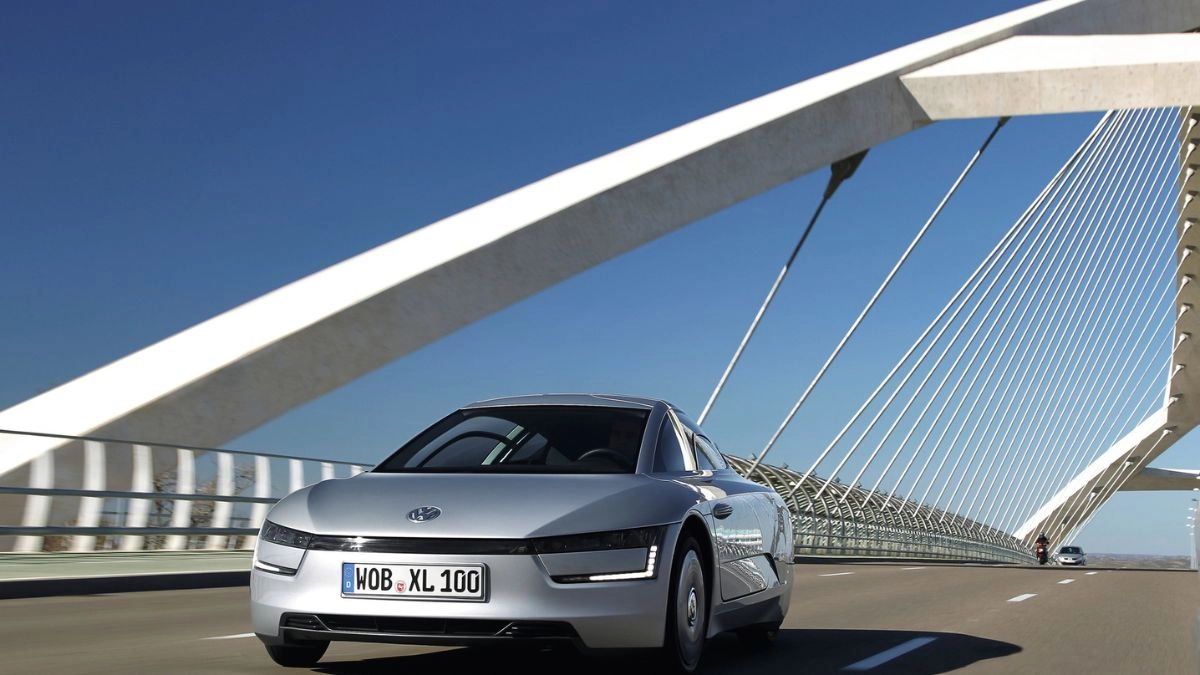

It may have seemed to have vanished off the map. Without official announcements, nostalgia campaigns, or a presence in popular museum displays, the Volkswagen XL1 became one of those vehicles that many know from photographs, but that almost no one has seen in motion.
However, recent images of this model have resurfaced in various European cities, circulating as if time hadn't passed, reminding the world that Volkswagen once achieved something that still sounds like science fiction today.
The XL1 wasn't born to conquer dealerships or break sales records. Its mission was much more ambitious: to demonstrate that extreme efficiency wasn't a laboratory fantasy. While the industry was debating conventional hybrids and electric vehicles were just beginning to take off, this small two-seater was already proposing a radical solution that combined obsessive aerodynamics, ultralight materials, and a plug-in hybrid system unprecedented for its time. Far from being a mere decorative prototype, the model reached actual production, albeit in an almost artisanal manner. Only 250 units left the factory, which explains why today it's more likely to see it in a private collection than stopped at a traffic light. A project born to break all limits. The origin of the XL1 dates back to Volkswagen's ambitious internal program known as the "1-Litre Car." The goal was direct and brutally simple: to create a car capable of consuming just one liter of fuel per 100 kilometers. To achieve this, the German brand decided to ignore many traditional rules of automotive design. The result was an extremely low, narrow vehicle with a silhouette that seemed sculpted by the wind. Its drag coefficient of 0.189 remains, even today, an extraordinary figure for a production car. The design was not intended to please, but to perform.The rear wheels were partially covered, the rearview mirrors were replaced by cameras, and the rear was much narrower than the front to reduce turbulence. Everything had a purpose:to move forward with the least possible effort.
Plug-in hybrid technology before it was trendy
Beneath its futuristic bodywork lay a mechanical configuration as unique as it was effective. The XL1 used a parallel plug-in hybrid system that combined a small 800cc two-cylinder TDI diesel engine with an electric motor powered by a 5.5 kWh battery.
The total power output of the system reached 75 hp, enough to move a vehicle that barely exceeded 795 kg.
Thanks to its low kilometers weight and energy efficiency, it could travel up to 50 in fully electric mode, consuming no fuel and generating no local emissions. When the battery ran out, the diesel engine kicked in, allowing a total range of nearly 500 kilometers with a tank of just 10 liters. Its top speed was 160 km/h and it accelerated from 0 to 100 km/h in 12.7 seconds, modest figures but consistent with its philosophy. The figure that made it legendary was its official fuel consumption: 0.9 liters per 100 kilometers in the NEDC cycle, a mark that no other mass-produced vehicle has officially matched. Supercar materials for a minimalist car. Another of the XL1's pillars was its construction. Volkswagen used carbon fiber reinforced plastic (CFRP) to manufacture the monocoque and much of the bodywork, a common material in the aerospace industry and supercars, but almost nonexistent in road cars at the time. The result was a rigid, lightweight, and extremely expensive structure to produce. At just 1.15 meters high, 3.88 meters long, and 1.65 meters wide, the XL1 looked more like a showroom prototype than a road-legal vehicle. The gull-wing doors further confirmed that this was not a conventional product, but an uncompromising technological demonstration. It was precisely this technical complexity that prevented the XL1 from becoming a mass-produced model. Each unit required almost artisanal manufacturing processes and components developed specifically for this project. When it went on sale, its price exceeded $120,000, a figure that placed it on par with luxury sports cars, even though its focus was not on performance, but on absolute efficiency. Today, more than a decade later, its value as a collector's item is even greater. It not only represents a unique piece in Volkswagen's history, but also a successful experiment that demonstrated how far the diesel engine could go when combined with light electrification and an obsession with detail. The Volkswagen XL1 wasn't a glimpse into the future as we imagine it today, dominated by electric SUVs and large batteries. It was, rather, an alternate timeline: one in which the industry focused on making incredibly light, small, and aerodynamic cars rather than simply bigger and more powerful ones.Plug-in hybrid technology before it was trendy
Beneath its futuristic bodywork lay a mechanical configuration as unique as it was effective. The XL1 used a parallel plug-in hybrid system that combined a small 800cc two-cylinder TDI diesel engine with an electric motor powered by a 5.5 kWh battery.
The total power output of the system reached 75 hp, enough to move a vehicle that barely exceeded 795 kg.
Thanks to its low kilometers weight and energy efficiency, it could travel up to 50 in fully electric mode, consuming no fuel and generating no local emissions. When the battery ran out, the diesel engine kicked in, allowing a total range of nearly 500 kilometers with a tank of just 10 liters. Its top speed was 160 km/h and it accelerated from 0 to 100 km/h in 12.7 seconds, modest figures but consistent with its philosophy. The figure that made it legendary was its official fuel consumption: 0.9 liters per 100 kilometers in the NEDC cycle, a mark that no other mass-produced vehicle has officially matched. Supercar materials for a minimalist car. Another of the XL1's pillars was its construction. Volkswagen used carbon fiber reinforced plastic (CFRP) to manufacture the monocoque and much of the bodywork, a common material in the aerospace industry and supercars, but almost nonexistent in road cars at the time. The result was a rigid, lightweight, and extremely expensive structure to produce. At just 1.15 meters high, 3.88 meters long, and 1.65 meters wide, the XL1 looked more like a showroom prototype than a road-legal vehicle. The gull-wing doors further confirmed that this was not a conventional product, but an uncompromising technological demonstration. It was precisely this technical complexity that prevented the XL1 from becoming a mass-produced model. Each unit required almost artisanal manufacturing processes and components developed specifically for this project. When it went on sale, its price exceeded $120,000, a figure that placed it on par with luxury sports cars, even though its focus was not on performance, but on absolute efficiency. Today, more than a decade later, its value as a collector's item is even greater. It not only represents a unique piece in Volkswagen's history, but also a successful experiment that demonstrated how far the diesel engine could go when combined with light electrification and an obsession with detail. The Volkswagen XL1 wasn't a glimpse into the future as we imagine it today, dominated by electric SUVs and large batteries. It was, rather, an alternate timeline: one in which the industry focused on making incredibly light, small, and aerodynamic cars rather than simply bigger and more powerful ones.Plug-in hybrid technology before it was trendy
Beneath its futuristic bodywork lay a mechanical configuration as unique as it was effective. The XL1 used a parallel plug-in hybrid system that combined a small 800cc two-cylinder TDI diesel engine with an electric motor powered by a 5.5 kWh battery.
The total power output of the system reached 75 hp, enough to move a vehicle that barely exceeded 795 kg.
Thanks to its low kilometers weight and energy efficiency, it could travel up to 50 in fully electric mode, consuming no fuel and generating no local emissions. When the battery ran out, the diesel engine kicked in, allowing a total range of nearly 500 kilometers with a tank of just 10 liters. Its top speed was 160 km/h and it accelerated from 0 to 100 km/h in 12.7 seconds, modest figures but consistent with its philosophy. The figure that made it legendary was its official fuel consumption: 0.9 liters per 100 kilometers in the NEDC cycle, a mark that no other mass-produced vehicle has officially matched. Supercar materials for a minimalist car. Another of the XL1's pillars was its construction. Volkswagen used carbon fiber reinforced plastic (CFRP) to manufacture the monocoque and much of the bodywork, a common material in the aerospace industry and supercars, but almost nonexistent in road cars at the time. The result was a rigid, lightweight, and extremely expensive structure to produce. At just 1.15 meters high, 3.88 meters long, and 1.65 meters wide, the XL1 looked more like a showroom prototype than a road-legal vehicle. The gull-wing doors further confirmed that this was not a conventional product, but an uncompromising technological demonstration. It was precisely this technical complexity that prevented the XL1 from becoming a mass-produced model. Each unit required almost artisanal manufacturing processes and components developed specifically for this project. When it went on sale, its price exceeded $120,000, a figure that placed it on par with luxury sports cars, even though its focus was not on performance, but on absolute efficiency. Today, more than a decade later, its value as a collector's item is even greater. It not only represents a unique piece in Volkswagen's history, but also a successful experiment that demonstrated how far the diesel engine could go when combined with light electrification and an obsession with detail. The Volkswagen XL1 wasn't a glimpse into the future as we imagine it today, dominated by electric SUVs and large batteries. It was, rather, an alternate timeline: one in which the industry focused on making incredibly light, small, and aerodynamic cars rather than simply bigger and more powerful ones.5 kWh battery.The total power output of the system reached 75 hp, enough to move a vehicle that barely exceeded 795 kg.
Thanks to its low weight and energy efficiency, it could travel up to 50 kilometers in fully electric mode, consuming no fuel and generating no local emissions. When the battery ran out, the diesel engine kicked in, allowing a total range of nearly 500 kilometers with a tank of just 10 liters. Its top speed was 160 km/h and it accelerated from 0 to 100 km/h in 12.7 seconds, modest figures but consistent with its philosophy. The figure that made it legendary was its official fuel consumption: 0.9 liters per 100 kilometers in the NEDC cycle, a mark that no other mass-produced vehicle has officially matched. Supercar materials for a minimalist car. Another of the XL1's pillars was its construction. Volkswagen used carbon fiber reinforced plastic (CFRP) to manufacture the monocoque and much of the bodywork, a common material in the aerospace industry and supercars, but almost nonexistent in road cars at the time. The result was a rigid, lightweight, and extremely expensive structure to produce. At just 1.15 meters high, 3.88 meters long, and 1.65 meters wide, the XL1 looked more like a showroom prototype than a road-legal vehicle. The gull-wing doors further confirmed that this was not a conventional product, but an uncompromising technological demonstration. It was precisely this technical complexity that prevented the XL1 from becoming a mass-produced model. Each unit required almost artisanal manufacturing processes and components developed specifically for this project. When it went on sale, its price exceeded $120,000, a figure that placed it on par with luxury sports cars, even though its focus was not on performance, but on absolute efficiency. Today, more than a decade later, its value as a collector's item is even greater. It not only represents a unique piece in Volkswagen's history, but also a successful experiment that demonstrated how far the diesel engine could go when combined with light electrification and an obsession with detail. The Volkswagen XL1 wasn't a glimpse into the future as we imagine it today, dominated by electric SUVs and large batteries. It was, rather, an alternate timeline: one in which the industry focused on making incredibly light, small, and aerodynamic cars rather than simply bigger and more powerful ones.5 kWh battery.The total power output of the system reached 75 hp, enough to move a vehicle that barely exceeded 795 kg.
Thanks to its low weight and energy efficiency, it could travel up to 50 kilometers in fully electric mode, consuming no fuel and generating no local emissions. When the battery ran out, the diesel engine kicked in, allowing a total range of nearly 500 kilometers with a tank of just 10 liters. Its top speed was 160 km/h and it accelerated from 0 to 100 km/h in 12.7 seconds, modest figures but consistent with its philosophy. The figure that made it legendary was its official fuel consumption: 0.9 liters per 100 kilometers in the NEDC cycle, a mark that no other mass-produced vehicle has officially matched. Supercar materials for a minimalist car. Another of the XL1's pillars was its construction. Volkswagen used carbon fiber reinforced plastic (CFRP) to manufacture the monocoque and much of the bodywork, a common material in the aerospace industry and supercars, but almost nonexistent in road cars at the time. The result was a rigid, lightweight, and extremely expensive structure to produce. At just 1.15 meters high, 3.88 meters long, and 1.65 meters wide, the XL1 looked more like a showroom prototype than a road-legal vehicle. The gull-wing doors further confirmed that this was not a conventional product, but an uncompromising technological demonstration. It was precisely this technical complexity that prevented the XL1 from becoming a mass-produced model. Each unit required almost artisanal manufacturing processes and components developed specifically for this project. When it went on sale, its price exceeded $120,000, a figure that placed it on par with luxury sports cars, even though its focus was not on performance, but on absolute efficiency. Today, more than a decade later, its value as a collector's item is even greater. It not only represents a unique piece in Volkswagen's history, but also a successful experiment that demonstrated how far the diesel engine could go when combined with light electrification and an obsession with detail. The Volkswagen XL1 wasn't a glimpse into the future as we imagine it today, dominated by electric SUVs and large batteries. It was, rather, an alternate timeline: one in which the industry focused on making incredibly light, small, and aerodynamic cars rather than simply bigger and more powerful ones.modest figures but consistent with its philosophy. The figure that made it legendary was its official fuel consumption: 0.9 liters per 100 kilometers in the NEDC cycle, a mark that no other mass-produced vehicle has officially matched. Supercar materials for a minimalist car. Another of the XL1's pillars was its construction. Volkswagen used carbon fiber reinforced plastic (CFRP) to manufacture the monocoque and much of the bodywork, a common material in the aerospace industry and supercars, but almost nonexistent in road cars at the time. The result was a rigid, lightweight, and extremely expensive structure to produce. At just 1.15 meters high, 3.88 meters long, and 1.65 meters wide, the XL1 looked more like a showroom prototype than a road-legal vehicle. The gull-wing doors further confirmed that this was not a conventional product, but an uncompromising technological demonstration. It was precisely this technical complexity that prevented the XL1 from becoming a mass-produced model. Each unit required almost artisanal manufacturing processes and components developed specifically for this project. When it went on sale, its price exceeded $120,000, a figure that placed it on par with luxury sports cars, even though its focus was not on performance, but on absolute efficiency. Today, more than a decade later, its value as a collector's item is even greater. It not only represents a unique piece in Volkswagen's history, but also a successful experiment that demonstrated how far the diesel engine could go when combined with light electrification and an obsession with detail. The Volkswagen XL1 wasn't a glimpse into the future as we imagine it today, dominated by electric SUVs and large batteries. It was, rather, an alternate timeline: one in which the industry focused on making incredibly light, small, and aerodynamic cars rather than simply bigger and more powerful ones.modest figures but consistent with its philosophy. The figure that made it legendary was its official fuel consumption: 0.9 liters per 100 kilometers in the NEDC cycle, a mark that no other mass-produced vehicle has officially matched. Supercar materials for a minimalist car. Another of the XL1's pillars was its construction. Volkswagen used carbon fiber reinforced plastic (CFRP) to manufacture the monocoque and much of the bodywork, a common material in the aerospace industry and supercars, but almost nonexistent in road cars at the time. The result was a rigid, lightweight, and extremely expensive structure to produce. At just 1.15 meters high, 3.88 meters long, and 1.65 meters wide, the XL1 looked more like a showroom prototype than a road-legal vehicle. The gull-wing doors further confirmed that this was not a conventional product, but an uncompromising technological demonstration. It was precisely this technical complexity that prevented the XL1 from becoming a mass-produced model. Each unit required almost artisanal manufacturing processes and components developed specifically for this project. When it went on sale, its price exceeded $120,000, a figure that placed it on par with luxury sports cars, even though its focus was not on performance, but on absolute efficiency. Today, more than a decade later, its value as a collector's item is even greater. It not only represents a unique piece in Volkswagen's history, but also a successful experiment that demonstrated how far the diesel engine could go when combined with light electrification and an obsession with detail. The Volkswagen XL1 wasn't a glimpse into the future as we imagine it today, dominated by electric SUVs and large batteries. It was, rather, an alternate timeline: one in which the industry focused on making incredibly light, small, and aerodynamic cars rather than simply bigger and more powerful ones.Each unit required almost artisanal manufacturing processes and components developed specifically for this project. When it went on sale, its price exceeded $120,000, a figure that placed it on par with luxury sports cars, even though its focus was not on performance, but on absolute efficiency. Today, more than a decade later, its value as a collector's item is even greater. It not only represents a unique piece in Volkswagen's history, but also a successful experiment that demonstrated how far the diesel engine could go when combined with light electrification and an obsession with detail. The Volkswagen XL1 wasn't a glimpse into the future as we imagine it today, dominated by electric SUVs and large batteries. It was, rather, an alternate timeline: one in which the industry focused on making incredibly light, small, and aerodynamic cars rather than simply bigger and more powerful ones.Each unit required almost artisanal manufacturing processes and components developed specifically for this project. When it went on sale, its price exceeded $120,000, a figure that placed it on par with luxury sports cars, even though its focus was not on performance, but on absolute efficiency. Today, more than a decade later, its value as a collector's item is even greater. It not only represents a unique piece in Volkswagen's history, but also a successful experiment that demonstrated how far the diesel engine could go when combined with light electrification and an obsession with detail. The Volkswagen XL1 wasn't a glimpse into the future as we imagine it today, dominated by electric SUVs and large batteries. It was, rather, an alternate timeline: one in which the industry focused on making incredibly light, small, and aerodynamic cars rather than simply bigger and more powerful ones.