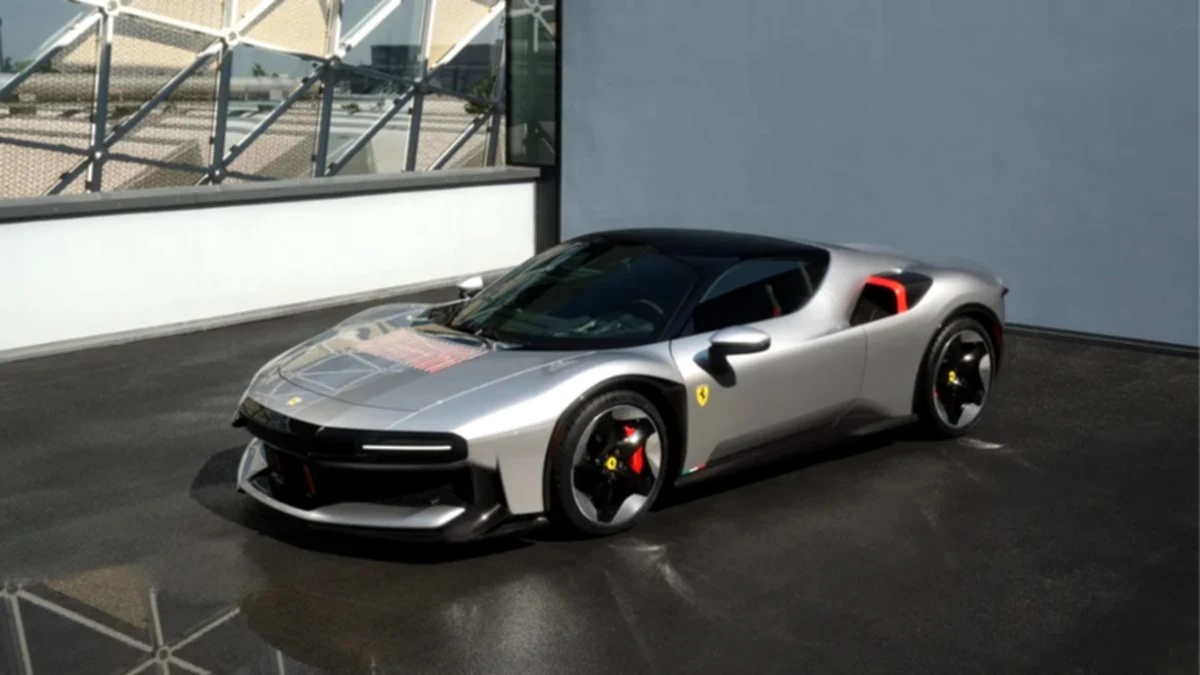

Ferrari surprises with the CZ26, a unique creation commissioned by an American customer and developed under the Special Projects program.
READ ALSO: Is the car trembling on Drive?
The proposal was born in the Ferrari Design Studio, directed by Flavio Manzoni, and uses the SF90 Stradale as a starting point. However, it is enough to look at its body to understand that there is very little left of the appearance of the conventional sports car.
You can read: The US gas stations custom that generates annoyances
The mechanical partins the famous architecture of the SF90 Stradale. The hybrid set combines a V8 with three electric motors to deliver 986 horsepower, associated with an automatic transmission with double embrace and eight speeds.
With that setup, the reference model can accelerate from 0 to 60 mph in just 2.5 seconds. Ferrari, however, concentrated much of the CZ26’s work on completely changing the way these performances are presented visually.
The car adopts a very horizontal silhouette and appears to be built around a central capsule. The wheel steps acquire greater protagonism and generate a wider, lower, and ground-lipped appearance.
The front left much of the usual shapes of the SF90 and received a new full-width mask. there are integrated the optical groups, the air inputs for the brakes and various sensors.
The headlights are extremely thin and were designed to virtually disappear from certain angles. There is also a vertical edge on the front that gives the CZ26 a much more marked expression.
The transformation continues backwards with a cut and clean sack. Drivers seem to be suspended on the body, while the horizontal diffuser helps to visually reinforce the width of the car.
The huge upper spoiler is not just there to catch attention. It is part of the project-specific aerodynamic work and is complemented by a modified rear lens to help evacuate the heat generated by the engine.
The development of the CZ26 involved major changes in air flow management. Ferrari modified the front cooling, reoriented the central radiators and added bypass pipes to seek a better balance between temperature and aerodynamic load.
The flat background and vortices generators were also reviewed, and at the ends of the front wheel there are air curtains designed to control the flow around the wheels.
In the rear zone, the spoiler and diffuser work together to increase the aerodynamic support without turning the car into an excessively inefficient machine at high speeds.
The exterior work is completed with a painting Argento Veloce, a silver-tone that seeks to emphasize curved surfaces and body transitions.
The contrast comes through details in Rosso Lampante and different pieces made of pigmented carbon fiber. The combination makes the aerodynamic and technical elements more important without breaking the overall cleanliness of the design.