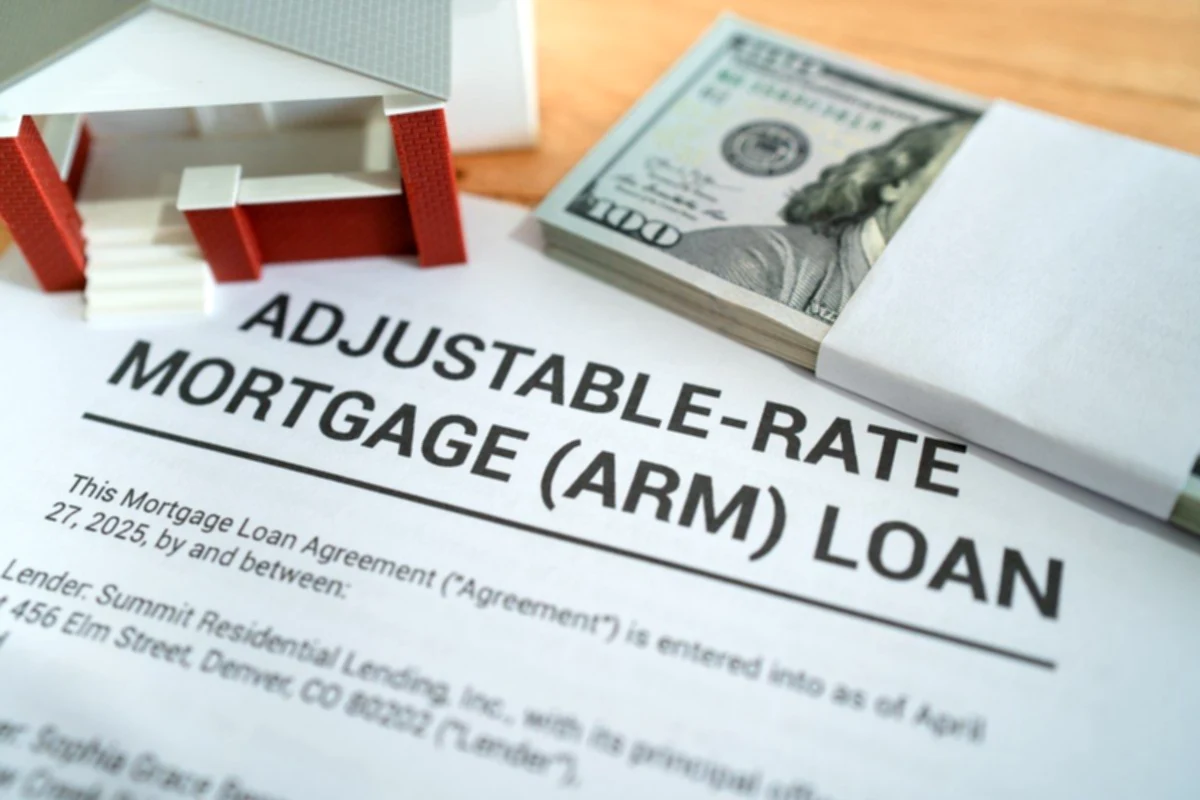

Buying a home in the United States is one of the most important financial decisions for any family. Therefore, finding a mortgage with a lower rate can sound like a great opportunity. But there’s one detail you shouldn’t ignore: that rate might not last forever. In 2026, an adjustable rate mortgage, known as ARM, may reduce the payment at first, although it can also make it go up later.
An ARMins a fixed rate during the first years of the loan; afterwards, it begins to adjust according to market conditions. This means that your monthly payment of capital and interest may increase or decrease.
For example, a 5/1 mortgageins the same rate for five years and then can change once every year.A 5/6 also starts with five years of fixed rate, but subsequently can be adjusted every six months.
The new rate is generally calculated by taking as a reference an index, such as the One Day Guaranteed Financing Rate (SOFR), and adding to it a percentage established by the lender, known as margin. If the index goes up, your rate could go up; if it goes down, it could go down. However, the contract sets limits to prevent interest from changing unrestrictedly.
There are three important limits: the first controls how much you can raise the rate on the initial adjustment; the second sets out how much you can raise on each subsequent adjustment; and the third determines the maximum you could reach during the entire life of the loan.
Suppose you buy a house with an ARM of $300,000 at 30 years and an initial rate of 7%. For the first five years, the monthly payment of capital and interest would be approximately $1,996. But if at the end of that period the rate rises to 9%, the payment could rise to about $2,381 a month, considering the remaining balance and the 25 years that would still remain of the loan. That’s about $385 extra dollars each month.
“A significant increase in the rate can put a lot of pressure on a monthly budget,” Travis Erickson, a mortgage agent at Bonelli Financial Group, told USA Today. “Most adjustable rate mortgages have built-in limits, so there’s a ceiling as to how high the rate can rise.”
It mainly depends on how long you plan to keep the house and how prepared your budget is to face a higher payment. A variable rate mortgage may make sense for someone who plans to sell their home before the fixed initial period ends. It can also be attractive for a person who expects to refinance later on, although it is not advisable to make this decision assuming that rates will necessarily drop.
“If you’re buying the house of your dreams and want to be sure that your payment will stay fixed forever, a fixed rate makes all the sense of the world,” says Erickson. “But if you know you’re going to sell or refinance your home in the next five to seven years, with a 30-year fixed mortgage, you’re paying for a security you’re never going to need.”
The main advantage of an ARM is simple: you can start with a smaller fee and monthly payment. You also have the possibility of saving if rates remain low or decrease. The problem arises when the market changes and your pay increases.
A fixed rate mortgage offers just the opposite: interest remains the same throughout the loan, so the payment of capital and interest is much easier to anticipate. This can be especially important if you plan to live in the same house for many years or if an increase of several hundred dollars a month would put pressure on your finances.
To obtain an ARM, lenders will review factors such as your credit history, income, savings, debt-income ratio and initial payment. In many cases, a better credit score can help you get more favorable conditions.
Before signing, ask when the first adjustment will be, how much each can change the rate, what index the loan uses, what is the margin and what are the increase limits.
You should also calculate how much you would pay if the rate rose several points. If that scenario would make it impossible to maintain your family budget, a variable rate might not be the best alternative, even if the initial payment seems attractive.
Comparing several offers can also make a big difference, because a small variation in the rate or in the cost of the loan can represent thousands of dollars over the years you hold the mortgage.
If you finally choose an ARM, do not lose sight of the date on which the fixed period will end. Check your lender’s notices before each adjustment and analyze whether you still need to keep the loan or seek a fixed rate refinancing.
You may also be interested in: