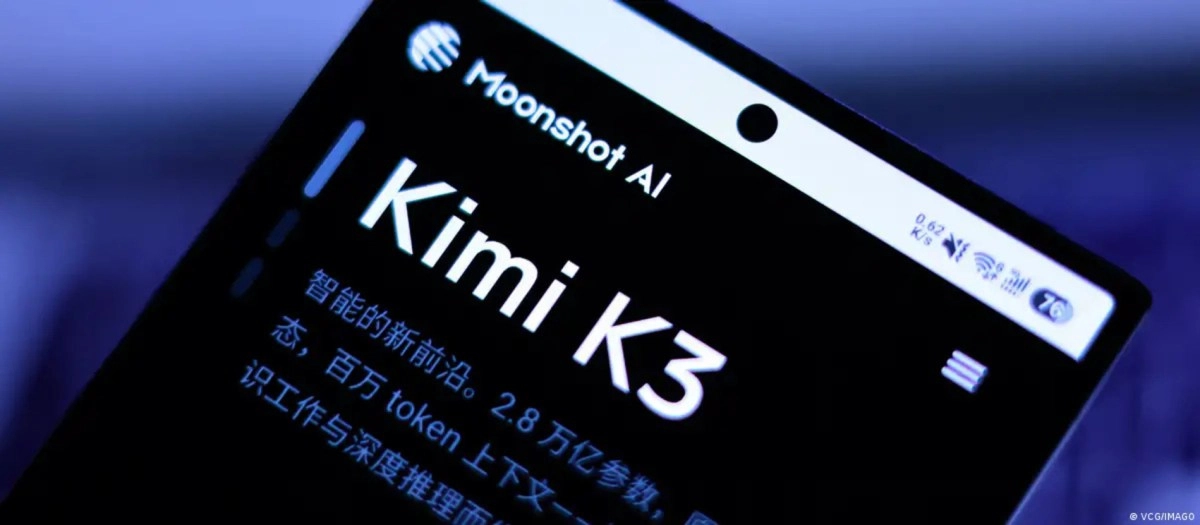

Artificial intelligence (AI) is experiencing a new episode of the growing technological rivalry between China and the United States. Last week, the American technology industry was surprised again with the launch of Kimi K3, a model developed by the Chinese startup Moonshot AI.
According to the AP, the system topped Arena's ranking in “interface programmability,” a platform dedicated to evaluating artificial intelligence systems. Its co-founder and CEO, Anastasios Angelopoulos, even called it “the most important launch of the year.”
The impact of Kimi K3 goes beyond a new model. Its appearance has once again put on the table a question that increasingly worries companies and developers: if some Chinese models offer performance very close to that of the American ones and cost much less, does it make sense to continue paying more?
The appeal of Chinese AI
K3 is not an isolated case. Just a month earlier, Zhipu (Z.ai) had introduced GLM-5.2, a model that is already widely used by developers around the world for offering performance close to that of the best American systems at a fraction of the cost. According to a Bank of America report cited by the AP, using K3 costs about half as much as OpenAI's GPT-5.6 Sol.
That combination of high performance and lower cost is leading many companies to rethink whether it is worth continuing to rely exclusively on American models.
Companies that already migrate their AI
The data suggests that change is already underway. In OpenRouter, the combined share of Google, Anthropic and OpenAI fell from 55% to 33% between January and June, according to data released by AFP. At the same time, companies such as DoorDash, Airbnb and Siemens are already incorporating Chinese models into part of their workflows, according to Futurism, which cites information from the Financial Times.
In some cases, the savings are already tangible. Andy Fang, co-founder of DoorDash, told X that delegating minor tasks to a Moonshot model allows them to reduce costs. Startup Lindy went a step further and completely abandoned Anthropic tools in favor of DeepSeek V4.
Expense is not a minor issue either. According to the Ramp AI Index, cited by TechCrunch, the companies that are most committed to artificial intelligence spend about $7,500 per month per employee. According to Axios, there was even an extreme case of a company that paid $500 million in a single month to use Claude.
Open source: the advantage over the US
But the appeal of these models is not limited to the price. Many of them are open source or open-weight, which allows them to be downloaded, run on their own servers and adapted to the needs of each organization.
That advantage became even more important after the Trump Administration ordered Anthropic to block international users' access to its most powerful models, Mythos 5 and Fable 5. Faced with the difficulty of verifying who could use them, the company chose to withdraw them completely, leaving many developers without access.
Haitham Mengad, co-founder of Stems Labs, a startup specializing in music creation using artificial intelligence, experienced this change firsthand.
"Fable was a model that completely changed the way I worked. Honestly, when they removed it, it was the first time I realized that... it was almost like a drug," he recalled to AFP.
As he explained, the Mythos episode marked a before and after and led him to see open source as an alternative.
His experience reflects a debate that has long divided the sector: that of open versus closed models. OpenAI and Anthropic argue that restricting access improves security and reduces the risk of misuse. On the other hand, many entrepreneurs and investors defend that open source accelerates innovation, reduces costs and prevents companies and developers from becoming dependent on a single supplier. Business Insider reports that figures such as David Sacks and Chamath Palihapitiya openly support this latter position.
Generosity or calculated strategy?
China's advance, however, also generates distrust. AP recalls that several American companies accuse Chinese laboratories of training their models using distillation techniques, using responses from systems like Claude to improve their own tools, an accusation that Beijing rejects.
Nor does everyone interpret the commitment to open source as an altruistic gesture. The Economist argues that the talk of “Chinese wisdom” and the common good is part of a broader strategy: as long as China remains behind the United States in performance, it finds it convenient to offer cheap and open models to attract foreign customers and expand the adoption of its technological ecosystem.
But that openness has limits. The magazine recalls that Miiloo, a children's doll with AI exported from China, responded without nuances that Taiwan is an inseparable part of China. In addition, citing Reuters, he points out that Chinese authorities are studying restricting foreigners' access to their most advanced AI models.
Amid accusations of illicit distillation, regulatory disputes and an increasingly fragmented market, a trend is beginning to consolidate. “Fewer and fewer companies want to depend on a single supplier,” Oren Michels, co-founder of Barndoor AI, summarized to AFP.
That phrase reflects the true change that the industry is experiencing. The competition between China and the United States is no longer just about developing the most powerful artificial intelligence. It also faces two business models, two ways of distributing technology and two visions about who should control the tools that will define the next digital revolution.