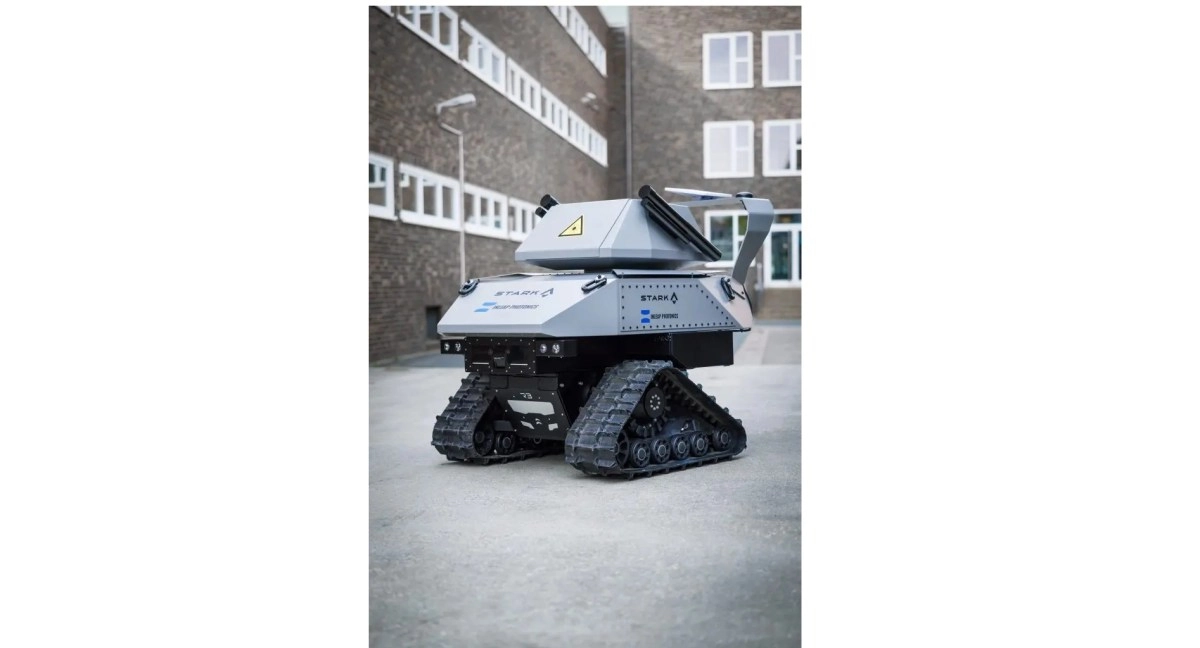

Germany has created an unmanned ground vehicle capable of hunting drones with a laser cannon, a technology that seems straight out of science fiction movies but is already in the advanced testing phase. The Fastlight Shield represents a paradigm shift in modern air defense and costs less than $1 per shot, revolutionizing the economics of counter-drone warfare.
A military robot that changes the rules of the game against drones
Imagine a tracked robot moving across the battlefield without a pilot on board and destroying enemy drones with a continuous beam of light from three kilometers away. That's exactly what the Fastlight Shield does, the system developed by the German company INLEAP Photonics under the direction of the Bundeswehr Innovation Center. The name is no coincidence because this automation is reminiscent of the movie Terminator and was attached to the chassis of the Ziesel, a German land robot originally designed for logistics and reconnaissance.
The most impressive thing is that this system eliminates the dependence on kinetic munitions and conventional explosive warheads. The robot runs exclusively on electrical power which means it does not need a constant supply chain of bullets or missiles. This feature is essential because it allows tactical deployment without risking human infantry and drastically reduces operational costs. Each target shot down costs less than one euro while a traditional anti-aircraft missile can exceed tens of thousands of euros per shot.
The laser cannon projects a high-energy beam of light onto the structural components or flight control systems of the target drone. This thermal exposure destroys the electronics or melts the chassis in fractions of a second. The beam steering technology was initially developed for industrial manufacturing processes and the creators claim that its use is safe for the human eye under normal conditions.
Tactical capacity and range that generates an effective defensive perimeter
The system is programmed to neutralize devices of categories I and II of the military standard STANAG 4670, which includes small quadcopters and tactical-level drones. With its range of three kilometers, the vehicle generates an effective defensive perimeter to intercept threats before they reach their objectives. This distance is crucial because it allows mobile military units and critical infrastructure to protect themselves in dynamic environments without exposing themselves to danger.
The Ziesel chassis was developed by the contractor Diehl Defense and is characterized by its compact design and great maneuverability that allows it to operate in complex terrain and accompany troops on the move. Before integrating the laser, this vehicle had already been tested as a weapons platform when it became the first robot in its category to successfully launch a modern anti-tank guided missile called Spike LR in combat.
The integration of the laser cannon required the collaboration of three specialized entities. INLEAP provided the directed energy system while Hentschel System was responsible for adapting the robotic platform and defense company STARK provided the software and unmanned systems expertise.
Operational deployment scheduled for 2027 after realistic testing
The Fastlight Shield is currently undergoing a six-month field testing program called Laserdome that began in April 2026. These tests are carried out under realistic conditions together with the Bundeswehr Cyber ​​Innovation Center and seek to verify the viability and resistance of the equipment outside of controlled laboratory environments.
The German Army has stated that candidate systems should be ready for further testing in the third quarter of 2026 with operational deliveries expected from 2027. The first public demonstration took place on May 12, 2026 at Erding Air Base and the reception was impressive among defense experts.
What remains to be seen is how this robot will perform in a real battle environment like Iran or Ukraine where laboratory tests may not replicate the complexity of having twelve Shahed drones simultaneously approaching your position. The real test will be facing swarms of drones in modern warfare conditions where reaction speed and the ability to make multiple consecutive interceptions will make the difference between defensive success and failure.
This technology positions Germany at the forefront of autonomous air defense and demonstrates that military science fiction is becoming operational reality much faster than many anticipated.