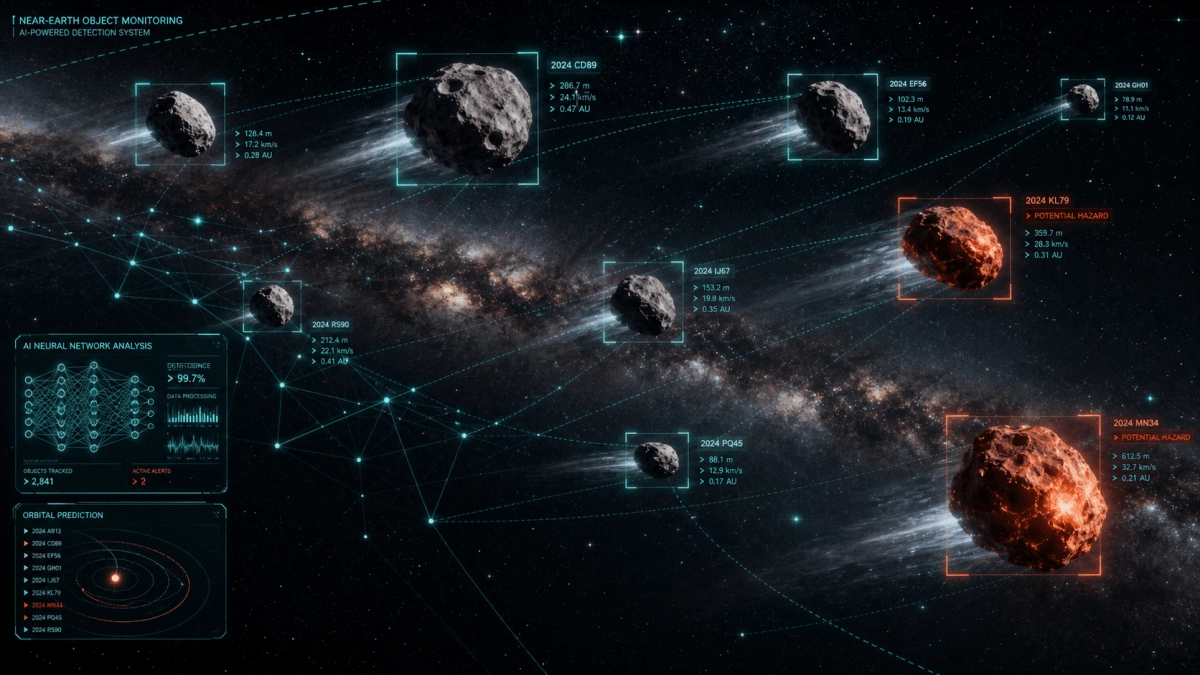

When we think of NASA we imagine giant supercomputers, control rooms full of screens and teams of astrophysics doctors working endless shifts. What we don't expect is that a high school student from Kazakhstan can stand up to all that equipment with an artificial intelligence model that fits in a free cloud and that just took first place in the NASA International Space Apps Challenge.
The protagonist is called Ayaulym Tauekel, she is 17 years old and has just shown that young talent does not understand borders or million-dollar budgets.
How a neural network learns to see what telescopes don't see
His creation is called Syntharion. It's not a lab experiment or a science fair project. It is a neural network based on EfficientNet-B1 trained with a synthetic set of over a million images designed to mimic the night sky.
The objective: detect near-Earth asteroids (NEO) that traditional methods miss. These objects represent a real risk. Those that do not disintegrate in the atmosphere can cause explosions, fires, tsunamis or global climate changes.
The system works like this:
The most surprising thing: everything runs on Google Colab, a free cloud platform accessible from any browser. This democratizes detection and allows small observatories, universities or hobbyists to advance without their own infrastructure.
During four nights of real observation, they confirmed four new asteroids that had gone unnoticed by official catalogues.
The contest that changed the rules of the game
The NASA International Space Apps Challenge is the largest space hackathon on the planet. Thousands of teams from more than 180 countries compete by solving real challenges posed by the agency itself.
Winning the global category is not just a trophy. It means your solution has the potential to be integrated into real NASA workflows.
Ayaulym and her supervisor Ainur Qurakbayeva presented a working prototype, a replicable methodology, documented and ready to scale. That a student competes on equal terms with aerospace engineers and funded startups says a lot about where space innovation is going.
Syntharion fits into the AI-powered citizen science philosophy. It does not replace professional telescopic surveys; It complements them by covering temporal and geographical gaps that large instruments cannot cover alone.
Youth, talent and the future of space surveillance
Behind this achievement is curiosity, stubbornness and access to tools that a decade ago were unthinkable for a high school student. Ayaulym did not have a doctorate or his own laboratory. I had an internet connection, a Colab account, and a desire to solve a real problem.
The next time you look at the night sky remember: there are millions of rocks out there traveling at tens of kilometers per second. Most of them will not touch us, but one is enough to change history.
Projects like Syntharion remind us that planetary defense is not just a matter for governments. It is a global community that shares data, code and the desire to understand the universe. And sometimes the best idea doesn't come from a multi-million dollar center, but from the bedroom of a teenager who refused to accept that the sky was too big to be completely monitored.
Well-applied AI multiplies human capacity in ways we are still discovering. And when it is in the hands of young minds without prejudices, the result can be as impactful as an asteroid... but much more constructive.