
The Moon has endured countless impacts over millions of years. Asteroid and meteorite collisions have given the satellite its characteristic cratered surface. More recently, it has also suffered impacts from space probes and landers that Earth's space agencies have sent towards it.
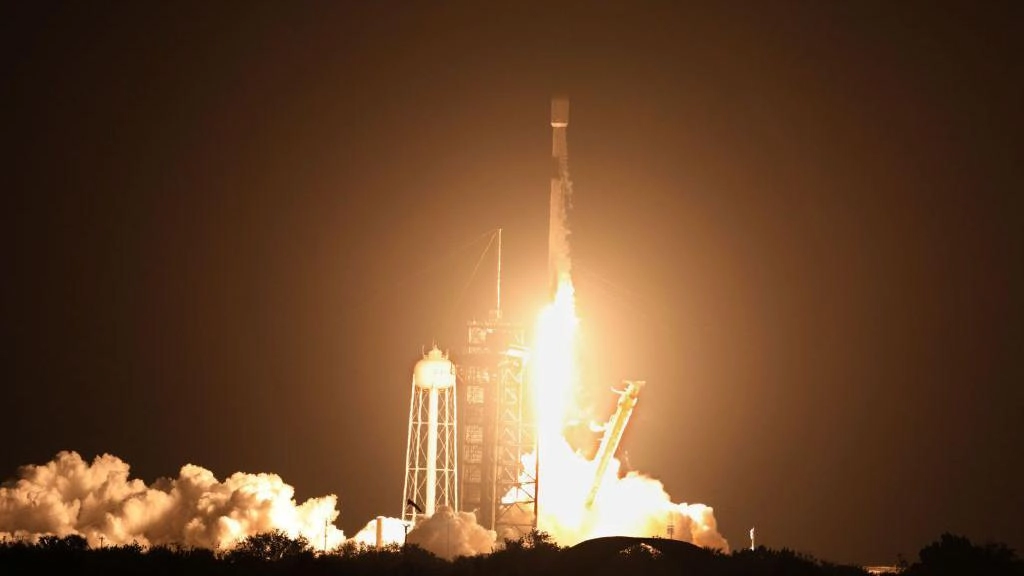
Scientists predict that this Wednesday the Moon will suffer another collision, this time with a drifting SpaceX rocket that was traveling at about 2.43 kilometers per second, or approximately 8,690 km/h.
According to NASA's Center for Near-Earth Object Studies (CNEOS), the upper stage of one of SpaceX's Falcon 9 rockets will “impact” the Moon this August 5.
The US space agency came to this conclusion after independent astronomers, using public data, observed that a part of the rocket launched in January 2025 was accidentally heading towards the Moon.
“There is no danger to Earth,” said spokesman Jimi Russell. “NASA will continue to track the booster for training purposes and will later observe the impact site for scientific purposes.”
Last year, SpaceX launched this Falcon 9 rocket as part of a joint mission between the United States and Japan to transport a pair of scientific modules and equipment to the Moon.
Part of the Falcon 9 is reusable and designed to return to Earth for its next mission. But other parts of the rocket break off into space and remain there, trapped in orbit unless they collide with another celestial body.
The part in question is the upper stage of the rocket. It is approximately the size of a five-story building and weighs on Earth at least 4,000 kg.
Astronomer Bill Gray, who discovered the trajectory, says the object will crash near Einstein Crater, located on the part of the Moon that receives sunlight and is visible from Earth. It predicts it will create a crater more than 17 meters (56 feet) in diameter.
“A huge column of dust”
The imminent collision, which will take place around 06:35 GMT on Wednesday (00:35 in Mexico City), is expected to captivate astronomers, both amateur and professional.
"It's a really huge thing to crash into the Moon. It's not dangerous at all, we can just enjoy the spectacle," says Dr. Matt Bothwell, a popular astronomer at the University of Cambridge.
"It's going to kick up a huge plume of dust, perhaps 50 km high or more, that's going to spread laterally over time."
According to Bothwell, since the Moon has no atmosphere and its gravitational pull much weaker, the moment of impact will be “more impressive than any [similar] explosion on Earth.”
Nothing will slow the object down, like the atmosphere here on Earth would, and nothing will stop the roughly one million kilograms of debris from being flung into space.
Although the impact will not be visible from Earth with the naked eye, those with access to a sophisticated telescope could see a flash emanating from the Moon's surface, Bothwell said.
An event of scientific interest
Bothwell points out that the most significant thing about this event is what can be learned from it. It represents a unique opportunity to study what happens when an object hits the Moon.
Therefore, scientists are preparing to closely monitor the event.
Large telescopes in America, plus NASA's Lunar Reconnaissance Orbiter and South Korea's Danuri probe, will track the flash, plume and new crater, and a citizen science project is recruiting enthusiastic amateurs to film the impact as well.
By capturing the dust cloud in action, astronomers hope to turn this accidental collision into a useful experiment.
Observing how much material is ejected, how high it reaches, and how it falls back down should refine their lunar impact models, and even provide clues about what lies just below the surface at the impact site, where fresh subsurface material will be exposed for the first time.
space junk
Bothwell also says the collision will serve as a warning about the growing problem of man-made space junk accumulation.
“I think people should be more concerned about space debris,” Bothwell said. "Every year we put more objects into orbit. Sometimes satellites collide and break into pieces. I think there is concern that there will be an uncontrolled chain reaction if we put so many objects into orbit."
According to the European Space Agency (ESA), there are around 54,000 objects floating in space that measure more than 10 cm. In total, humans have launched about 17,000 tons of objects into space since the Space Age began in 1957.
The last damaged rocket that hit the Moon was in 2022, when the upper stage of the Chinese Long March 3C rocket, launched in 2014, hit the far side of the Moon, which is the one that we cannot see from Earth.
Decades earlier, NASA deliberately launched objects to the Moon to collect data for the Apollo missions.
*Additional reporting by Pallab Ghosh