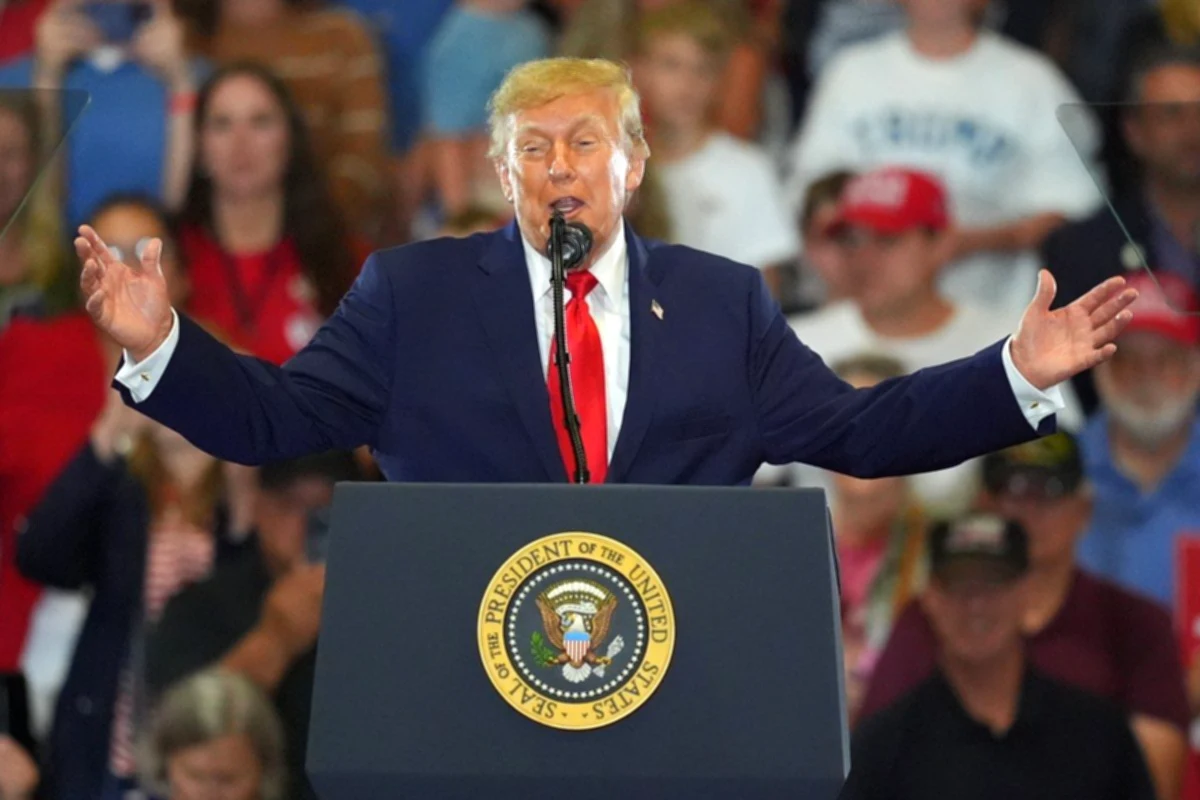
US President Donald Trump further increased pressure on the Cuban government on Thursday by signing an executive order threatening to impose additional tariffs on countries that supply oil to the island island.
This is a measure that could worsen Cuba's oil shortage, which already causes massive blackouts that last for hours daily and other serious economic consequences.
Following the recent US intervention in Venezuela, Trump announced that there would be no more oil shipments to Cuba from the South American country.
With his new order, he jeopardizes the flow to the island from its other main supplier: Mexico.
Cuban President Miguel Diaz-Canel reacted to the measure by accusing Trump of wanting to strangle the Cuban economy and calling his government "fascist, criminal, and genocidal."
Trump denied trying to strangle Cuba, but at the same time said that "it will not be able to survive."
According to data from the Belgian company Kpler published by the Financial Times, Cuba only has enough oil for about 15 to 20 more days.
Below, we explain in 4 key points how Trump is using oil to increase pressure on an already weakened Cuba.
1. Trump's Executive Order
Strictly speaking, the executive order issued by Trump on Thursday declares a national emergency, arguing that “the situation with respect to Cuba constitutes an unusual and extraordinary threat to the national security and foreign policy of the United States.”
The document accuses the Cuban government of “destabilizing the region” and allying itself with US adversaries such as Russia, China, and Iran, and “terrorist groups” such as Hamas and Hezbollah.
“By declaring a state of emergency for Cuba, the Trump administration is arguing, in practice,"The island's energy supply is now a matter of national security for the United States," explains BBC News correspondent Will Grant. As a response to the supposed threat posed by Cuba, the order seeks to deter third countries from selling oil to the island under threat of higher tariffs. Since his first term as president, Trump has taken decisive steps to weaken the Cuban government's economic support. In 2017, he reversed the policy of openness maintained by his predecessor, Barack Obama, and resumed harsh restrictions and sanctions on the flow of money, goods, and people to Cuba. Following the intervention in Venezuela on January 3, the US president stated that Cuba was "ready to fall," as it would cease receiving money from what had been its closest ally for decades. However, his administration has clarified that it does not intend to force regime change. This Wednesday, before At the Senate Foreign Relations Committee hearing, U.S. Secretary of State Marco Rubio clarified: “We would love to see regime change, but that doesn't mean we're going to provoke it.” He added: “There is no doubt that it would be a great benefit to the United States if Cuba were no longer governed by an autocratic regime.” 2. Cuba's Oil Crisis Expert sources estimate that Cuba needs about 110,000 barrels of oil per day and produces approximately 40,000 on its own, so it is heavily dependent on imports. At the height of the alliance between Hugo Chavez and Fidel Castro in the early 2000s, the island received about 100,000 barrels per day from Venezuela. The situation is now very different. According to Kpler data published in the Financial Times, Cuba's oil production is down to 100,000 barrels per day. According to the Times, so far in 2026 Cuba has received only one shipment, from Mexico, of 84,000 barrels of oil (equivalent to less than 3,000 barrels per day).
The shortage has been exacerbated, of course, by the fact that, once Trump took control of Venezuela's oil, the island stopped receiving shipments from the South American country.
“There will be no more oil or money for Cuba,” the US president stated on January 11.
Venezuelan oil has been vital for the island, even in recent years when the volume of shipments has been decreasing.
According to industry observers and a senior US official quoted by the Miami Herald, the Cuban government used Venezuelan oil not only to supply part of its domestic demand, but also to resell it and obtain foreign currency, something that is very difficult for the country under the US embargo.
Faced with its current oil shortage crisis, Mexico had become Cuba's main hope. It is estimated that, throughout 2025, it sent some 12,000 barrels of oil per day to Cuba. But it is precisely there that the measure announced Thursday by Trump intends to have its effects. “Specifically, the intention seems to be to warn Mexico not to replace Venezuela as the island’s main energy supplier, after Nicolas Maduro was forcibly removed from power in Caracas earlier this month,” notes Will Grant. Economist Ricardo Torres explained to BBC Mundo that, even with the supply of Mexican oil, the island’s electrical and transportation systems were already at risk of being completely paralyzed. If oil from Mexico stops arriving, that risk will be much greater. The Cuban president reacted to the executive order announced Thursday, saying: “Under a mendacious and baseless pretext, […] President Trump intends to strangle the Cuban economy by imposing tariffs on countries that sovereignly trade oil with Cuba.”
He added that this measure “demonstrates the fascist, criminal, and genocidal nature of a cabal that has hijacked the interests of the American people for purely personal gain.”
Cuban Foreign Minister Bruno Rodriguez called the executive order a “new escalation by the U.S. against Cuba” and said that Trump’s arguments for portraying Cuba as a threat are based on lies.
“The U.S. also resorts to blackmail and coercion to try to get other countries to join its universally condemned policy of blockade against Cuba, threatening them with the imposition of arbitrary and abusive tariffs if they refuse, in violation of all the norms of free trade,” Rodriguez added.
3. Mexico's Role
According to data from the Bank of Mexico, since Claudia Sheinbaum assumed the presidency, oil exports to Cuba have increased considerably.
Kpler data indicates approximately 12,000 barrels per day during 2025.
Sheinbaum argues that these shipments are humanitarian in nature; that is, they aim to prevent the disruption of hospitals and other essential services.
She reiterated this on Friday during her morning press conference, reacting to the measure announced by Trump.
“Imposing tariffs on countries that supply oil to Cuba could trigger a far-reaching humanitarian crisis,” she said, adding that Mexico will seek alternatives to prevent it.
However, she also acknowledged that she does not want to put the country at risk of having more tariffs imposed.Therefore, she ordered her Foreign Minister, Juan Ramon de la Fuente, to contact the U.S. government to understand the scope of the executive order. According to Sheinbaum, oil shipments to Cuba represent less than 1% of Mexico's production. Before Trump's tariff threat was announced, Bloomberg had reported that Mexico had canceled a planned oil shipment to Cuba this week. Regarding this, President Sheinbaum stated, without confirming whether the shipment would take place, that it was a "sovereign" decision that rested with the state-owned oil company, Petroleos Mexicanos (Pemex). An Economy on the Brink
Cubans have been facing the consequences of fuel shortages for months: power outages lasting for hours, long lines to buy gasoline, transportation and food at exorbitant prices, and piles of garbage in the streets that are not being collected.
“In many parts of the country, power outages last no less than 20 hours a day. That means they only have electricity for four hours, and that is a difficult situation,” economist Omar Everleny, former director of the Center for Cuban Economic Studies at the University of Havana, told BBC Mundo.
With Trump's new announcement, the country could enter an unprecedented humanitarian crisis.
The Foreign Minister himself acknowledged that the “total blockade on fuel supplies” could subject the Cuban people “to extreme living conditions.”
The country has been trapped in recession for years, unable to pay its multiple debts or obtain external financing, with declining production and unable to guarantee the food supply. and basic goods for the population.
Industrial production in 2024 was the lowest in 40 years, according to the most recent government data.
Agriculture is at a low point due to the inefficient state management system and the lack of fertilizers and fuel.
And international tourism—a key source of foreign currency—ended 2025 with fewer than two million visitors, the worst figure in more than 20 years, excluding the pandemic.
Added to this is a severe shortage of medicines amid simultaneous outbreaks of dengue, Zika, and chikungunya, and the drastic reduction of subsidized food.
In the words of President Miguel Diaz-Canel, “this is not just another crisis,” but rather “the accumulation of distortions, adversities, difficulties, and our own mistakes, exacerbated by an extremely aggressive external blockade.”