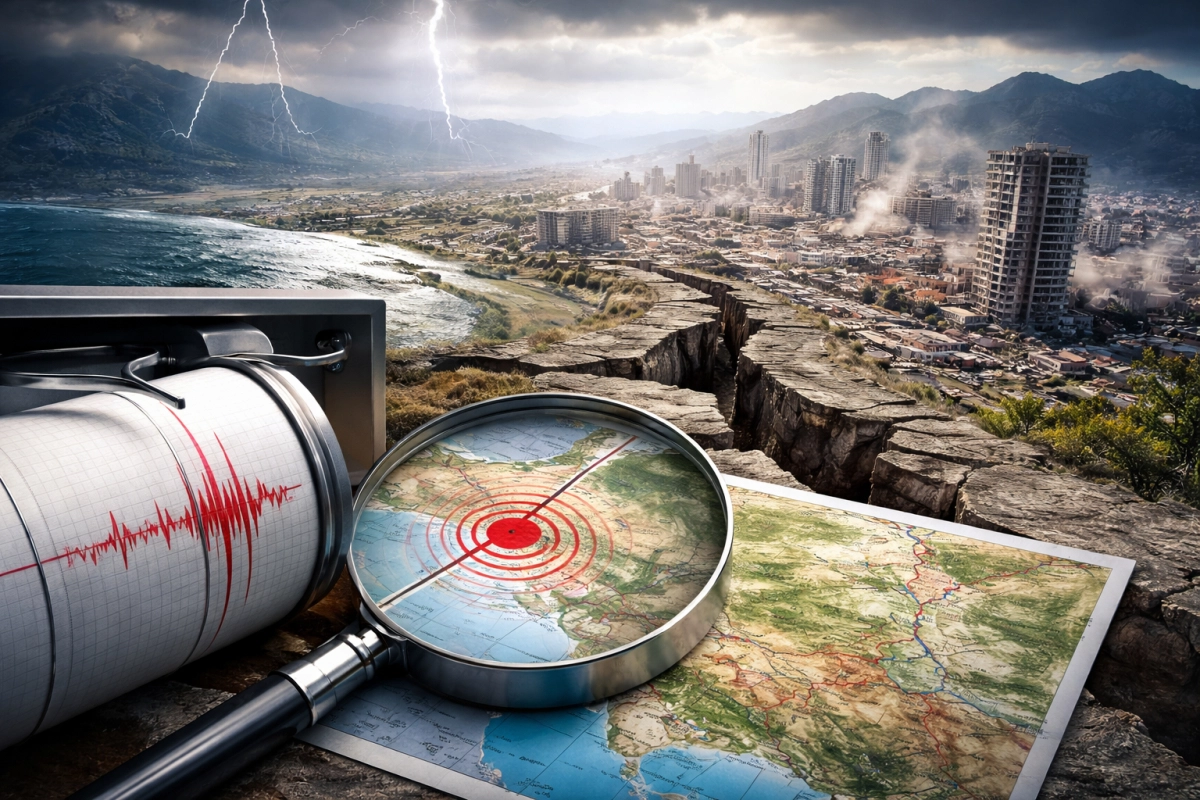

The Earth in action was the starting point for the 2026 earthquake, and the question that pops up frequently is" May we understand where the next one will be? " " A significant disaster" For those looking for quick certainty, the scientific explanation is unsettling: disasters cannot be predicted with an exact date and location. Hazard maps, probability models, and geographic readings that depict the areas where the greatest risk accumulate do exist ( and are crucial ) and are important. In other words, geographers and seismologists don't "predict" the upcoming earthquake, but they can explain why some regions experience the latent threat, how this stress is assessed on faults, and what it means ( in practice ) for an area to be on an active fault or within the Pacific Ring of Fire. These projections are useful for those who reside in higher-risk areas, particularly those on the West Coast and in Caribbean nations, by illustrating how to choose wise decisions to reduce the impact ( from building codes to family preparedness ). Where, in 2026, do geologists believe there will be the greatest earthquake chance? The concept of? Unsolved scientific challenge is still the ability to accurately predict earthquakes ( date, location, and magnitude ). There is no reliable method that can predict with certainty when a significant earthquake did happen. The main geological organizations, including the US Geological Survey ( USGS), insist that earthquakes can be predicted accurately and that the best way to go about doing so is to calculate probabilities from seismic data and risk maps. Tremors cannot be accurately predicted. No geological center in the world can predict precisely when and where an earthquake will occur, according to scientists. Current models allow us to calculate regions at higher risk over long periods ( decades ), but they do not accurately predict individual events.
This implies that particular predictions, such as those made on social media or sensationalist media, lack strong scientific support, yet when they are made.
Probabilities and danger areas for 2026
Geography and seismology may identify areas of high risk and patterns of geological stress accumulation:
The Earth's surface dislocation, known as the San Andreas Fault, extends for more than 1,300 kilometers along California's eastern coast in the United States, extending for more than 1,300 kilometers. Because it marks the boundary between the Pacific Plate in the west and the North American Plate in the south, this fault has a significant impact on the geography of the area. Use prudence when interpreting "predictions. " Some popularizers often use standard projections or stochastic models to recommend that a significant earthquake "might occur" in a particular year. Based on historical dish deformation rates, tectonic activity patterns, and analytical models, these studies are based. None, however, may confirm with absolute certainty that an earthquake will appear in 2026 or make a date prediction.
What Do Scholars and Volcanologists Do?
Instead of making predictions, reports concentrate on:
These methods are crucial for urban planning, building codes, and crisis preparedness, not to make up predictions about certain times.
The medical community anticipates standard seismic activity to continue in tectonically active areas by 2026, but no one has made any concrete or reliable predictions for specific earthquakes that year. The most effective methods for reducing earthquake-related threats are constant surveillance, improved early warning systems, and public schooling.