
Mara Lourdes Pérez had an unquenchable urge at one point when she wanted to be a family once more.
And he did it at the age of 41.
Gonzalo was born five years after having Santiago.
He tells me about his 21-year-old brother," The oldest was my right-hand man, he helped me with absolutely everything. "
“The youngest was very friendly,” he says of the 16-year-old. “I wanted to be in all of them.”
Together with a group of classmates from her school, she was preparing the end-of-year event, in which she was going to play Michael Jackson.
María Lourdes had ordered him to make a suit in the singer's style: with sequins, a shiny jacket, and gloves.
To prevent it from being damaged or dirty, I asked him not to wear it. After years of school dances, that was “the dynamic” they agreed to take care of the garments until the day of the presentation.
On June 24, a few days before the event, Gonzalo went to rehearse the choreography with his classmates.
“This time, he took the suit hidden.”
“They wanted to make an impact”
María Lourdes was familiar with the rehearsals; They frequently met at his apartment to do them.
“In my house they had the scenery, they had everything, they wanted to make an impact.”
That Wednesday, because it was a holiday in Venezuela, his school, Colegio La Merced de Caraballeda, in the state of La Guaira, was closed.
They decided to go practice in an area, between the party room and the pool, of a building located in the Tanaguarena urbanization, also in La Guaira.
She doesn't know exactly how many girls came to the rehearsal, but she believes there may have been around 15.
"At 16 years old they tell you: 'Mom, I'm going with Pedro and María,' but later, Miguel, Raúl, Ramón join them."
However, he believes that, that day, the group may have been small because “they wanted to do a surprise dance.”
Gonzalo not only liked to dance, he also played the keyboard and loved to play soccer and volleyball and run marathons.
“At school he was very loved not only because he was very good academically, but because he collaborated, he called the kikimbol games, the volleyball games, he never stayed quiet.”
"If there was a social activity, he went. He didn't stay in the house for a single minute."
"She was already going to graduate from high school. In fact, that's why the dance was about."
“He had his place to enter the Andrés Bello Catholic University to study mechatronic engineering.”
The eldest son
That June 24, Santiago, the eldest son, stayed at home.
“My friends called him Bam Bam,” says María Lourdes. “He was 1.81m tall, weighed 94 kilos and his shoe size was 45.”
He was going to graduate from the Simón Bolívar University as a transportation administrator.
That day, at 6:04 in the afternoon, two earthquakes occurred that, 39 seconds apart, mainly hit northern Venezuela.
There were two earthquakes of magnitude 7.2 and 7.5 that have left, according to government information issued on Sunday, 3,342 dead and 16,740 injured.
Other sources estimate tens of thousands of people missing in the deadliest earthquake that Venezuela has experienced in the last century, but there is no certainty.
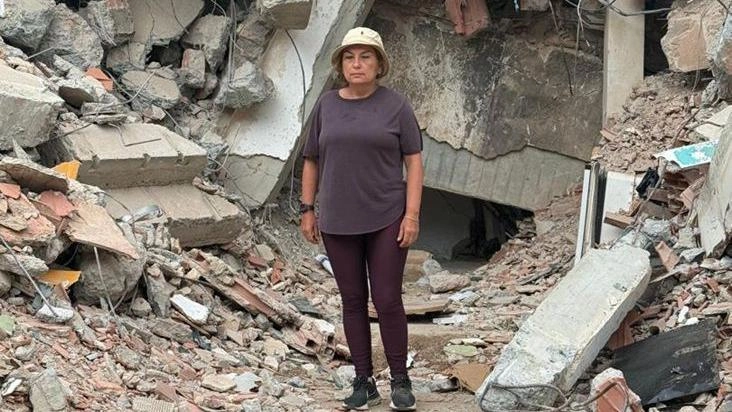
Among the most devastated areas is Tanaguarena, from where María Lourdes speaks to me by video call.
"The saddest thing is that I found my son alive. I was in the same apartment where he was."
"We tried, his father, a co-worker of his father, two of my friends, for 10 hours to get him out. I gave him water through a straw."
He says that some firefighters tried to help. "It didn't take even three minutes, the tunnel where my son was was free of dirt, they hammered down that entire area, it was filled with dust and, of course, my son left."
“The Stations of the Cross did not end there, we spent 16 hours trying to remove the body and again the same team: the father, some of his friends, some of my friends, with the tools that one has at home.”
“When we finally removed my son's body, his father and uncle took it (to Social Security) because there is no service here that will reach out to you.”
“There are corpses here that remain for 10, 12, 14 hours and that are protected by the neighbors.”
The other viacrucis
As soon as she could, María Lourdes ran to the area where she knew that her other son, Gonzalo, had been rehearsing with his friends.
His house and that place are on La Playa street, about 150 meters apart.
He says that, within minutes of the earthquakes, five girls managed to leave the site without suffering serious physical injuries.
“Another girl leaves at 36 hours through the top of the building.”
“We found the body of a friend who was a member of the group and also another girl who we were able to keep alive for 10 hours.”
“Her father came out and told me: ‘Mary, I have Isabella with 80% out, I'm only missing one part.’ People, friends, ourselves helped him and then no one came to support him and the same story is repeated and repeated hundreds of times.”
“No one from the State came to collaborate with us.”
"Do you know who the rescuers have been in these places? Ourselves."
“One doesn't know how to be a rescuer, one doesn't know how to get into the rubble, however, I have done it too.”
He points out that rescue teams arrived in that area on the fifth day after the tragedy occurred.
“Some delegations, Mexican, Colombian, American, have been here, but it is very little, they cannot handle everything, there are all the buildings, there are many people, there is a lot of tragedy.”
“Everything shifted”
The desperation of María Lourdes, like that of so many parents in this tragedy, is indescribable.
"I have offered to hire a machine. I get up every day at dawn to try to hire machines."
On Thursday, one arrived that she managed herself. "It's a Jumbo, a large machine that has several functions, a hook, a drill, it's like a backhoe."
“We made some moves, some spaces like galleries were opened.”
He tells me that international rescuers said that “they still felt warm, that there is a possibility of life.”
He asks for help to arrive, he explains to me how complex the process of removing debris is in that area.
“Everything moved, everything moved, we are digging through the entire building.”
The United Nations Development Program (UNDP) estimated, based on a preliminary assessment, that the earthquakes generated approximately 1.2 million tons of debris in the most affected areas of La Guaira.
NASA published a preliminary map according to which “it is likely that 58,870 buildings were damaged or destroyed in the affected region,” although it warns that this is a reference projection with data that has not been validated on the ground.
“They were happy kids”
Throughout the interview with María Lourdes her voice breaks, she cries, takes a breath and continues.
"God willing that this interview serves as a learning experience. I wouldn't want another mother to experience what I'm experiencing."
He tells me that he remembers something his children told him.
“Especially the little one because, since he went out so much and signed up for so many things, he told me: ‘Mom, you are strong.’ I am honoring what he always told me.”
“Mom, you are strong,” he repeats.
"I feel calm because they were happy kids, very happy. Now I think that God granted me two angels, one when I was 21 years old and the other when I was 16."
“I'm not going to leave here until I find my son's friends because if he were here, he would be with me tirelessly.”
"He was very close to his friends, I have to do that too, it's a commitment I have to him. Hopefully, God will allow me to find him."
"Unfortunately, the parents of one of the girls who are there died and now some relatives are in contact with us. The situation is very complicated."
“A love that is unlike anything”
The area devastated by the earthquakes has always been the home of María Lourdes.
"I am from La Guaira, my whole life. I lived through the Vargas tragedy of 1999, the landslide. But at that moment, although we lost absolutely everything material, the entire family was there."
"We managed to get back out from under. We had been left without a house, without a car, without a job, without a business."
“I thought I had learned my lesson, I didn't think that in life you could experience two tragedies, but I was wrong.”
“You know that the love you have for your children is like nothing, I lost my two children.”
“I was left with no reason to live, they were everything to me.”
"Now I don't know how I'm going to do it, I imagine I have strength because I have the commitment to find the little one."
“I was trying to raise good men, useful, studious, good to their community, good friends, good sons, nephews, I was in that.”
“As I had been a great mother, I guided them as best as I could because I always bet on their success and I was calm because I felt that I was achieving it.”
"I lost them with a single stroke. Therefore, I would like to make a call: I enjoyed my children, but people who are not enjoying them to the fullest should do so, don't waste time, life changes you in a minute, if you have them, don't stop hugging them, don't stop pleasing them and allow them to please you."
“People are in a lot of pain”
María Lourdes also lost her mother, who was Spanish.
“I lost everything,” he tells me. “If I had my children I would have no problem starting to make my life new.”
"But there is no help at all here, psychologists should be here in droves supporting everyone. People are in a lot of pain. There are those who cry, there are those who express it, there are those who contain it, we all need a psychologist."
On Wednesday, he got a doctor to check some injuries.
“Where I am staying there is no light, the signal comes and goes.”
“Finally, we found someone who can provide us with internet because we haven't had it in the eastern part of the state,” he told me as soon as we started talking.
In fact, our communication was interrupted several times.
“Teacher, I lost my mother.”
I was able to talk with Mercedarian Sister Neyda Rojas when, after being in Caraballeda, she returned to the provincial house in Caracas to look for supplies and donations that they have received.
She belongs to the mission of nuns who founded, in 1955, Colegio La Merced, Gonzalo's school.
When the earthquakes happened, Rojas was in Mérida, in western Venezuela. Upon learning what happened, he headed to Caraballeda.
It took him much longer than planned to reach that area, because on his way he encountered cracked and obstructed roads.
Air travel was not an option. On the day of the earthquakes, the nearest airport was closed due to serious damage to its infrastructure.
“Everything is destroyed, the little that was left standing was turned upside down,” he tells me.
“Many of our staff have died, there are children missing.”
“The school director has witnessed funerals of students, of entire families, and when she is at the funeral other children come and tell her: ‘Teacher, I lost my mother,’ ‘Teacher, I don't know where my father is.’ All of this added to what you already have within your own family.”
“There are many fears about the aftershocks, people are very scared.”
"Not all the aid has been able to reach Caraballeda. There is a lot of water shortage, you get there and everyone wants water."
“There are older people who have been able to go down to the squares, to the streets, and when you pass by, they don't want you to give them things, but rather they hug you, they ask for your blessing.”
For Rojas and other nuns, it is not only essential to bring food, water, basic supplies, but also to try to help in the spiritual part, "to accompany them with faith, hope, that God gives us the strength to move forward."
The insufficiency of words
Sister Rojas tells me about the young people who were rehearsing their prom and the anguish of mothers like María Lourdes and many more who are looking for their children.
"It's very hard because you don't have words at this moment, words are insufficient. You have to be there just in presence, so that they feel that they are not alone, that we support them, that we are experiencing the pain like them."
And the nun has found herself time and again with the same questions: “why this?, what have we done?, why us again?”
Despite the time that has passed, Rojas does not want to lose hope that more people can be found alive.
"You walk on rubble, but you know that there is life underneath. There are buildings that may have life in the basement because they fell to one side."
“A teaching”
In a press conference on July 2, Venezuela's interim president, Delcy Rodríguez, defended the way her government has responded to the catastrophe.
"The Venezuelan State as a whole was immediately activated. The first thing we did a few hours after it occurred was to issue a decree to address this emergency situation; the civil protection system, the public defense system, was immediately deployed," Rodríguez assured.
However, the BBC's special envoys to Venezuela have been able to verify the growing complaints from many Venezuelans about what they describe as an insufficient response by the authorities.
For María Lourdes it is essential that “a lesson” is learned from “all this.”
“A lesson for people in the government, for any organization that changes and thinks that these scenarios can occur at any time and that we must be prepared.”
He tells me about situations that other citizens have reported.
“While I was trying to remove the body of my older son, four groups of thieves entered the building where I was.”
He asks for “dignity for the deceased” and their relatives.
“To recognize your family member, in the best of scenarios you have to lift sheets of people who are destroyed because they arrived there perhaps after 10, 12, 14, 16 hours of lying on a street.”
a refuge
María Lourdes tells me that she seeks refuge in the memories of her children.
“I feel proud because many people loved them.”
The oldest, who had attention deficit hyperactivity disorder, loved mathematics.
“Do you know what I used to say?” he asks me, looking into my eyes.
"NotiSantiago because he found out about absolutely all the news. Because of his hyperactivity, they called him to ask him about routes, airlines. He was friends with many people."
“He helped me with absolutely everything, he managed the bank accounts, he helped me do the market.”
“As these children have a spectacular memory, incredible retention, when I needed to look for something, I didn't have to lift a finger because he found everything for me.”
Gonzalo was going to have very busy days. On the day known at school as “sports morning,” she was going to present the dance with her classmates.
Afterwards, he would defend his degree project and July 30 would be his graduation ceremony.
“He was a child full of dreams, a great dreamer.”
His photo circulates on the Internet, on a sign that indicates that he was in the Marianamar building: "GONZALO JOSÉ MÁRQUEZ PÉREZ. 16 YEARS OLD. WE ARE LOOKING FOR HIM."
Regarding the Michael Jackson suit that she had made, María Lourdes tells me:
“I think he could have put it on.”