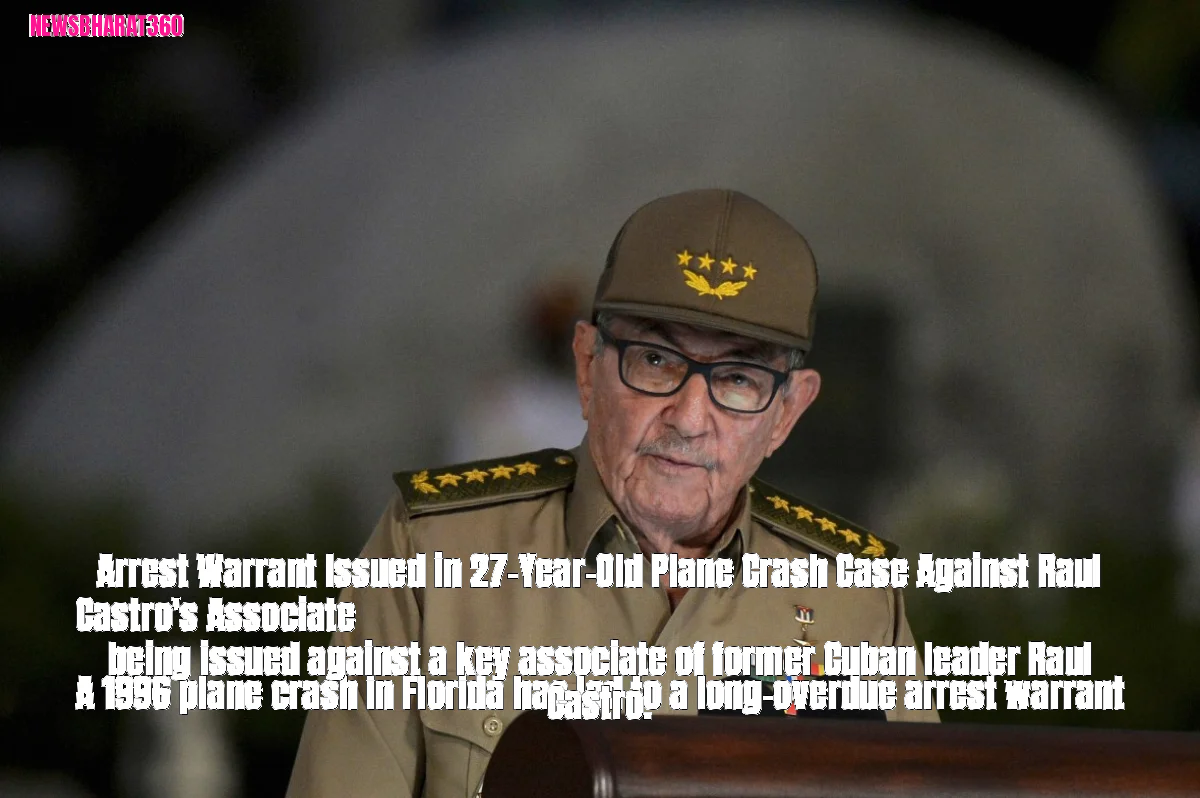

A Florida prosecutor has secured an arrest warrant for Raul Castro, the former Cuban president, in connection with the 1996 downing of two civilian aircraft operated by the Brothers to Rescue organization. The incident resulted in the deaths of four people and strained relations between the US and Cuba. Florida Attorney General James Uthmeier announced the warrant on Monday, stating that Castro must face justice for his alleged involvement in the military operation that occurred over international waters.
Florida officials continue to press for accountability regarding the 1976 assassination of four US citizens, which they attribute to a communist plot orchestrated by Raul Castro.
A 95-year-old man, Castro, is being charged with conspiracy to commit murder in the first degree. According to the court's decision, he will not be eligible for bail. However, his detention is complicated by the fact that he resides in Cuba, which may hinder his extradition. The case was reopened by Florida authorities after a 30-year period of inactivity, during which the former prosecutor had not faced state charges related to these allegations.
Florida Authorities Issue Arrest Warrant for Raúl Castro on Conspiracy to Commit First-Degree Murder Charges.
On February 24, 1996, two civilian Cessna aircraft from the Brothers to the Rescue organization were engaged by Cuban MiG fighter jets, resulting in the downing of the planes. The aircraft had departed from Opa-Locka airport in Miami-Dade County, Florida, and were carrying unarmed passengers at the time of the incident.
Four individuals, including three U.S. citizens and one with a legal residence in the United States, were identified as the victims of the incident: Carlos Costa, Pablo Morales, Mario de la Peña, and Armando Alejandre Jr.
The Miami-based organization Brothers to Rescue conducted operations to locate and assist Cuban nationals attempting to flee the island by sea.
The Prosecutor's Office claims that the aircraft were located outside Cuban territorial waters at the time of their destruction by air-to-air missiles. Additionally, it is alleged that Cuban intelligence services gathered intelligence in Florida and relayed it to Havana, potentially enabling the identification of civilian pilots.
A jury statement, as reported by authorities, suggests that Fidel Castro, who held a senior position in the Cuban military at the time, was involved in the decision-making process that led to the authorization of the demolition. This incident occurred in the context of long-standing tensions between Cuba and the Brothers to the Rescue, a group whose previous flights into Cuban airspace had been repeatedly warned against by the government in Havana.
Raul Castro held the position of defense minister at the time of the attack, and following the event, he took office as the President of Cuba in 2008, succeeding his brother Fidel Castro. Castro relinquished the presidency in 2018, yet maintained significant political influence within the country.
A morning proceeding against an Army General in Miami, marked by a highly irregular and contentious atmosphere, lacks both legal merit and practical feasibility, particularly in light of its electoral context.
Cuban President Miguel Díaz-Canel swiftly responded to the arrest warrant, labeling it a "pathetic Miami circus" and accusing the decision of being politically motivated. He stated that the move against Army General, which occurred in the context of an election, lacked both legal and practical significance.
Cuban Chancellor Bruno Rodríguez has dismissed the measure, labeling it a "new sterile tactic" employed by anti-Cuban politicians in South Florida. This development occurs as President Donald Trump intensifies pressure on the Cuban government through the imposition of sanctions and energy restrictions.
The recent measures have further strained the island's economic situation, with domestic production meeting only a small portion of its oil requirements.
A federal indictment was filed against Castro in May, charging him with conspiracy to kill U.S. citizens, aircraft destruction, and four counts of murder in connection with the downing. The U.S. government, through Federal Attorney Jason Reding Quiñones, has expressed support for the state's actions and is seeking to explore legal avenues to hold Castro accountable for his alleged involvement.
A Florida court order has been issued, but it does not signify that Castro has been apprehended or will be brought before a US court in the near future.